
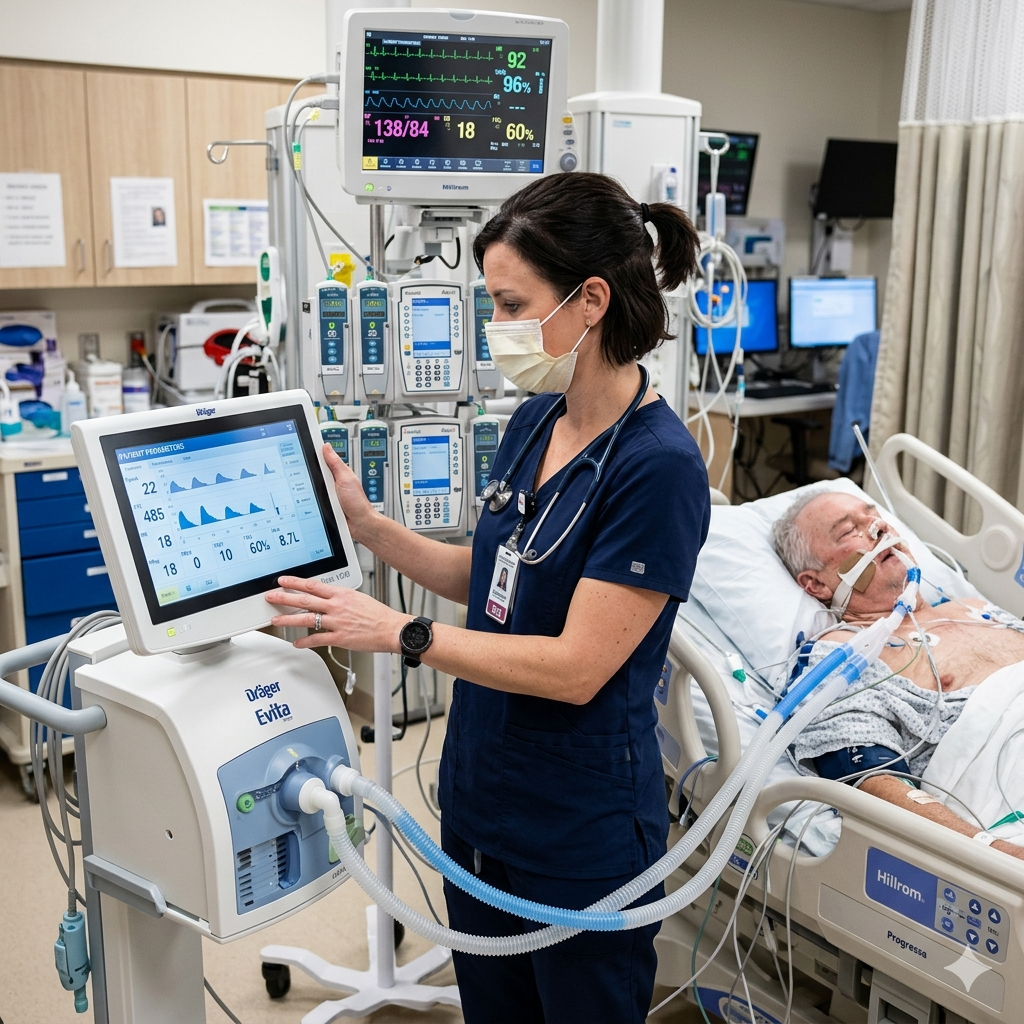
Mechanical ventilation is one of the most critical interventions in the ICU — but getting a patient off the ventilator is just as demanding as managing them on it. Ventilator weaning failure is a complex clinical challenge that every registered nurse working in critical care will encounter. For nursing students preparing for the NCLEX, understanding why patients fail to wean is not just exam content — it is essential knowledge for safe, high-acuity practice. The process of liberating a patient from mechanical ventilation requires systematic nursing assessment, early identification of barriers, and coordinated interprofessional care. This guide breaks down the pathophysiology, risk factors, clinical indicators, and nursing interventions that define successful weaning management.
What Is Weaning Failure and Why It Matters for Nursing Practice
Weaning, also called liberation from mechanical ventilation, is the gradual process of reducing ventilatory support so the patient assumes independent breathing. Weaning failure is defined as the inability to tolerate spontaneous breathing during a Spontaneous Breathing Trial (SBT) or the need to reintubate within 48 hours of extubation.
For the RN nurse in the ICU, recognizing failure early prevents respiratory arrest, prolongs unnecessary sedation, and guides the care team toward targeted interventions. Weaning failure is associated with:
- Prolonged ICU and hospital length of stay
- Increased risk of ventilator-associated pneumonia (VAP)
- Higher mortality rates
- Greater need for tracheostomy
The registered nurse plays a central role in monitoring SBT tolerance, communicating changes to the physician or advanced practice provider, and implementing the nursing bundle of care that optimizes weaning readiness.
Common Causes of Ventilator Weaning Failure
Understanding the underlying causes of weaning failure is fundamental to the NCLEX and to clinical nursing practice. Causes are broadly categorized as respiratory, cardiovascular, neurological, or systemic.
Respiratory Causes
- Respiratory muscle weakness or fatigue: Prolonged mechanical ventilation causes diaphragmatic atrophy. The patient simply lacks the muscle strength to sustain breathing.
- Increased work of breathing (WOB): Conditions like COPD, bronchospasm, pulmonary edema, or secretion retention dramatically increase the effort required to breathe.
- Inadequate gas exchange: Persistent hypoxemia (SpO₂ < 90%, PaO₂ < 60 mmHg) or hypercapnia signals that the lungs cannot maintain ventilation independently.
- Unresolved atelectasis or pneumonia: Active infection or collapsed lung segments impair oxygen delivery.
Cardiovascular Causes
- Weaning-induced pulmonary edema: The transition from positive-pressure ventilation to negative-pressure spontaneous breathing dramatically increases venous return and cardiac preload. In patients with left ventricular dysfunction, this can precipitate acute pulmonary edema.
- Hemodynamic instability: Ongoing vasopressor dependence or arrhythmias indicate the cardiovascular system cannot tolerate the added stress of independent breathing.
Neurological and Neuromuscular Causes
- Depressed respiratory drive: Residual sedation, opioid effects, or brain injury can blunt the drive to breathe, making self-sustained ventilation unsafe.
- Critical illness polyneuropathy or myopathy (CIPNM): A common complication of prolonged critical illness, CIPNM causes diffuse muscle weakness affecting respiratory muscles.
- Phrenic nerve injury: Damage from surgery, trauma, or line placement can paralyze the diaphragm.
Systemic and Metabolic Causes
- Malnutrition: Inadequate caloric intake weakens respiratory muscles and delays recovery.
- Electrolyte imbalances: Hypophosphatemia, hypokalemia, and hypomagnesemia are classic contributors to respiratory muscle failure. The nursing bundle for ICU patients should always include vigilant electrolyte monitoring.
- Anemia: Reduced oxygen-carrying capacity limits tissue oxygenation and increases the demand on the respiratory system.
- Uncontrolled pain or anxiety: Both increase oxygen demand and respiratory rate, making an SBT unsustainable.
Assessing Readiness to Wean: The NCLEX-Tested Criteria
Before initiating an SBT, the nurse should confirm the patient meets standard readiness criteria. The ABCDE bundle and institutional weaning protocols typically require:
| Parameter | Acceptable Threshold |
|---|---|
| FiO₂ | ≤ 0.40–0.50 |
| PEEP | ≤ 5–8 cmH₂O |
| SpO₂ | ≥ 90–92% |
| Hemodynamic stability | No or minimal vasopressors |
| Level of consciousness | Follows simple commands (RASS 0 to -1) |
| Adequate cough/gag reflex | Present |
| Respiratory rate | < 35 breaths/min |
| Negative Inspiratory Force (NIF) | More negative than -20 to -25 cmH₂O |
| Rapid Shallow Breathing Index (RSBI) | < 105 breaths/min/L |
The RSBI (f/VT ratio) is one of the most commonly tested weaning parameters on the NCLEX. An RSBI below 105 suggests the patient may tolerate spontaneous breathing; values above 105 predict failure.
Nursing Interventions to Optimize Weaning Success
The role of the registered nurse extends well beyond documentation. Active nursing interventions directly influence whether a patient successfully weans.
1. Daily Sedation Vacations (SAT) Paired with SBTs, spontaneous awakening trials (SATs) reduce the duration of mechanical ventilation. The nurse coordinates the safe reduction of continuous sedation infusions per protocol and monitors for agitation, pain, and respiratory distress.
2. Positioning Elevating the head of the bed to 30–45 degrees reduces aspiration risk and improves diaphragmatic excursion, directly supporting respiratory mechanics. This is also a key intervention in the VAP prevention nursing bundle.
3. Secretion Management Retained secretions increase airway resistance and WOB. Nursing interventions include scheduled suctioning, chest physiotherapy, in-line nebulizer treatments, and early mobility protocols.
4. Electrolyte Replacement The RN nurse should actively monitor and report abnormal phosphate, potassium, and magnesium levels. Replacing these electrolytes is critical before and during weaning attempts.
5. Nutrition Optimization Early enteral feeding supports respiratory muscle strength. The nurse collaborates with the dietitian to ensure adequate caloric and protein goals are met. Avoid overfeeding, as excess carbohydrate metabolism increases CO₂ production, worsening hypercapnia.
6. Pain and Anxiety Management Uncontrolled pain drives tachypnea and sympathetic activation. Use validated pain scales (CPOT, BPS) and coordinate with the provider to balance comfort with alertness during SBTs.
7. Early Mobility Progressive mobility — even passive range of motion — combats ICU-acquired weakness and rebuilds the respiratory muscle endurance needed for successful weaning.
Recognizing SBT Failure: When to Return to Full Support
The nurse monitors the patient continuously during an SBT and must recognize failure criteria promptly. Return to full ventilatory support if any of the following develop:
- SpO₂ < 90% or PaO₂ < 60 mmHg
- Respiratory rate > 35 breaths/min for more than 5 minutes
- Heart rate or blood pressure change > 20% from baseline
- Use of accessory muscles, paradoxical chest movement, or diaphoresis
- Altered mental status, agitation, or loss of consciousness
- Arterial pH < 7.32 or rising PaCO₂ > 50 mmHg
Clear communication using SBAR (Situation, Background, Assessment, Recommendation) ensures the physician is notified rapidly and the patient is returned to a comfortable ventilatory mode — typically AC/VC or PSV — to allow respiratory muscle rest before the next attempt.
💡 NCLEX Tips for Ventilator Weaning Failure
- RSBI < 105 = favorable for weaning; RSBI > 105 = weaning failure likely — this is a high-yield NCLEX value.
- The first nursing action when a patient fails an SBT is to return them to prior ventilator settings and notify the provider.
- Hypophosphatemia is a classic NCLEX cause of respiratory muscle weakness and weaning failure — always check the phosphate level.
- Weaning-induced pulmonary edema is tested on the NCLEX: suspect it when the patient develops crackles and worsening SpO₂ during an SBT despite no prior signs of fluid overload.
- Daily SAT + SBT pairing is evidence-based practice for reducing ventilator days — know this for the NCLEX and for clinical nursing care.
Conclusion
Ventilator weaning failure is a multifactorial problem that demands skilled, systematic nursing care. The registered nurse is on the front lines of identifying barriers — from respiratory muscle fatigue and electrolyte derangements to hemodynamic instability and poor nutrition — and implementing targeted interventions that move the patient toward liberation. Mastering ventilator weaning failure nursing concepts prepares RN nurses not only for the ICU bedside, but for the NCLEX as well. Reinforce this knowledge with practice questions and explore the full critical care nursing bundle at rn-nurse.com/nclex-qcm/. For comprehensive ICU and critical care courses, visit rn-nurse.com/nursing-courses/.