
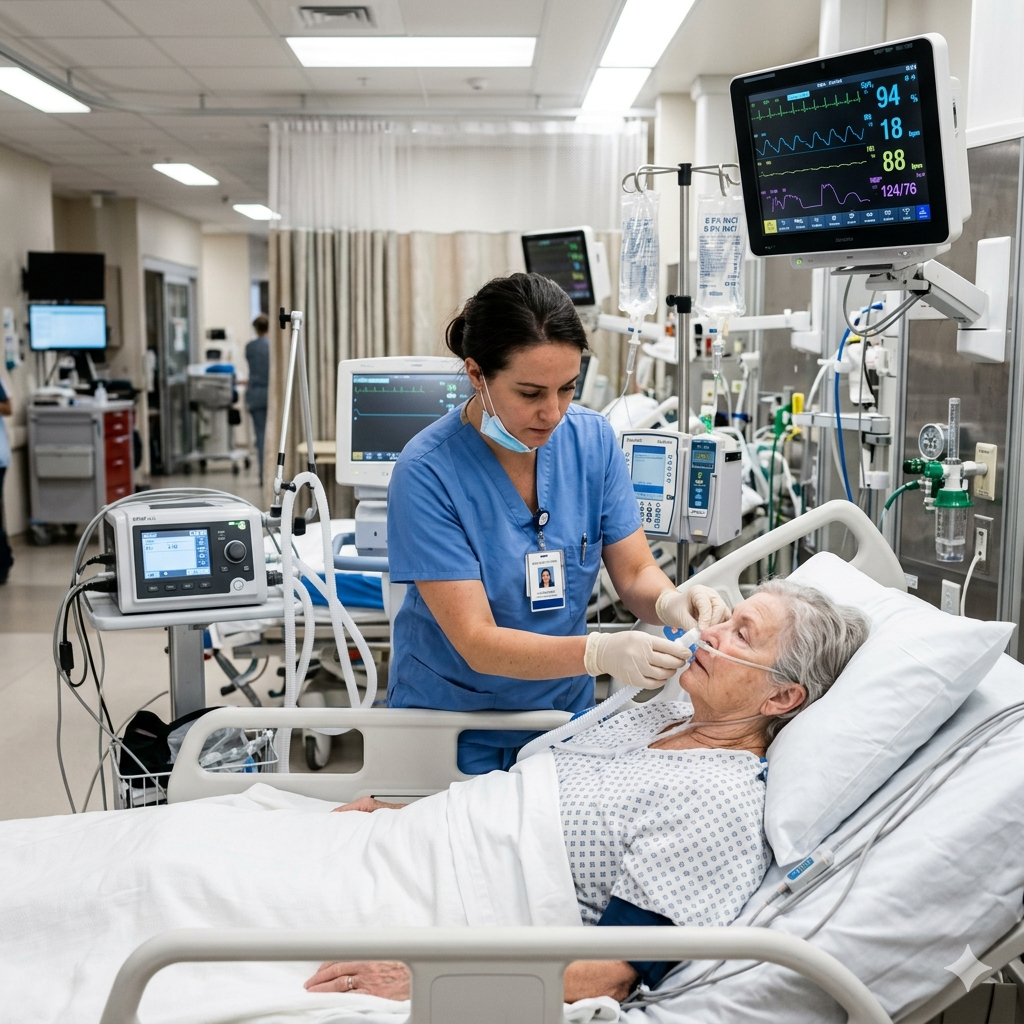
Respiratory failure is one of the most urgent clinical scenarios a registered nurse will encounter, and the choice between High-Flow Nasal Cannula (HFNC) and Non-Invasive Ventilation (NIV) — including BiPAP and CPAP — can directly influence patient outcomes. For nursing students preparing for the NCLEX and practicing RN nurses working in critical care or medical-surgical settings, understanding when and why each modality is used is high-yield knowledge. These two approaches to respiratory support differ in mechanism, indication, patient tolerance, and nursing management. This article breaks down HFNC vs non-invasive ventilation nursing priorities so you can apply them with confidence at the bedside and on exam day.
What Is High-Flow Nasal Cannula (HFNC)?
High-Flow Nasal Cannula (HFNC) delivers heated, humidified oxygen through wide-bore nasal prongs at flow rates ranging from 20 to 60 L/min, with FiO₂ titrated from 21% to 100%. Unlike standard nasal cannula, HFNC generates a small amount of positive end-expiratory pressure (PEEP) — typically 2–5 cmH₂O — which helps maintain alveolar recruitment without the discomfort of a tight-fitting mask.
Key mechanisms of HFNC include:
- Washout of nasopharyngeal dead space — reduces CO₂ rebreathing and improves ventilatory efficiency
- Delivery of accurate FiO₂ — because flow exceeds patient inspiratory demand, room air dilution is minimized
- Heated humidification — promotes mucociliary clearance and patient comfort
HFNC is primarily indicated for hypoxemic respiratory failure (Type I), such as in pneumonia, COVID-19-related lung injury, or post-extubation support. It is generally not the first choice for hypercapnic respiratory failure (Type II), where CO₂ retention is the primary problem.
Nursing assessment priorities with HFNC include monitoring SpO₂ continuously, assessing work of breathing (use of accessory muscles, respiratory rate, nasal flaring), and evaluating patient comfort with the nasal interface.
What Is Non-Invasive Ventilation (BiPAP and CPAP)?
Non-Invasive Ventilation (NIV) refers to positive pressure respiratory support delivered via a sealed mask — nasal, full-face, or total-face — without an endotracheal tube. The two primary modalities are CPAP and BiPAP.
CPAP (Continuous Positive Airway Pressure) delivers a single, continuous pressure throughout both inspiration and expiration. It stents open the airway and recruits collapsed alveoli but provides no additional inspiratory support. CPAP is the standard treatment for obstructive sleep apnea (OSA) and is used clinically in cardiogenic pulmonary edema.
BiPAP (Bilevel Positive Airway Pressure) delivers two pressure levels:
- IPAP (Inspiratory Positive Airway Pressure) — higher pressure during inhalation, augmenting tidal volume
- EPAP (Expiratory Positive Airway Pressure) — lower pressure during exhalation, equivalent to PEEP
BiPAP is the preferred NIV modality for hypercapnic respiratory failure — such as acute exacerbations of COPD or obesity hypoventilation syndrome — because the pressure differential actively assists ventilation and promotes CO₂ elimination.
Nursing considerations for NIV include proper mask fit (to minimize air leaks), skin integrity assessment under the mask, oral care, and monitoring for signs of NIV failure requiring escalation to intubation.
HFNC vs Non-Invasive Ventilation: Clinical Indications Compared
Understanding the indications for each modality is essential for NCLEX success and safe nursing practice. The table below summarizes the primary clinical scenarios where HFNC or NIV is preferred.
| Condition | Preferred Modality | Rationale |
|---|---|---|
| Hypoxemic respiratory failure (e.g., pneumonia, ARDS) | HFNC | High FiO₂ delivery with minimal discomfort |
| Cardiogenic pulmonary edema | CPAP or BiPAP | PEEP reduces preload/afterload, improves oxygenation |
| COPD exacerbation with hypercapnia | BiPAP | Reduces work of breathing; lowers PaCO₂ |
| Post-extubation support | HFNC or NIV | Prevent reintubation; HFNC preferred for hypoxemia |
| Obstructive sleep apnea | CPAP | Maintains airway patency during sleep |
| Obesity hypoventilation syndrome | BiPAP | Augments minute ventilation to correct CO₂ |
| Immunocompromised patient with respiratory failure | HFNC (preferred) | Avoids intubation risks; better tolerated |
A key NCLEX principle: BiPAP is the treatment of choice for acute COPD exacerbation with CO₂ retention. HFNC does not reliably correct hypercapnia and should not replace BiPAP in this population without careful clinical judgment.
Nursing Assessment and Monitoring for HFNC and NIV
Whether managing HFNC or NIV, the RN nurse must perform systematic respiratory assessments at regular intervals. Key nursing monitoring parameters include:
For HFNC:
- SpO₂ target: typically ≥ 92–96% (adjust per diagnosis; COPD patients may target 88–92%)
- Respiratory rate: RR > 30/min is a warning sign of impending failure
- ROX index — a validated bedside tool: (SpO₂/FiO₂) ÷ Respiratory Rate; a ROX < 4.88 at 2–6 hours predicts HFNC failure and need for intubation
- Assess for nasal irritation, epistaxis, and patient tolerance of the high-flow interface
For NIV (BiPAP/CPAP):
- Monitor for mask leak — significant leaks reduce therapy effectiveness and cause eye irritation
- Assess skin integrity at mask contact points; use prophylactic dressings on the nasal bridge to prevent pressure injuries
- Monitor ABGs (arterial blood gases): improvement in pH and PaCO₂ within 1–2 hours indicates NIV success
- Watch for aerophagia (air swallowing), which can cause gastric distension and vomiting risk
- Ensure the patient can remove the mask independently in case of vomiting
Both HFNC and NIV require the registered nurse to recognize the signs of failure promptly: worsening hypoxemia, increasing work of breathing, altered mental status, or hemodynamic instability. These findings warrant immediate provider notification and potential escalation to invasive mechanical ventilation.
Contraindications and When to Escalate
Not every patient is a candidate for HFNC or NIV. Nursing students must know the contraindications, as these are commonly tested on the NCLEX.
Contraindications to HFNC:
- Apnea or respiratory arrest
- Severe hemodynamic instability
- Inability to protect the airway (e.g., decreased GCS)
Contraindications to NIV:
- Facial trauma or recent facial/esophageal surgery
- Copious secretions or inability to clear secretions
- Uncooperative or agitated patient
- Recent upper GI surgery (relative contraindication)
- Hemodynamic instability requiring immediate intubation
If a patient on NIV shows worsening ABGs after 1–2 hours, fails to improve work of breathing, or becomes hemodynamically unstable, the nurse must escalate immediately. Delayed intubation in NIV failure is associated with worse outcomes. SBAR communication — Situation, Background, Assessment, Recommendation — is the appropriate framework for communicating urgent respiratory changes to the provider.
💡 NCLEX Tips: HFNC vs Non-Invasive Ventilation
- BiPAP = COPD exacerbation — this is the highest-yield association. If the question describes CO₂ retention + obstructive lung disease, BiPAP is the answer.
- HFNC does not reliably treat hypercapnia — it primarily corrects hypoxemia.
- CPAP provides one pressure; BiPAP provides two — IPAP (inspiration) and EPAP (expiration).
- Mask fit is a nursing priority for NIV — a leaking mask reduces efficacy and causes complications.
- ROX index < 4.88 = HFNC failure risk — know this number for critical care NCLEX questions.
Patient Comfort and Education in Nursing Practice
Both HFNC and NIV can cause significant discomfort, and the nurse plays a central role in improving tolerance. Patient education and comfort interventions include:
- For HFNC: Explain that the high flow sensation is normal; reassure patients that the warmth and humidity are therapeutic. Secure prongs to prevent dislodgement during movement.
- For NIV: Allow the patient to hold the mask initially before securing it. Titrate pressure settings gradually (start low, increase incrementally). Provide mouth care frequently, as mask interfaces promote mouth dryness.
Anxiety is common in patients experiencing respiratory distress. Calm, clear communication from the nursing team reduces air hunger-related panic, which can worsen work of breathing. For patients on long-term NIV (e.g., overnight BiPAP for OSA or home ventilation), patient education about mask maintenance, device cleaning, and compliance is part of the nursing bundle for discharge planning.
Conclusion
Mastering the clinical differences between HFNC and non-invasive ventilation is essential for every RN nurse working in acute care or preparing for the NCLEX. HFNC excels in hypoxemic respiratory failure where high FiO₂ delivery and comfort are priorities. BiPAP is the cornerstone of management for hypercapnic failure, particularly in COPD exacerbations. CPAP addresses airway obstruction and cardiogenic pulmonary edema. The registered nurse must assess both modalities continuously, recognize signs of failure early, and communicate findings using structured handoff tools like SBAR.
Deepen your clinical reasoning with NCLEX-style practice at rn-nurse.com/nclex-qcm/ and explore our full critical care nursing bundle at rn-nurse.com/nursing-courses/.