
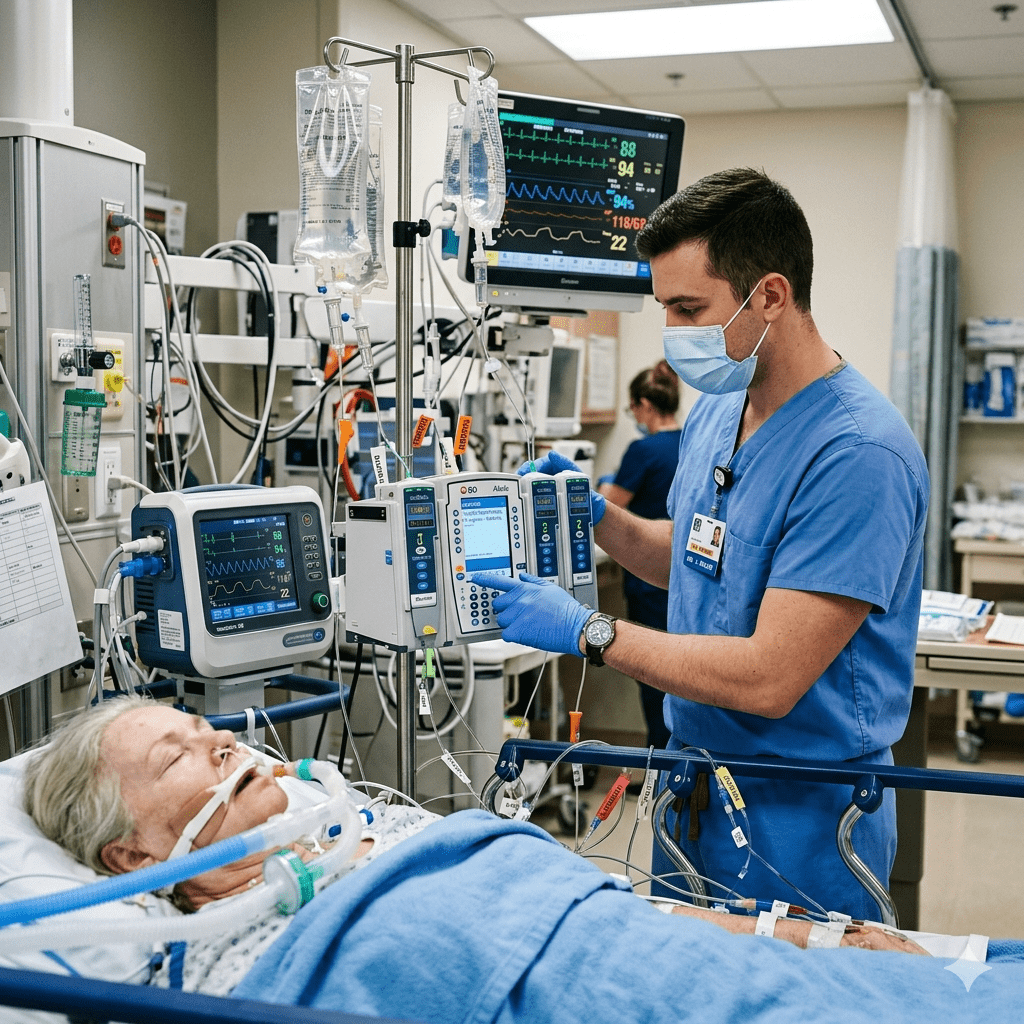
Critically ill patients rarely receive medications as isolated boluses. In the ICU, continuous infusion medications are the backbone of hemodynamic management, sedation, analgesia, and organ support. For a registered nurse working in intensive care — or for a nursing student preparing for the NCLEX — understanding how these drips work, how to titrate them safely, and what complications to monitor is non-negotiable clinical knowledge. The stakes are high: a mistitrated vasopressor or an incorrectly mixed sedation infusion can mean the difference between stability and a life-threatening event.
Why Continuous Infusions Are Used in Critical Care
Intermittent IV boluses create peaks and troughs in drug plasma levels. For medications that require precise, sustained therapeutic concentrations — such as vasopressors, antiarrhythmics, and sedatives — this variability is clinically unacceptable.
Continuous infusions deliver a steady drug concentration that can be titrated in real time based on the patient’s physiologic response. This allows the RN nurse to:
- Maintain consistent mean arterial pressure (MAP) targets
- Achieve steady-state sedation without under- or over-sedation
- Support cardiac output and organ perfusion continuously
- Respond rapidly to clinical deterioration by adjusting the rate
Most institutions use standardized concentration protocols (also called smart pump drug libraries) to reduce medication errors. Every nurse working in critical care must be familiar with these protocols, including allowable concentration ranges and maximum infusion rates.
Vasoactive Infusions: Vasopressors and Inotropes
Vasoactive medications are among the most critical infusions an RN manages at the bedside. They directly affect vascular tone, cardiac contractility, and blood pressure.
Common Vasopressors
| Drug | Primary Action | Typical Rate | Key Nursing Consideration |
|---|---|---|---|
| Norepinephrine (Levophed) | α1 > β1 agonist; vasoconstriction | 0.01–3 mcg/kg/min | First-line in septic shock; monitor for peripheral ischemia |
| Vasopressin | V1 receptor agonist; vasoconstriction | 0.03–0.04 units/min | Fixed dose; not typically titrated; monitor sodium |
| Dopamine | Dose-dependent: DA, β1, α1 | 2–20 mcg/kg/min | Monitor for tachyarrhythmias; largely replaced by norepinephrine |
| Phenylephrine | Pure α1 agonist | 0.4–9.1 mcg/kg/min | Reflex bradycardia possible; avoid in low cardiac output states |
| Epinephrine | α1, β1, β2 agonist | 0.01–0.5 mcg/kg/min | Used in anaphylaxis, refractory shock; raises lactate |
Dobutamine is an inotrope (β1 agonist) used to increase cardiac contractility without primary vasoconstriction — important for cardiogenic shock. Norepinephrine remains the first-line vasopressor for septic shock per current Surviving Sepsis Campaign guidelines, a detail high-yield for NCLEX and practiced daily by every critical care nursing professional.
Central line access is required for most vasoactive infusions due to the risk of peripheral extravasation and tissue necrosis.
Sedation and Analgesia Infusions
Pain, agitation, and delirium are common in ICU patients — especially those on mechanical ventilation. The PADIS guidelines (Pain, Agitation/Sedation, Delirium, Immobility, Sleep) guide nursing management of these infusions.
Commonly Used Sedation Drips
- Propofol (Diprivan): Lipid-based sedative/hypnotic. Rapid onset and offset — ideal for patients requiring frequent neurological assessments. Monitor for Propofol Infusion Syndrome (PRIS), characterized by metabolic acidosis, elevated triglycerides, and rhabdomyolysis. Maximum rate: 5 mg/kg/hr in most protocols.
- Dexmedetomidine (Precedex): α2 agonist producing sedation without respiratory depression. Preferred for light sedation; allows patient interaction. Monitor for bradycardia and hypotension.
- Midazolam: Benzodiazepine with longer half-life; associated with increased ICU delirium. Generally avoided as first-line unless propofol or dexmedetomidine are contraindicated.
Analgesia First
Modern critical care nursing follows an analgesia-first approach — treating pain before sedation. Fentanyl and hydromorphone infusions are common. The nurse assesses pain using validated tools such as the BPS (Behavioral Pain Scale) or CPOT (Critical-Care Pain Observation Tool) in non-verbal, intubated patients.
A strong nursing bundle approach in the ICU includes systematic sedation and analgesia titration using validated scoring tools (RASS for sedation, CPOT for pain), daily spontaneous awakening trials (SATs), and delirium monitoring with the CAM-ICU.
Antiarrhythmic and Cardiac Infusions
Cardiac arrhythmias in critically ill patients often require sustained pharmacologic management beyond a single bolus dose.
- Amiodarone: Used for atrial fibrillation with rapid ventricular response, VT, and VF. Loading infusion of 150 mg over 10 minutes, followed by maintenance infusion. Monitor QTc prolongation and hypotension during IV administration. Requires careful nursing documentation of infusion start times.
- Lidocaine: Second-line antiarrhythmic for ventricular arrhythmias. Monitor for CNS toxicity — tremors, confusion, seizures — especially with prolonged use or hepatic impairment.
- Diltiazem: Calcium channel blocker used for rate control in atrial fibrillation. Monitor for hypotension and bradycardia. Continuous cardiac monitoring is mandatory.
The registered nurse must perform continuous cardiac monitoring, document rhythm changes, and escalate to the provider using structured SBAR communication when infusion-related arrhythmias or hemodynamic changes occur.
Insulin Infusions and Glycemic Control
Insulin infusions are standard in critical care for managing stress-induced hyperglycemia. Target blood glucose in most ICUs is 140–180 mg/dL per current guidelines.
Key nursing responsibilities:
- Perform hourly or every-2-hour glucose monitoring per protocol
- Titrate insulin rate using the institution’s validated protocol (e.g., Yale protocol or unit-specific nomogram)
- Recognize early signs of hypoglycemia: diaphoresis, altered mental status, tachycardia — especially difficult to detect in sedated patients
- Maintain a 10% dextrose solution at the bedside as a hypoglycemia rescue agent
Insulin drips are a common NCLEX high-yield topic because of the critical nature of hypoglycemia risk. Every RN nurse managing an insulin infusion must anticipate, not just react to, glucose fluctuations.
Titration Principles and Safety Standards
Titrating continuous infusions requires clinical judgment grounded in physiologic targets. The RN nurse does not adjust drips arbitrarily — every titration decision is driven by patient response and documented protocol endpoints.
Core titration principles:
- Know the target: MAP ≥ 65 mmHg, RASS score −1 to 0, pain score ≤ 3
- Titrate in increments: Small, incremental changes reduce overshoot and hemodynamic instability
- Double-check concentrations: Verify drug, concentration, rate, and pump programming with a second RN for high-alert medications (vasopressors, insulin, heparin, concentrated electrolytes)
- Document every change: Record the time, rate change, indication, and patient response in the nursing note
Participation in a nursing bundle program that includes structured titration protocols, smart pump utilization, and daily goals communication significantly reduces adverse events in the ICU.
💡 NCLEX Tips for Continuous Infusion Medications
- Norepinephrine is the first-line vasopressor for septic shock — always a NCLEX priority answer.
- Propofol infusions require triglyceride monitoring and dose capping due to PRIS risk.
- Analgesia before sedation is the current PADIS-guided standard — pain must be addressed first.
- For insulin drips, the nurse’s priority is preventing hypoglycemia — glucose checks must never be skipped.
- Central access is required for most vasoactive infusions — never administer through a peripheral IV without provider order and close monitoring.
Conclusion
Continuous infusion medications define critical care nursing. From vasoactive drips maintaining hemodynamic stability to sedation and analgesia protocols that prioritize patient comfort and safety, the RN nurse at the ICU bedside must be both clinically precise and constantly vigilant. Mastering drug mechanisms, titration principles, and complication monitoring is foundational — not just for the NCLEX, but for every shift in the intensive care unit.
Strengthen your critical care knowledge and prepare for the NCLEX with targeted practice at rn-nurse.com/nclex-qcm/, or explore the full nursing bundle and critical care courses at rn-nurse.com/nursing-courses/.