
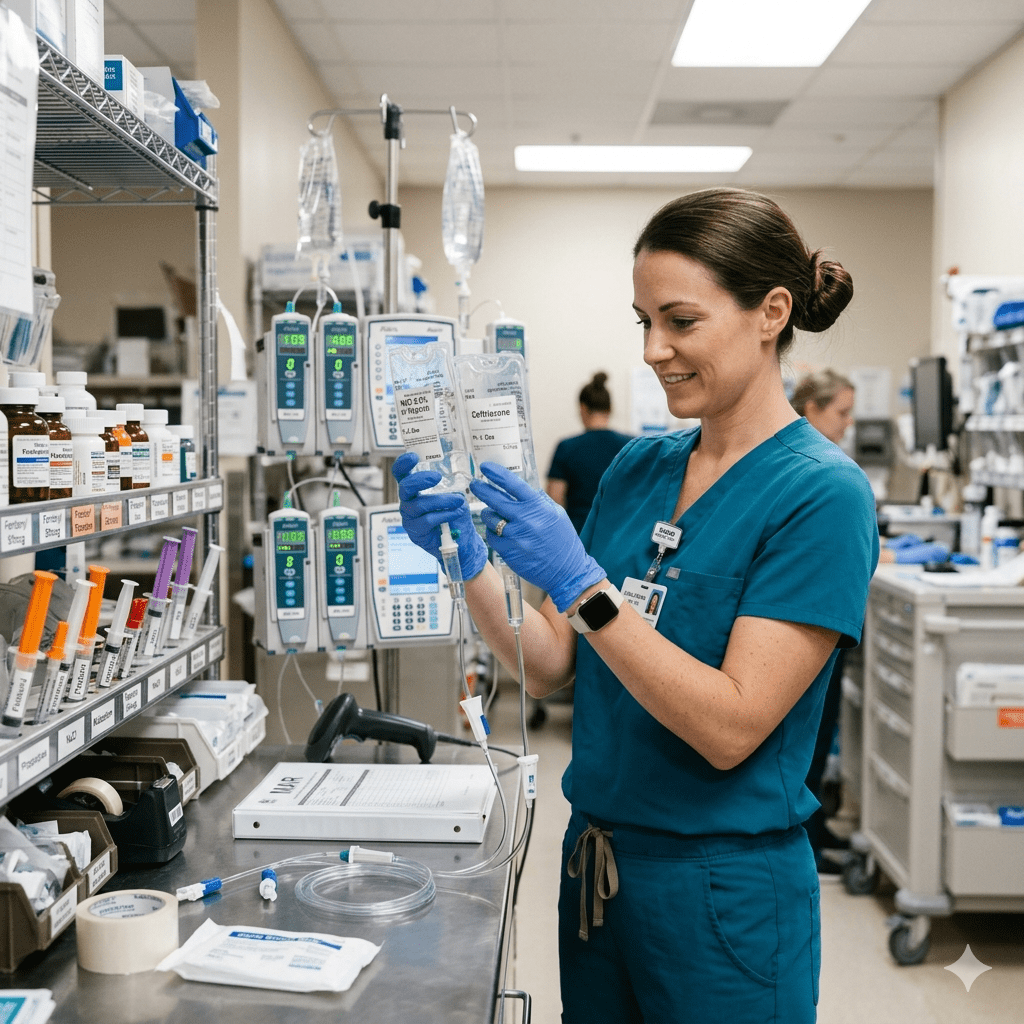
Medication errors involving intravenous drugs rank among the most preventable — and most dangerous — adverse events in clinical practice. IV compatibility and medication mixing safety form a critical knowledge domain for every registered nurse, from the new graduate to the seasoned ICU clinician. Whether a nurse administers vasoactive drips in the critical care unit or runs antibiotics on a medical-surgical floor, knowing which drugs can safely share IV lines, Y-sites, or admixtures can determine the difference between a therapeutic outcome and a life-threatening reaction. Furthermore, this topic appears consistently on the NCLEX and demands mastery in real-world nursing practice.
Why IV Compatibility Matters in Nursing Practice
When nurses combine two or more medications in the same IV line or solution, those drugs can interact physically or chemically. Physical incompatibility produces a visible change — precipitate formation, color change, cloudiness, or gas evolution. Chemical incompatibility, however, is more insidious: the drugs may degrade silently, reducing efficacy or generating toxic byproducts without any visual cue.
Every RN nurse must recognize that IV incompatibility can cause:
- Loss of drug potency — reduced therapeutic effect
- Precipitate formation — risk of pulmonary embolism or vascular occlusion
- Toxic byproduct generation — direct patient harm
- Altered pH or osmolality — vessel damage or phlebitis
The bedside nurse stands as the last line of defense before a medication enters the patient’s bloodstream. Therefore, recognizing unsafe combinations before administration is a non-negotiable nursing competency — not an optional safety step.
Common High-Risk IV Incompatibilities Every Nurse Must Know
Certain drug combinations produce incompatibility so reliably that clinicians consider them absolute contraindications for co-administration. Consequently, nursing students preparing for the NCLEX should memorize the most frequently tested pairs:
| Drug A | Drug B | Result |
|---|---|---|
| Furosemide | Aminoglycosides (e.g., gentamicin) | Precipitate formation |
| Phenytoin | Any dextrose-containing solution | Precipitation |
| Calcium gluconate | Sodium bicarbonate | Calcium carbonate precipitate |
| Ceftriaxone | Calcium-containing solutions | Potentially fatal precipitate (especially in neonates) |
| Diazepam | Most aqueous IV solutions | Precipitate |
| TPN | Most medications | Never mix; use a dedicated lumen |
Phenytoin deserves special attention as a high-yield NCLEX example. Nurses must dilute it only in normal saline (0.9% NaCl) — never in dextrose solutions — because even brief contact with dextrose causes rapid crystallization. Similarly, ceftriaxone and calcium co-administration carries fatal risk in neonates and requires strict avoidance regardless of the administration route.
Y-Site Compatibility: What Registered Nurses Need to Know
Y-site compatibility describes the ability of two drugs to run simultaneously through the same IV line via a Y-connector — without mixing in the same bag or syringe. Notably, many drugs that prove incompatible when mixed directly can still run safely at the Y-site, because brief contact time and dilution reduce the reactivity risk.
Key nursing principles for Y-site administration include:
- Always verify compatibility before allowing two infusions to share a line — never assume safety based on prior experience alone.
- Flush the line between incompatible drugs using a compatible flush solution, typically NS or D5W.
- Check concentration — some drugs remain Y-site compatible only within specific concentration ranges, so concentration matters as much as drug identity.
- Consult a validated reference — use the institution’s pharmacy system, Trissel’s IV Compatibility database, or a clinical pharmacist before proceeding.
A common nursing error involves assuming that two drugs are Y-site compatible simply because they run through the same port. Instead, the registered nurse must actively verify every new drug combination. When in doubt, always contact pharmacy before administration.
Safe Practices for Medication Mixing and Admixture Preparation
When nurses prepare IV admixtures — such as adding a medication to a large-volume parenteral (LVP) solution — they must follow strict aseptic and compatibility protocols. Additionally, nurses should approach every admixture as a high-stakes preparation, regardless of how routine it may seem.
Critical safe practices include:
- Verify the order first: Confirm drug, dose, diluent type, final concentration, and rate before touching any supplies.
- Apply sterile technique throughout: Admixture preparation should occur under a laminar airflow hood when possible, or at minimum using strict aseptic technique at the bedside.
- Inspect for visual changes: After mixing, examine the solution for cloudiness, color change, or particulate matter. If any abnormality appears, discard the solution and prepare a new one immediately.
- Label completely and accurately: Every admixture must carry the drug name, dose, diluent, total volume, concentration, preparation date and time, expiration, and the nurse’s initials.
- Avoid oversimplifying compatibility: Never assume a drug is “always compatible” with saline or dextrose. For example, amphotericin B requires specific lipid-based preparations and does not tolerate standard electrolyte solutions.
Furthermore, nurses who prepare or verify high-alert medications — such as potassium chloride (KCl), concentrated electrolytes, insulin, and anticoagulants — must apply additional safety checks at every step. Many institutions require independent double-checks for these agents. The nursing bundle of safety practices — including two-nurse verification, barcode scanning, and pump programming confirmation — significantly cuts IV medication error rates across clinical settings.
NCLEX Tips for IV Compatibility Safety
💡 NCLEX Tips: IV Compatibility and Medication Safety
- Phenytoin belongs only in NS — never dextrose. This is a classic NCLEX distractor.
- Ceftriaxone + calcium = contraindicated in neonates due to risk of fatal cardiopulmonary precipitation.
- TPN always requires a dedicated lumen — never piggyback medications directly into TPN.
- When the NCLEX presents a compatibility question, choose to flush between drugs — NS is the most universally safe flush option.
- Visual inspection before administration is a core nursing responsibility — always check for precipitate, color change, or turbidity.
The Nurse’s Role in Preventing IV Medication Errors
Beyond memorizing incompatibility tables, the RN nurse plays an active safety role at every step of IV medication administration. Specifically, the nursing process maps directly onto this responsibility:
Assessment: Before adding any new drug, the nurse must know the patient’s current IV access points, available line lumens, and all ongoing infusions. This assessment prevents accidental co-administration of incompatible agents.
Planning: The nurse reviews compatibility for every new medication before administration — proactively, not reactively. Using pharmacy resources during the planning phase catches errors before they reach the patient.
Implementation: The nurse follows the six rights of medication administration, flushes the line appropriately between incompatible agents, and never mixes medications in the IV bag without pharmacy guidance. Moreover, accurate pump programming and rate verification occur at every administration.
Evaluation: After administration, the nurse monitors the IV site and tubing closely. Any unexpected response — pain at the site, change in infusion rate, or signs of an adverse reaction — warrants immediate reporting and intervention.
Nursing students benefit from using a structured nursing bundle approach: combining compatibility checks with barcode verification, pump programming protocols, and independent double-checks for high-alert drugs. This bundled strategy is evidence-based and directly reduces medication harm at the bedside. As a result, nurses who consistently apply this bundle contribute to measurable improvements in patient safety outcomes.
Conclusion
IV compatibility and medication mixing safety are not peripheral nursing concerns — they are foundational to safe, evidence-based clinical practice. Every registered nurse must identify incompatibilities confidently, manage Y-site co-administration safely, apply proper admixture techniques, and serve as an active patient safety checkpoint. These principles appear repeatedly on the NCLEX because they reflect real clinical stakes where knowledge directly protects patients.
To strengthen pharmacology knowledge and boost NCLEX readiness, explore the full nursing bundle of study resources at rn-nurse.com. Practice high-yield pharmacology and medication safety questions at the NCLEX question bank to reinforce these concepts before exam day.