
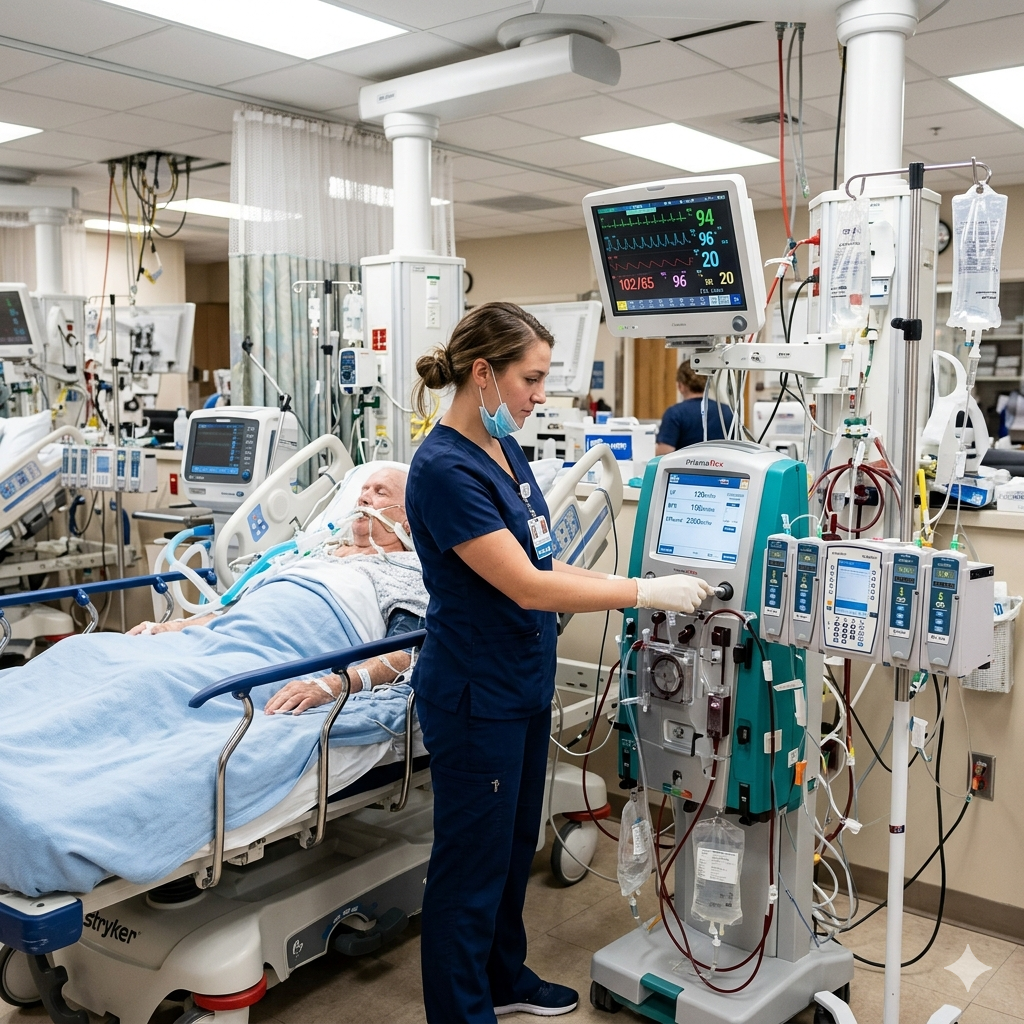
When the heart fails, the kidneys suffer — and when the kidneys fail, the heart deteriorates further. This vicious bidirectional cycle defines cardiorenal syndrome (CRS), one of the most complex and life-threatening conditions managed in the intensive care unit. For any registered nurse working in critical care, understanding this syndrome is not optional. It shapes every fluid decision, every vasopressor titration, and every lab trend that matters at the bedside. NCLEX questions on CRS are increasingly common on the Next Generation NCLEX, making this a high-yield topic for nursing students and practicing RN nurses alike.
What Is Cardiorenal Syndrome? A Framework Every Nurse Must Know
Cardiorenal syndrome describes a spectrum of disorders in which acute or chronic dysfunction in one organ — the heart or the kidney — initiates or perpetuates dysfunction in the other. The classification system, established by the Acute Dialysis Quality Initiative (ADQI), divides CRS into five subtypes:
| Type | Name | Primary Organ | Example |
|---|---|---|---|
| Type 1 | Acute Cardiorenal | Heart → Kidney | Acute decompensated heart failure causing AKI |
| Type 2 | Chronic Cardiorenal | Heart → Kidney | Chronic HF leading to CKD |
| Type 3 | Acute Renocardiac | Kidney → Heart | Sudden AKI causing cardiac dysfunction |
| Type 4 | Chronic Renocardiac | Kidney → Heart | CKD contributing to cardiomyopathy |
| Type 5 | Secondary CRS | Systemic disease | Sepsis, diabetes, or amyloidosis affecting both |
For ICU nursing practice, Type 1 (acute decompensated heart failure triggering acute kidney injury) and Type 3 (sudden renal failure stressing the heart) are the most frequently encountered. Knowing the subtype guides the nurse’s priority interventions and helps anticipate deterioration before it occurs.
Pathophysiology: Why the Heart and Kidney Are Inseparable
The heart and kidneys share a profound hemodynamic relationship. Under normal conditions, the heart delivers approximately 20–25% of cardiac output directly to the kidneys. When cardiac output drops — as in cardiogenic shock or acute decompensated heart failure — renal perfusion pressure falls and the kidneys respond defensively.
Several mechanisms drive the spiral of injury:
- Reduced renal perfusion: Low cardiac output activates the renin-angiotensin-aldosterone system (RAAS), causing sodium and water retention. This worsens volume overload and further strains the failing heart.
- Venous congestion: Elevated central venous pressure (CVP) transmits back into the renal veins, increasing renal venous pressure and impairing glomerular filtration. Counterintuitively, this is often more damaging than low arterial flow.
- Neurohormonal activation: Persistent sympathetic nervous system activation and RAAS stimulation cause renal vasoconstriction, reducing the GFR even when MAP appears adequate.
- Inflammatory mediators: In Type 5 CRS (sepsis), cytokines attack both organ systems simultaneously, accelerating dysfunction in hours.
Understanding these mechanisms is essential for cardiorenal syndrome nursing management, because interventions that fix one variable — such as aggressive diuresis — can worsen another if poorly monitored.
ICU Assessment: What the RN Nurse Monitors and Why
Early recognition of cardiorenal syndrome depends on systematic, trend-based assessment. The registered nurse at the bedside must synthesize hemodynamic data, laboratory values, and clinical findings continuously.
Hemodynamic Monitoring:
- Mean arterial pressure (MAP): Target ≥ 65 mmHg to maintain renal perfusion pressure
- Central venous pressure (CVP): Elevated CVP (> 8–12 mmHg) signals venous congestion that threatens GFR
- Cardiac output/index (CO/CI): Low CI (< 2.2 L/min/m²) predicts worsening renal perfusion
- Pulmonary artery pressures: Elevated PAWP indicates left-sided filling pressure overload
Renal Biomarkers — Key Lab Trends:
| Lab | Normal Range | CRS Concern |
|---|---|---|
| Serum creatinine | 0.6–1.2 mg/dL | Rising ≥ 0.3 mg/dL in 48 hrs = AKI Stage 1 |
| BUN | 7–20 mg/dL | Elevated; BUN:Cr ratio > 20 suggests prerenal |
| GFR | ≥ 60 mL/min | Declining trend signals renal compromise |
| Urine output | ≥ 0.5 mL/kg/hr | Oliguria < 0.5 mL/kg/hr is an early warning sign |
| Serum potassium | 3.5–5.0 mEq/L | Hyperkalemia common in CRS — monitor for peaked T waves |
| BNP / NT-proBNP | BNP < 100 pg/mL | Markedly elevated in cardiac stress |
The nurse should also assess daily weights, fluid balance trends, jugular venous distension (JVD), peripheral edema, and lung sounds for crackles indicating pulmonary congestion.
Nursing Interventions for Cardiorenal Syndrome in the ICU
Cardiorenal syndrome nursing management requires precision. The goals are to optimize cardiac output, relieve venous congestion, and protect renal function — simultaneously.
1. Fluid Management: Fluid administration must be approached with extreme caution. In CRS, aggressive fluid resuscitation can worsen renal venous congestion and reduce GFR further. Nurses titrate fluids based on dynamic fluid responsiveness markers (pulse pressure variation, stroke volume variation) rather than static CVP alone.
2. Diuretic Therapy: Loop diuretics — most commonly furosemide (Lasix) — are the cornerstone of decongestion in Type 1 CRS. IV furosemide infusions are often preferred over bolus dosing in the ICU, as they provide more consistent decongestion. The nurse monitors:
- Hourly urine output
- Electrolytes (Na⁺, K⁺, Mg²⁺) — replace aggressively per orders
- Signs of over-diuresis: rising creatinine, falling MAP, and decreased skin turgor
3. Vasopressor and Inotrope Support: When MAP drops despite decongestion, norepinephrine is first-line to restore renal perfusion pressure. In low cardiac output states, dobutamine increases contractility and CO, secondarily improving renal flow. Dopamine at low doses is no longer recommended for renal protection — a key NCLEX fact.
4. Continuous Renal Replacement Therapy (CRRT): When diuretics fail to achieve adequate fluid removal or when AKI progresses, CRRT (continuous venovenous hemofiltration or hemodialysis) provides controlled fluid removal with less hemodynamic instability than intermittent hemodialysis. Nursing responsibilities include circuit monitoring, anticoagulation management (typically heparin or citrate), and hourly fluid balance documentation.
5. Electrolyte Management: Hyperkalemia is a constant threat in CRS. The nurse must monitor for ECG changes — peaked T waves (early), widened QRS, and sine-wave pattern (emergent) — and anticipate orders for sodium bicarbonate, calcium gluconate, insulin/dextrose, and Kayexalate or Lokelma.
SBAR Communication and Priority Nursing Actions
Effective SBAR handoff is critical in CRS because deterioration can be rapid and subtle. When reporting to the provider or during shift change, the nurse should structure communication around:
- Situation: “Patient with acute decompensated heart failure now showing rising creatinine and decreased urine output over 6 hours”
- Background: Relevant cardiac history, baseline renal function, current medications
- Assessment: Trending hemodynamics, CVP, fluid balance, latest BNP and creatinine
- Recommendation: Requesting diuretic dose adjustment, nephrology consult, or CRRT initiation
This structured approach, fundamental to nursing bundle protocols in most ICUs, ensures no critical data is missed in a complex patient.
💡 NCLEX Tips for Cardiorenal Syndrome
- Oliguria (< 0.5 mL/kg/hr) is the earliest warning sign of AKI in a cardiac patient — always report it promptly.
- Elevated CVP does not mean the patient needs fluids in CRS — it often means venous congestion is worsening renal function.
- Low-dose dopamine is NOT renoprotective — this is a classic NCLEX distractor; the correct answer is optimizing cardiac output and MAP.
- Peaked T waves on the ECG in a CRS patient = hyperkalemia until proven otherwise — prepare for immediate interventions.
- On NCLEX, the priority nursing action in Type 1 CRS is typically monitoring urine output and fluid balance, not increasing IV fluids.
Conclusion
Cardiorenal syndrome nursing management in the ICU demands a systems-level thinker — a registered nurse who understands that every intervention in one organ system sends ripples through the other. From precise fluid balance documentation to interpreting rising creatinine trends alongside worsening CVP, the RN nurse at the bedside is the first and most consistent line of defense against irreversible organ damage. Mastery of this topic not only prepares nurses for the realities of critical care but also positions NCLEX candidates to answer complex multi-system questions with confidence.
Strengthen your critical care knowledge further with the nursing bundle at rn-nurse.com/nursing-courses, and test your understanding with NCLEX-style practice questions at rn-nurse.com/nclex-qcm.