
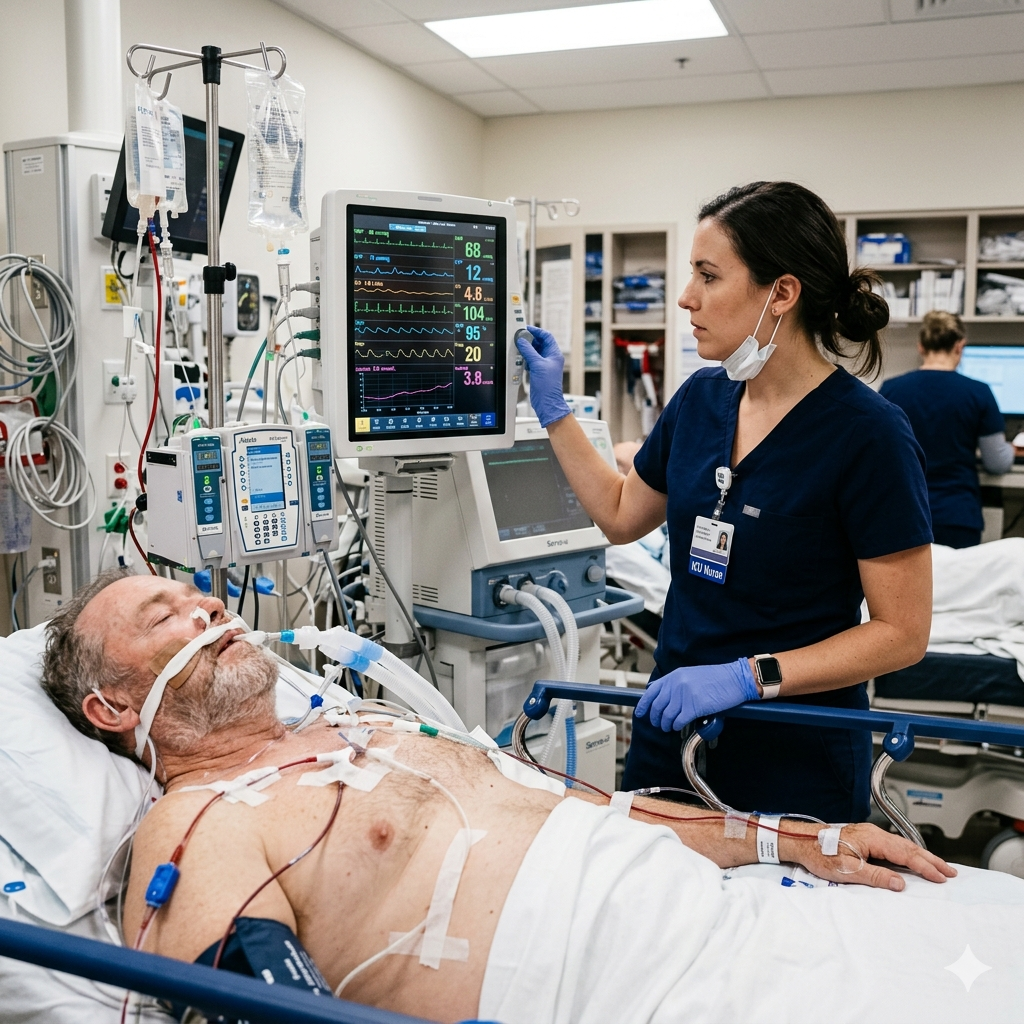
Shock is never just about blood pressure. Beneath the numbers on the monitor lies a microscopic catastrophe — microcirculation failure — that determines whether a patient survives or deteriorates despite aggressive resuscitation. For the registered nurse working in a critical care environment, understanding what happens at the capillary level in shock states is not optional. It is the clinical foundation for recognizing treatment failure, escalating care appropriately, and passing NCLEX questions that test beyond surface-level hemodynamics. Whether preparing for licensure or refining ICU skills, every RN nurse benefits from mastering this concept.
What Is Microcirculation and Why Does It Fail in Shock?
The microcirculation refers to the network of small vessels — arterioles, capillaries, and venules — responsible for delivering oxygen and nutrients directly to tissues and removing metabolic waste. These vessels, measuring less than 100 micrometers in diameter, are where cellular life actually happens.
In shock states — whether distributive, cardiogenic, hypovolemic, or obstructive — the microcirculation is disrupted through different but overlapping mechanisms:
- Distributive shock (e.g., sepsis, anaphylaxis): Massive vasodilation and maldistribution of blood flow cause some capillary beds to be flooded while others receive near-zero perfusion.
- Hypovolemic shock: Reduced intravascular volume leads to compensatory vasoconstriction, shunting blood away from non-vital microvascular beds.
- Cardiogenic shock: Decreased cardiac output reduces driving pressure, impairing capillary perfusion even when macrovascular parameters appear partially compensated.
- Obstructive shock (e.g., tension pneumothorax, cardiac tamponade): Mechanical obstruction prevents adequate venous return, collapsing capillary filling pressures.
In all four categories, the end result is tissue hypoxia at the cellular level — the defining injury of shock.
The Pathophysiology Nurses Need to Recognize
When microcirculation fails, a cascade of events unfolds that every nurse must be able to trace clinically:
1. Oxygen extraction failure: Cells cannot receive adequate O₂, forcing a switch to anaerobic metabolism. This produces lactic acid, making elevated serum lactate (>2 mmol/L) one of the earliest and most reliable markers of microvascular failure.
2. Endothelial dysfunction: The vascular endothelium, normally a tight barrier, becomes inflamed and permeable. Fluid shifts into the interstitium (third spacing), worsening intravascular volume depletion even as total body water may increase.
3. Microvascular thrombosis: Activated coagulation pathways deposit fibrin microthrombi within capillaries, mechanically blocking flow and contributing to disseminated intravascular coagulation (DIC) in severe cases.
4. Glycocalyx degradation: The endothelial glycocalyx — a gel-like protective layer lining vessels — is rapidly shed during shock, worsening permeability and promoting platelet and leukocyte adhesion.
5. Mitochondrial dysfunction: Prolonged hypoxia impairs the mitochondrial electron transport chain, leading to cytopathic hypoxia — a state in which cells cannot use oxygen even when it is restored. This explains why some patients fail to improve despite apparent hemodynamic normalization.
Nursing Assessment: Recognizing Microvascular Compromise
NCLEX and clinical practice both demand that a registered nurse recognize signs of inadequate tissue perfusion beyond the vital signs. Microcirculation failure manifests as:
| Clinical Sign | Mechanism | Nursing Significance |
|---|---|---|
| Cool, mottled skin | Peripheral vasoconstriction; capillary shutdown | Early sign of compensated shock; worse with progression |
| Prolonged capillary refill (>3 sec) | Reduced capillary driving pressure | Assess bilaterally on fingers and knees |
| Altered mental status | Cerebral microvascular hypoperfusion | Agitation before lethargy; do not overlook |
| Oliguria (<0.5 mL/kg/hr) | Renal afferent arteriole constriction | Early indicator of inadequate organ perfusion |
| Elevated serum lactate | Anaerobic metabolism from O₂ debt | Trend serial values; clearance matters as much as initial level |
| Mottling score >2 | Skin blood flow redistribution | Validated bedside marker of shock severity |
The mottling score — assessed from the knees outward — is an increasingly recognized bedside tool in ICU nursing. A score ≥3 correlates with significantly increased mortality and should prompt immediate provider notification.
Nursing Interventions in Shock-Induced Microcirculation Failure
The role of the RN nurse in managing microcirculation failure requires simultaneous resuscitation and reassessment. Key nursing interventions include:
1. Fluid resuscitation with targeted endpoints Administer crystalloids as ordered, but monitor for signs of fluid overload impairing microvascular flow. In septic shock, the Surviving Sepsis Campaign recommends 30 mL/kg IV crystalloid within the first three hours. Reassess using dynamic fluid responsiveness markers — pulse pressure variation, stroke volume variation — rather than relying on static CVP alone.
2. Vasopressor administration Norepinephrine remains the first-line vasopressor in distributive shock, titrated to maintain a mean arterial pressure (MAP) ≥65 mmHg. The nurse must monitor the arterial line closely, understand the pharmacology of vasopressors within the nursing scope, and recognize signs of digital ischemia or extravasation if administered peripherally.
3. Serial lactate monitoring Obtain lactate every 1–2 hours during active resuscitation. A lactate clearance ≥10% within two hours is a goal-directed target associated with improved outcomes. Document and trend values in the nursing assessment.
4. Temperature management Hypothermia worsens microvascular vasoconstriction and coagulopathy. Apply active warming measures unless targeted temperature management is specifically ordered.
5. Oxygen therapy and ventilatory support Maintain SpO₂ ≥94% and optimize oxygen delivery. If the patient is mechanically ventilated, collaborate with the respiratory therapist to ensure lung-protective ventilation strategies do not compromise cardiac output — since low tidal volumes can reduce venous return and worsen microvascular perfusion.
6. Positioning Elevate the head of the bed 30–45° to prevent VAP in intubated patients, but consider the passive leg raise (PLR) maneuver — raising legs to 45° for 60–90 seconds — as a reversible fluid challenge to assess preload responsiveness without administering volume.
💡 NCLEX Tips for Microcirculation Failure in Shock
- Lactate is your microvascular window: Elevated serum lactate signals anaerobic metabolism and tissue hypoperfusion even when MAP appears normal. Always trend, not just check.
- MAP ≥65 mmHg is the target: NCLEX questions on vasopressors in shock often test this threshold — know it cold.
- Capillary refill >3 seconds = perfusion problem: This simple bedside sign carries serious clinical weight on both the exam and in practice.
- DIC is a microvascular complication: When a shock patient develops unexpected bleeding or clotting, think microthrombosis and coagulopathy — escalate immediately.
- Fluid does not equal perfusion: Administering volume normalizes preload but does not guarantee capillary flow. The NCLEX tests nurses on reassessment after interventions — always evaluate response.
Refractory Shock and Microvascular Rescue Strategies
When standard resuscitation fails to restore tissue perfusion — a state called refractory shock — the microcirculation may be irreversibly compromised or require targeted adjuncts. The registered nurse must recognize this clinical plateau and escalate care accordingly.
Emerging and established adjuncts include:
- Hydrocortisone: Used in vasopressor-dependent septic shock to address relative adrenal insufficiency and improve vasopressor responsiveness at the microvascular level.
- Thiamine supplementation: In suspected thiamine deficiency (e.g., alcohol use disorder, prolonged critical illness), thiamine supports mitochondrial function and prevents worsening cytopathic hypoxia.
- Vitamin C protocols: Though evidence remains evolving, some ICUs use ascorbic acid in septic shock to reduce oxidative endothelial injury.
- Blood transfusion: In anemic shock patients, targeting hemoglobin ≥7–10 g/dL (per clinical context) improves oxygen-carrying capacity and microvascular O₂ delivery.
The nurse’s role is documentation, monitoring for response, recognizing adverse effects, and communicating findings using SBAR — Situation, Background, Assessment, Recommendation — to the interprofessional team.
Conclusion
Microcirculation failure in shock states is the invisible crisis that drives organ failure, coagulopathy, and mortality in the critically ill patient. The RN nurse who understands this pathophysiology at the capillary level — not just the hemodynamic surface — is equipped to detect deterioration earlier, implement resuscitation more precisely, and advocate more powerfully for patients. From trending lactate to assessing skin mottling, from titrating vasopressors to performing the passive leg raise, nursing care at this level is what separates adequate management from truly expert critical care.
Strengthen your critical care and NCLEX preparation by practicing with targeted questions at https://rn-nurse.com/nclex-qcm/, and explore the full nursing bundle of ICU resources and courses at https://rn-nurse.com/nursing-courses/. Mastering the microcirculation is mastering shock — and that knowledge saves lives.