
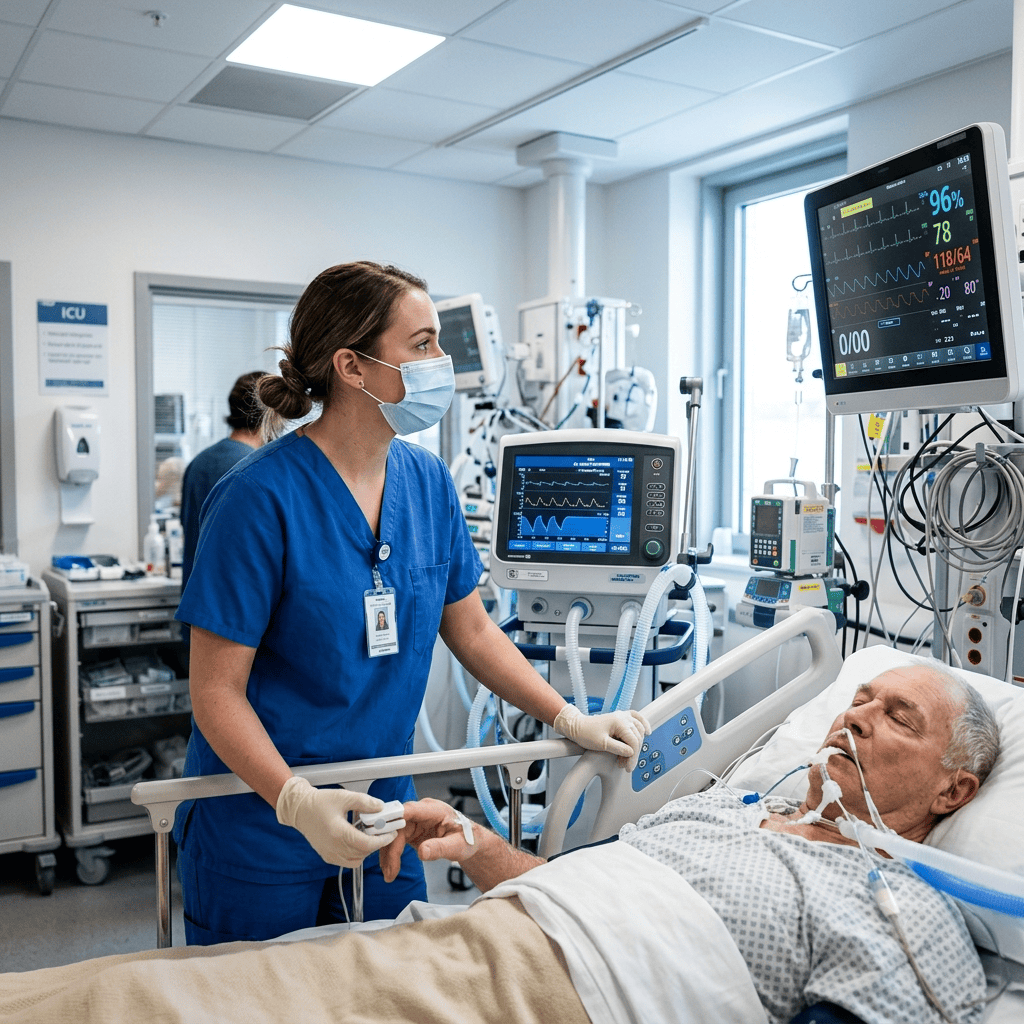
A patient sits comfortably, chatting with visitors, breathing without visible distress — and their oxygen saturation reads 82%. This is silent hypoxemia, a phenomenon that can catch even experienced clinicians off guard. For any nurse preparing for the NCLEX or working at the bedside, understanding this condition is not optional — it is a patient-safety essential. Every registered nurse must learn to look past the absence of obvious symptoms and trust objective data, because silent hypoxemia proves that a patient can be in danger long before they look sick.
Recognizing this condition is one of the clearest examples of why nursing assessment must go beyond “how do you feel?” It is a core concept tested repeatedly on the NCLEX and encountered daily in nursing practice, especially in respiratory and critical care settings.
What Is Silent Hypoxemia?
Silent hypoxemia, sometimes called “happy hypoxia,” occurs when a patient has significantly low blood oxygen levels (SpO2 typically below 90%) without the expected signs of respiratory distress — no severe dyspnea, no accessory muscle use, no obvious air hunger. The patient may appear calm, alert, and even conversational despite dangerously low oxygenation.
This pattern gained widespread clinical attention during the COVID-19 pandemic, where patients with viral pneumonia sometimes presented with oxygen saturations in the 70s or 80s while reporting only mild breathlessness. However, silent hypoxemia is not exclusive to COVID-19; it can occur with pulmonary embolism, early-stage pneumonia, altitude-related hypoxia, and certain neuromuscular conditions that blunt the body’s respiratory drive.
Why the Body Fails to Signal Distress
Several physiological mechanisms explain why patients don’t “feel” as sick as their numbers suggest:
- Blunted hypoxic ventilatory response: Some patients have a reduced central nervous system reaction to falling oxygen levels, delaying the urge to breathe harder.
- Preserved lung compliance: In early viral pneumonia, lungs may still expand normally even as gas exchange fails, so the work of breathing doesn’t feel abnormal.
- Ventilation-perfusion (V/Q) mismatch: Blood may bypass poorly oxygenated alveoli, causing hypoxemia without triggering the sensation of dyspnea.
- Individual variation in dyspnea perception: Age, chronic lung disease, and even psychological factors can alter how a patient subjectively experiences low oxygen.
Understanding these mechanisms helps a nursing professional explain why relying solely on the patient’s self-report of breathing comfort is clinically dangerous.
Nursing Assessment: Trust the Monitor, Not Just the Patient
The cornerstone of catching silent hypoxemia is continuous pulse oximetry paired with vigilant clinical judgment. Key assessment priorities include:
- Monitor SpO2 trends, not just single readings — a gradual downward drift is a red flag even if the current number seems tolerable.
- Correlate oxygen saturation with mental status, skin color, and capillary refill, since confusion or restlessness can be an early, subtle sign of hypoxia.
- Obtain an arterial blood gas (ABG) when ordered to confirm true oxygenation status and rule out pulse oximeter inaccuracies (e.g., in patients with dark skin pigmentation, poor perfusion, or nail polish).
- Reassess frequently in high-risk patients, including those with pneumonia, COPD exacerbation, or post-operative respiratory compromise.
- Apply a respiratory nursing bundle that standardizes oxygen assessment intervals, escalation criteria, and documentation to ensure nothing is missed during shift changes.
Every RN nurse should remember: a patient who “looks fine” can still be hypoxemic enough to require immediate intervention.
Nursing Interventions for Silent Hypoxemia
Once identified, prompt nursing action can prevent deterioration into acute respiratory failure:
- Initiate supplemental oxygen per facility protocol and provider orders, titrating to target saturation (often 92–96% for most adults).
- Position the patient in high-Fowler’s or prone positioning (when appropriate and ordered) to improve V/Q matching and oxygenation.
- Notify the provider immediately using SBAR communication when SpO2 drops below the parameter threshold, even if the patient denies distress.
- Prepare for escalation of care, including high-flow nasal cannula, non-invasive ventilation, or transfer to a higher level of care.
- Educate the patient and family about the importance of continuous monitoring, since patients may resist interventions if they don’t feel unwell.
💡 NCLEX Tips for Silent Hypoxemia
- Never rely solely on the patient’s subjective report of breathing comfort — trust objective SpO2 and ABG data.
- Pulse oximetry can be falsely reassuring in patients with poor peripheral perfusion or darker skin tones; correlate with clinical findings.
- A sudden change in mental status or restlessness may be the first true sign of hypoxia.
- Prioritize airway and oxygenation interventions over reassurance when SpO2 is critically low.
- Remember the NCLEX principle: assess before you intervene, but never delay oxygen for a hypoxemic patient.
Quick Reference: Hypoxemia Severity and Nursing Response
| SpO2 Range | Classification | Priority Nursing Action |
|---|---|---|
| 95–100% | Normal | Routine monitoring |
| 91–94% | Mild hypoxemia | Reassess, consider supplemental O2 |
| 86–90% | Moderate hypoxemia | Notify provider, initiate/increase oxygen therapy |
| ≤85% | Severe hypoxemia | Immediate provider notification, prepare for escalation |
Building Clinical Confidence with Silent Hypoxemia
For nursing students, silent hypoxemia is a powerful reminder that clinical assessment must be systematic rather than intuition-based. It reinforces the ABCs of nursing priority-setting — airway, breathing, circulation — regardless of how comfortable a patient appears. Practicing scenario-based questions on this topic strengthens the clinical reasoning skills the NCLEX is specifically designed to test, and reviewing a structured respiratory nursing bundle during clinical rotations helps translate theory into confident bedside practice.
Conclusion
Silent hypoxemia challenges the assumption that how a patient “looks” reflects how they are actually doing physiologically. For every nurse, nursing student, and practicing registered nurse, the lesson is clear: objective data — pulse oximetry, ABGs, and mental status changes — must guide clinical decisions, not just patient comfort or self-report. Mastering this concept builds both safer bedside practice and stronger NCLEX performance.
Ready to test your knowledge on respiratory emergencies and other high-yield topics? Practice with our NCLEX-style question bank or deepen your clinical skills with our comprehensive nursing courses.