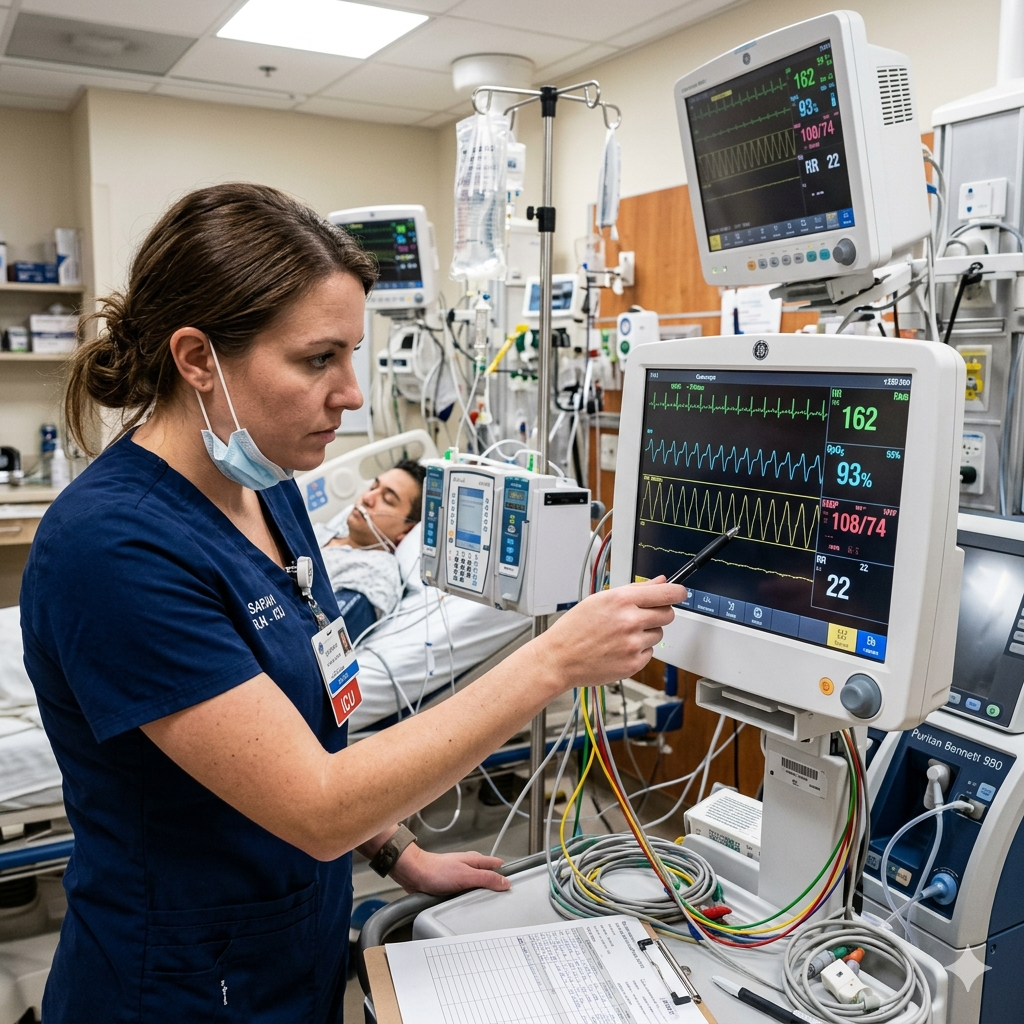
Early Repolarization vs. STEMI on ECG: A Nursing Guide for Clinical Practice and NCLEX

Early Repolarization vs. STEMI on ECG

Misreading an ECG in a high-stakes cardiac environment can mean the difference between life and death. For any registered nurse working in an emergency department, ICU, or telemetry unit, the ability to distinguish early repolarization (ER) from ST-elevation myocardial infarction (STEMI) is one of the most clinically critical — and frequently tested — skills in … Read more

Sgarbossa Criteria for Detecting MI in Left Bundle Branch Block

Sgarbossa Criteria for MI

Detecting a myocardial infarction (MI) on an electrocardiogram (ECG) is usually straightforward when classic ST-segment elevation is present. However, diagnosis becomes more challenging when a patient has a left bundle branch block (LBBB). In this situation, the normal electrical pattern of the heart is altered, which can hide or mimic signs of a heart attack. … Read more

Differentiating Ventricular Tachycardia from Supraventricular Tachycardia with Aberrancy

Ventricular Tachycardia vs SVT

Cardiac rhythm interpretation is a critical skill in emergency and intensive care environments. One of the most challenging electrocardiogram (ECG) interpretations involves distinguishing ventricular tachycardia (VT) from supraventricular tachycardia with aberrancy (SVT with aberrancy). Both rhythms can appear as wide-complex tachycardias, which means the ECG shows a rapid heart rate with a widened QRS complex. … Read more

Advanced ECG Interpretation in Electrolyte Emergencies: A Practical NCLEX Guide for Nurses

Advanced ECG in Electrolyte

Electrolyte imbalances can silently change the ECG before symptoms become severe. For any nurse or registered nurse, recognizing these early cardiac clues can prevent cardiac arrest. Advanced ECG interpretation in electrolyte emergencies is heavily tested on the NCLEX and frequently seen in critical care and telemetry nursing practice. When electrolytes shift, the heart’s electrical system … Read more

Electrical Alternans and Cardiac Tamponade Clues: NCLEX Guide for Nurses

Electrical Alternans & Cardiac Tamponade

Electrical alternans is a classic ECG finding that every nurse must recognize. It is strongly associated with cardiac tamponade, a life-threatening emergency frequently tested on the NCLEX. Electrical alternans plus hypotension and jugular venous distention should immediately make a nurse suspect cardiac tamponade. Whether you are a nursing student, a new registered nurse, or reviewing … Read more

Hyperkalemia vs MI ECG Differences: NCLEX Guide for Nurses

Hyperkalemia vs MI ECG Differences

Understanding hyperkalemia vs MI ECG differences is critical for every nurse, especially when preparing for the NCLEX. These two life-threatening conditions can produce similar ECG findings — but the treatments are completely different. Differentiating hyperkalemia from myocardial infarction (MI) on ECG can prevent fatal treatment errors and save a patient’s life. Whether you’re a nursing … Read more

Atrial Flutter vs Atrial Fibrillation: Subtle Differences

Atrial Flutter vs Atrial Fibrillation

A High-Yield NCLEX Guide for the Nurse, Registered Nurse, and RN Nurse Atrial flutter is regular and sawtooth-shaped, while atrial fibrillation is irregularly irregular with no visible P waves. For every nurse, registered nurse, and RN nurse, distinguishing atrial flutter (AFL) from atrial fibrillation (AFib) is a critical ECG interpretation skill. Both are supraventricular arrhythmias, … Read more

Long QT Syndrome and Torsades de Pointes

Long QT Syndrome and Torsades de Pointes

A High-Yield NCLEX Guide for the Nurse, Registered Nurse, and RN Nurse Long QT Syndrome prolongs ventricular repolarization, increasing the risk for Torsades de Pointes—a life-threatening polymorphic ventricular tachycardia. For every nurse, registered nurse, and RN nurse, recognizing prolonged QT intervals and the dangerous rhythm Torsades de Pointes (TdP) is critical in emergency, telemetry, and … Read more

Brugada Syndrome ECG Pattern Explained

Brugada Syndrome ECG

A High-Yield NCLEX Guide for the Nurse, Registered Nurse, and RN Nurse Brugada syndrome is identified on ECG by ST elevation in V1–V3 with a characteristic “coved” or “saddleback” pattern and a high risk for sudden ventricular arrhythmias. For every nurse, registered nurse, and RN nurse, recognizing dangerous ECG patterns is critical. Brugada syndrome is … Read more