
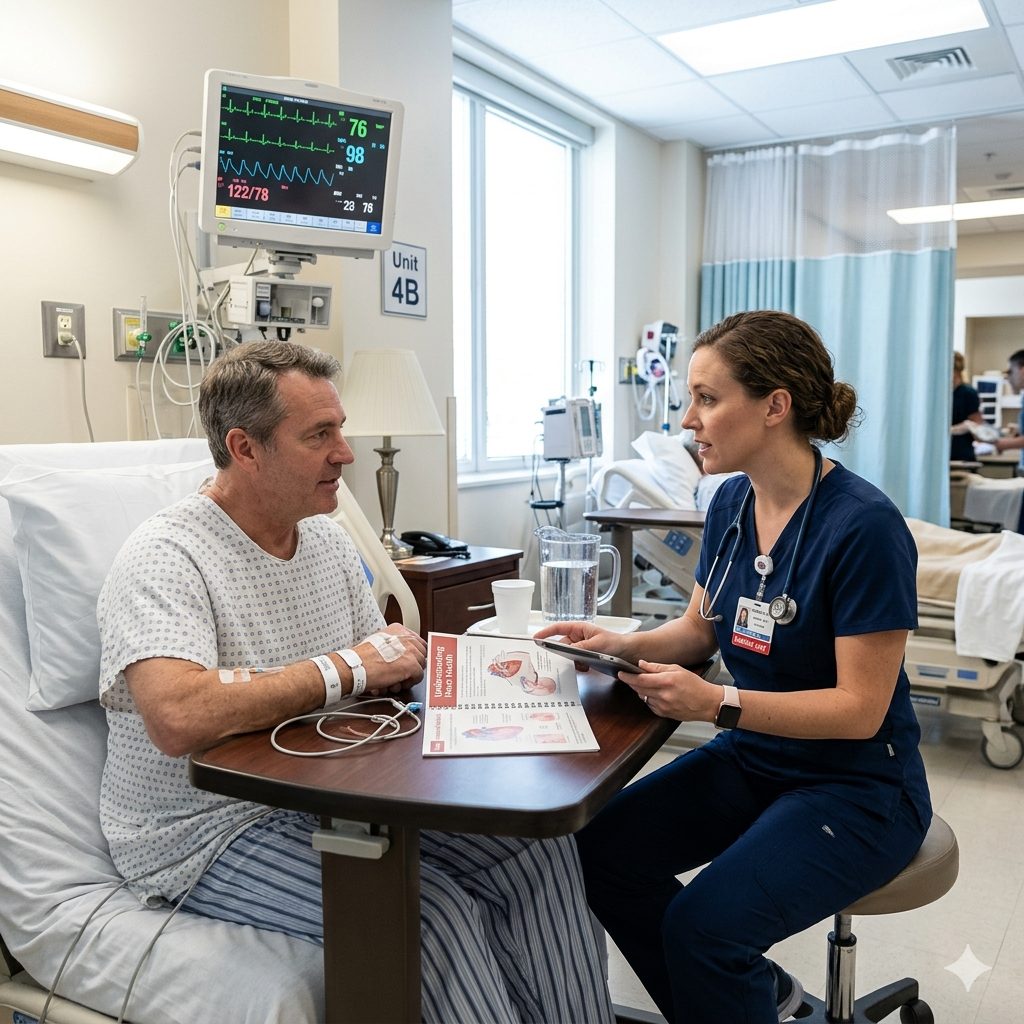
Sexual activity is a topic many patients with heart disease hesitate to raise — and one that many nurses feel uncertain addressing. Yet cardiovascular disease and sexual activity safety is a legitimate, evidence-based clinical concern that belongs in every cardiac nurse’s scope of practice. For patients recovering from myocardial infarction, living with heart failure, or managing stable angina, the question of when and whether sexual activity is safe is deeply personal and medically significant. Registered nurses and RN nurses are uniquely positioned to provide this education with both clinical accuracy and sensitivity. Understanding the physiologic demands of sexual activity, risk stratification frameworks, and appropriate nursing interventions is also high-yield content for the NCLEX — making it an essential component of any comprehensive nursing bundle.
The Cardiovascular Demands of Sexual Activity
Sexual activity places measurable stress on the cardiovascular system. During intercourse, heart rate and blood pressure rise in a pattern similar to moderate physical exertion. Studies consistently show that peak sexual activity is roughly equivalent to climbing two flights of stairs or walking briskly at 3–4 METs (metabolic equivalents of task).
For most patients with stable cardiovascular disease, this level of exertion is manageable. However, the nursing concern lies in patients whose cardiac reserve is compromised. Key physiologic responses during sexual activity include:
- Heart rate: Peaks between 90–130 bpm during orgasm
- Systolic blood pressure: May rise 30–80 mmHg above resting baseline
- Cardiac output: Increases 50–100% above resting values
- Duration of peak demand: Typically only 10–15 seconds at climax
These parameters matter when a registered nurse is counseling a patient post-MI or post-cardiac surgery. Nursing assessment must account for the patient’s resting function, exercise tolerance, and current medication regimen before any guidance is offered.
Risk Stratification: The Princeton Consensus Guidelines
The most widely referenced framework for cardiovascular disease sexual activity safety is the Princeton Consensus Conference guidelines, which stratify patients into three risk categories: low, intermediate, and high.
Low Risk
Patients in this category can generally resume sexual activity without further cardiac evaluation:
- Asymptomatic, well-controlled hypertension
- Mild, stable angina
- Post-revascularization (CABG or PCI) with no residual symptoms
- Compensated, mild heart failure (NYHA Class I)
- Post-MI with no complications (typically after 6–8 weeks)
Intermediate Risk
These patients require further evaluation, typically a stress test or cardiology consultation, before resuming sexual activity:
- Moderate stable angina
- Recent MI (2–6 weeks)
- NYHA Class II heart failure
- Peripheral arterial disease
- Stroke or TIA history
High Risk
Sexual activity should be deferred until the condition is stabilized and cardiology clearance is obtained:
- Unstable or refractory angina
- Uncontrolled hypertension (systolic >180 mmHg)
- Decompensated heart failure (NYHA Class III–IV)
- Recent MI (<2 weeks)
- High-risk arrhythmias (ventricular tachycardia, complete heart block)
- Hypertrophic obstructive cardiomyopathy
As an RN nurse, knowing these categories allows for accurate triage of patient education needs and timely escalation to the care team.
Nursing Assessment and Patient Education Priorities
Cardiovascular disease sexual activity safety counseling requires a structured nursing approach. Many patients will not initiate this conversation — the nurse must create a safe, non-judgmental space to address it.
Key nursing assessment questions include:
- What is the patient’s current functional capacity? Can they climb two flights of stairs without symptoms?
- Are they experiencing angina at rest, with exertion, or not at all?
- What medications are they currently taking (especially nitrates and PDE-5 inhibitors)?
- Do they have concerns about resuming sexual activity?
- Is their partner also anxious or avoiding the topic?
Patient education priorities:
- Explain that sexual activity is comparable to moderate exercise and provide realistic expectations
- Teach warning signs that require stopping and calling 911: chest pain, severe shortness of breath, palpitations, or prolonged fatigue lasting more than 15 minutes after activity
- Advise the patient to choose familiar, comfortable settings — anxiety in unfamiliar environments increases sympathetic demand
- Encourage resuming gradually, starting with less strenuous intimacy before full intercourse
- Reinforce that emotional connection and non-coital intimacy are safe for virtually all cardiac patients
This type of structured patient education is a core competency tested on the NCLEX and a hallmark of evidence-based nursing practice.
Medication Considerations: Nitrates and PDE-5 Inhibitors
One of the most critical pharmacologic concerns in this population is the absolute contraindication between nitrates and phosphodiesterase type-5 (PDE-5) inhibitors. This is a high-priority nursing safety consideration and a common NCLEX question stem.
PDE-5 inhibitors — including sildenafil (Viagra), tadalafil (Cialis), and vardenafil (Levitra) — are frequently used by male patients with cardiac disease who also have erectile dysfunction. When combined with any form of nitrate (sublingual nitroglycerin, isosorbide mononitrate, isosorbide dinitrate, or nitroprusside), the result can be severe, life-threatening hypotension.
Key nursing teaching points:
- Sildenafil and vardenafil: do NOT take within 24 hours of any nitrate dose
- Tadalafil: do NOT take within 48 hours of any nitrate dose
- If a patient using a PDE-5 inhibitor develops chest pain, nitroglycerin is contraindicated — emergency services must be activated immediately
- Alpha-blockers combined with PDE-5 inhibitors can also cause significant hypotension and require careful monitoring
The registered nurse must reconcile medications on admission and educate patients before discharge. Inclusion of this drug interaction in a nursing bundle review is highly recommended for NCLEX preparation.
Nursing Interventions for Special Populations
Certain cardiac patient populations require tailored nursing guidance for cardiovascular disease sexual activity safety.
Post-Myocardial Infarction
Most clinical guidelines recommend waiting a minimum of 6–8 weeks before resuming sexual activity after an uncomplicated MI. The nurse should confirm the patient has passed a symptom-limited exercise test or can tolerate moderate exertion without symptoms before providing clearance guidance.
Heart Failure
Patients with compensated heart failure (NYHA Class I–II) can often engage in sexual activity safely. Those in Class III–IV require cardiologist guidance. Fatigue, dyspnea, and fluid retention must be stabilized first. Nursing education should address energy conservation techniques and positioning to reduce cardiac workload.
Implantable Cardioverter-Defibrillator (ICD) Recipients
ICD patients and their partners often fear that sexual activity will trigger a shock. Reassurance is a key nursing intervention. Most ICD-triggered shocks during sexual activity are benign and do not cause injury to a partner. The nurse should explain that if a shock occurs, the partner may feel a mild, harmless sensation. Encourage open communication with the electrophysiology team about device settings.
Post-Cardiac Surgery
Following CABG or valve replacement, sternal precautions typically apply for 6–8 weeks. Nursing education should address activity restrictions and positioning adaptations to protect the healing sternum. Sexual activity from behind or side-lying positions may be recommended to minimize sternal stress.
💡 NCLEX Tips for Cardiovascular Disease and Sexual Activity Safety
- Sexual activity ≈ 3–4 METs — equivalent to climbing two flights of stairs; if the patient tolerates this, activity is generally safe
- Nitrates + PDE-5 inhibitors = absolute contraindication — this is frequently tested on the NCLEX
- Low-risk patients post-uncomplicated MI may resume sexual activity after 6–8 weeks
- High-risk patients (unstable angina, decompensated HF) must defer until medically stabilized
- Always assess patient AND partner anxiety — partner fear is a major barrier to resuming intimacy
Quick Reference: Risk Categories and Nursing Actions
| Risk Level | Examples | Nursing Action |
|---|---|---|
| Low | Stable angina, post-PCI, HTN well-controlled | Educate and clear for activity |
| Intermediate | Recent MI (2–6 wks), NYHA II HF | Refer for stress testing before guidance |
| High | Unstable angina, decompensated HF, severe arrhythmia | Defer; notify provider; stabilize first |
| Medication Alert | Nitrates + PDE-5 inhibitors | Absolute contraindication — document and teach |
Conclusion
Cardiovascular disease and sexual activity safety is not a peripheral topic — it is a core component of holistic cardiac nursing care. Every RN nurse who works with cardiac patients will encounter questions about this issue, whether patients ask directly or not. Mastering risk stratification, pharmacologic contraindications, and patient education strategies equips the registered nurse to address this sensitive subject with confidence and clinical accuracy.
For nurses preparing for the NCLEX, this topic intersects cardiology, pharmacology, and patient education — making it high yield across multiple question formats. Strengthen your understanding with practice questions and deepen your review with a comprehensive nursing bundle.
👉 Practice cardiovascular NCLEX questions at rn-nurse.com/nclex-qcm/ 👉 Explore full cardiac nursing courses at rn-nurse.com/nursing-courses/