
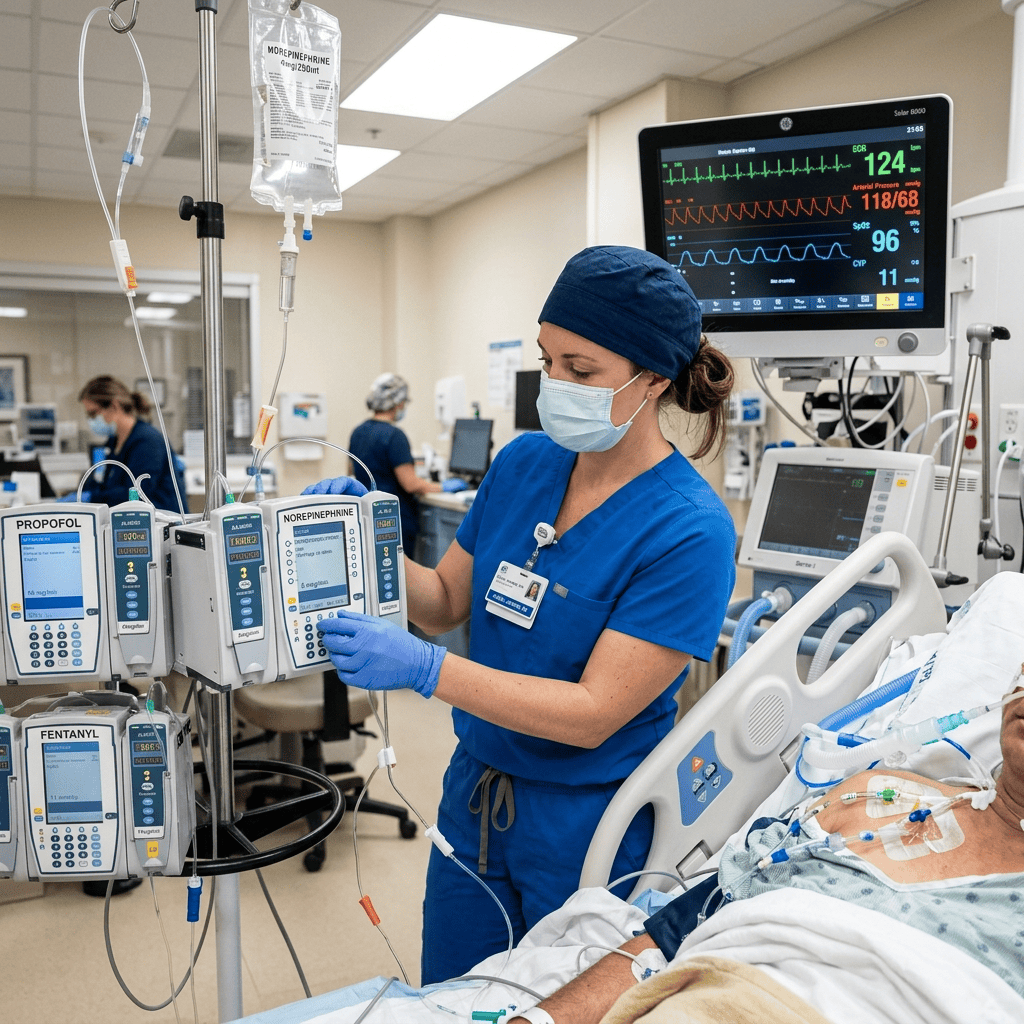
Vasopressor titration nursing is one of the highest-stakes skills a critical care nurse performs, and it shows up constantly on the NCLEX and in real ICU shifts. When a patient’s blood pressure collapses from septic, cardiogenic, or distributive shock, the bedside nurse is often the one making minute-to-minute adjustments to a norepinephrine or vasopressin drip to keep vital organs perfused. Every registered nurse working in critical care needs a clear, protocol-driven understanding of how these drugs work, how to titrate them safely, and what complications to watch for. This guide breaks down vasopressor titration nursing step by step, with the dosing ranges, monitoring parameters, and nursing bundle actions every RN nurse should know before stepping into a shock room.
What Vasopressors Do and Why Titration Matters
Vasopressors are potent vasoactive medications that raise blood pressure by constricting peripheral blood vessels, increasing cardiac contractility, or both. Clinicians use them when fluid resuscitation alone fails to restore adequate perfusion in shock states — most commonly septic shock, but also cardiogenic, neurogenic, and anaphylactic shock.
Because these drugs have a narrow therapeutic window and a short half-life, nurses must give them as continuous infusions and adjust, or titrate, them in small increments based on the patient’s response. Too little medication leaves organs underperfused; too much causes severe hypertension, arrhythmias, or tissue ischemia. This is why vasopressor titration nursing requires frequent reassessment — often every 5 to 15 minutes during initiation — rather than a “set it and forget it” mindset.
The overarching goal of titration is to reach and sustain a target mean arterial pressure (MAP), typically 65 mmHg or greater, unless the provider orders a different individualized goal.
Norepinephrine Titration and Nursing Considerations
Norepinephrine (brand name Levophed) is the first-line vasopressor that the Surviving Sepsis Campaign recommends for septic shock. It works primarily as a potent alpha-1 agonist, causing vasoconstriction, with mild beta-1 activity that modestly increases heart rate and contractility.
Key nursing considerations:
- Dosing range: Nurses typically start the infusion at 0.01–0.05 mcg/kg/min and titrate it upward, commonly in increments of 0.01–0.02 mcg/kg/min, based on MAP response.
- Access: Administer through a central venous catheter whenever possible; peripheral administration is only acceptable short-term, in a large proximal vein, with close site monitoring, per many institutional protocols.
- Monitoring: Continuous blood pressure monitoring — ideally via an arterial line for beat-to-beat accuracy — plus heart rate, rhythm, urine output, capillary refill, and mentation.
- Extravasation risk: Norepinephrine is a potent vesicant. If it infiltrates, notify the provider immediately; the antidote, phentolamine, reverses the local vasoconstriction.
- Never abruptly discontinue: Stopping the drip suddenly can cause rebound hypotension; wean gradually per protocol.
Vasopressin Titration in Refractory Shock
Clinicians typically add vasopressin as a second agent when norepinephrine alone isn’t achieving the target MAP, rather than titrating it up and down like norepinephrine. It acts on V1 receptors to cause vasoconstriction independent of the catecholamine pathway, which makes it useful in catecholamine-resistant shock.
Key nursing considerations:
- Fixed dosing: Nurses usually infuse vasopressin at a fixed rate (commonly 0.03–0.04 units/min) rather than titrating it up, unlike norepinephrine.
- Purpose: Adding vasopressin often lets nurses reduce the norepinephrine dose, decreasing catecholamine-related side effects such as tachyarrhythmias.
- Monitoring: Watch for signs of excessive vasoconstriction, including decreased urine output, mottled skin, or digital ischemia, and monitor sodium levels since vasopressin has antidiuretic effects.
- Discontinuation order: Clinicians generally wean or stop vasopressin after they reduce norepinephrine to a low dose, per most institutional weaning protocols.
Hemodynamic Monitoring During Titration
Safe vasopressor titration nursing depends on tight, continuous hemodynamic monitoring. At minimum, expect to track:
- MAP every few minutes during active titration, then per protocol once stable
- Heart rate and rhythm via continuous telemetry
- Urine output hourly as a marker of renal perfusion
- Lactate levels trending down as a sign of improving tissue perfusion
- Skin color, temperature, and capillary refill at the extremities
Many ICUs use a standardized vasopressor titration nursing bundle or protocol that defines the exact MAP thresholds for increasing, holding, or decreasing the infusion rate, which reduces variability and supports patient safety.
Complications and Safety Considerations
Nurses managing vasopressor drips must recognize and respond to complications quickly:
- Arrhythmias, especially with higher-dose norepinephrine or epinephrine
- Peripheral and digital ischemia from prolonged, high-dose vasoconstriction
- Extravasation injury at the IV site
- Rebound hypotension from abrupt discontinuation
- Excessive vasoconstriction masking ongoing hypovolemia
Any of these findings should prompt immediate reassessment and provider notification.
💡 NCLEX Tips for Vasopressor Titration
- Norepinephrine is the first-line vasopressor in septic shock — know this fact cold.
- The target MAP is generally ≥65 mmHg unless otherwise ordered.
- Vasopressin is added at a fixed dose, not titrated like norepinephrine.
- Central line access is preferred; monitor peripheral sites closely if used.
- Never stop a vasopressor abruptly — wean gradually to avoid rebound hypotension.
Quick Reference: Norepinephrine vs. Vasopressin
| Feature | Norepinephrine | Vasopressin |
|---|---|---|
| Drug class | Catecholamine, alpha-1 agonist | Antidiuretic hormone analog |
| Typical role | First-line vasopressor | Second-line, add-on agent |
| Starting dose | 0.01–0.05 mcg/kg/min | Fixed ~0.03–0.04 units/min |
| Titration style | Titrated up/down per MAP | Usually fixed, not titrated |
| Access | Central line preferred | Central line preferred |
| Key risk | Extravasation, arrhythmias | Digital ischemia, hyponatremia |
| Antidote for infiltration | Phentolamine | N/A |
Conclusion
Vasopressor titration nursing combines pharmacology knowledge with sharp bedside assessment skills. Understanding how norepinephrine and vasopressin work, their correct dosing approach, and the hemodynamic parameters that guide every adjustment prepares nursing students for NCLEX questions and prepares practicing RN nurses for real shock management. Reinforce this knowledge with hands-on practice using a nursing bundle checklist at the bedside, and test your understanding further with practice questions at the RN-Nurse NCLEX question bank or deepen your critical care skills through our nursing courses.