
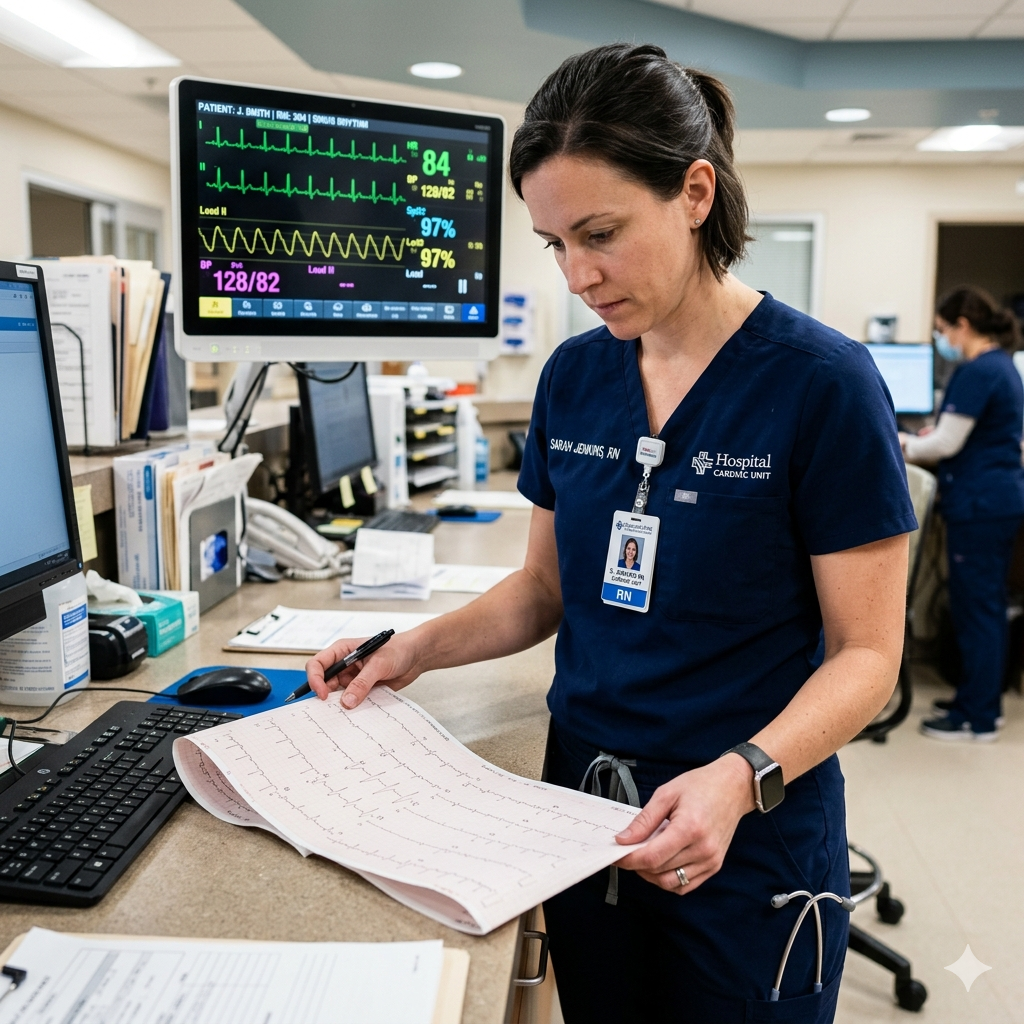
T-wave inversions are one of the most frequently misunderstood findings on an electrocardiogram — and for good reason. The T-wave represents ventricular repolarization, and when it dips below the isoelectric line, it signals a change in the electrical recovery of the heart muscle. Every registered nurse working in cardiology, telemetry, the ICU, or the emergency department must understand the difference between benign and pathological T-wave inversions — it is a critical clinical skill. It is also a high-yield topic for the NCLEX, where distinguishing normal variants from dangerous rhythms can directly impact patient safety questions. This guide breaks down T-wave inversions in a way that supports both bedside nursing practice and exam success.
Understanding the T-Wave: A Quick EKG Review
Before identifying inversions, a nurse must understand what a normal T-wave looks like. On a standard 12-lead EKG, the T-wave follows the QRS complex and should deflect upright (positive) in most leads. Specifically:
- Normally upright: Leads I, II, V3–V6
- Normally inverted: Lead aVR
- Variable: Leads III, aVL, V1, and V2
A T-wave is inverted when it deflects below the baseline in a lead where it normally points upward. Inversions may be symmetric (both limbs equal) or asymmetric, and may appear in isolated leads or across multiple contiguous leads. The depth of inversion — whether shallow (less than 1 mm) or deep (greater than 2–5 mm) — also carries clinical significance. The nurse must always assess T-wave changes within the full clinical picture: symptoms, history, vital signs, and serial EKGs.
Benign Causes of T-Wave Inversions
Not all T-wave inversions indicate cardiac pathology. Several benign or non-ischemic causes exist, and recognizing them prevents unnecessary alarm and intervention.
1. Normal Variant in Leads V1–V2 Inverted T-waves in leads V1 and V2 represent a normal finding in many adults, particularly women. These right precordial leads overlie the right ventricle, which depolarizes differently from the thicker left ventricle.
2. Juvenile T-Wave Pattern In children and young adults (especially women under 30), T-wave inversions in leads V1–V4 may persist from childhood. Clinicians call this the persistent juvenile T-wave pattern, and it remains generally benign unless symptoms or structural abnormalities accompany it.
3. Early Repolarization Early repolarization patterns can sometimes produce T-wave changes, particularly in young, athletic individuals. While historically considered benign, current nursing bundles and cardiology guidelines recommend monitoring when this pattern appears in inferior leads, as emerging evidence links certain variants to sudden cardiac death risk.
4. Hyperventilation and Anxiety Transient T-wave inversions in anterior leads can result from hyperventilation due to sympathetic nervous system activation. These typically resolve when the nurse addresses the underlying cause.
5. Post-Tachycardia Syndrome Following a period of sustained tachycardia (e.g., SVT or atrial fibrillation with rapid ventricular response), T-wave inversions may persist for hours to days. Cardiologists call this cardiac memory — a benign, reversible finding that every RN nurse should recognize to avoid unnecessary escalation.
Pathological Causes of T-Wave Inversions
When T-wave inversions turn pathological, they reflect genuine myocardial injury, strain, or ischemia. These causes demand immediate nursing assessment and often urgent intervention.
1. Myocardial Ischemia and NSTEMI The most clinically significant cause of T-wave inversions is myocardial ischemia. Deep, symmetric T-wave inversions — particularly in the anterior leads (V1–V4) — are classic for Wellens’ syndrome, a pre-infarction pattern indicating critical stenosis of the left anterior descending (LAD) artery. Every registered nurse must recognize Wellens’ pattern as a medical emergency even when the patient reports no pain, as it signals impending anterior MI.
2. Pulmonary Embolism (PE) Acute PE produces T-wave inversions in the right precordial leads (V1–V4) and inferior leads due to acute right heart strain. The classic S1Q3T3 pattern — deep S wave in lead I, Q wave in lead III, inverted T in lead III — is the hallmark EKG finding, though it appears in only 20% of PE cases.
3. Left Ventricular Hypertrophy (LVH) with Strain In LVH with strain pattern, T-wave inversions appear in the lateral leads (I, aVL, V5–V6) as a secondary repolarization abnormality. The ST segment typically shows a characteristic downsloping depression followed by the inversion, reflecting chronic pressure or volume overload on the left ventricle.
4. Right Ventricular Hypertrophy (RVH) RVH produces T-wave inversions in the right precordial leads (V1–V3) alongside right axis deviation. Common causes include chronic pulmonary hypertension and congenital heart disease.
5. Cerebrovascular Events Massive strokes, subarachnoid hemorrhage, and other intracranial emergencies cause dramatic neurogenic T-wave inversions — often deeply inverted, widespread, and associated with QT prolongation. These reflect autonomic nervous system dysregulation rather than primary cardiac disease.
6. Takotsubo (Stress) Cardiomyopathy Also called apical ballooning syndrome, Takotsubo cardiomyopathy typically follows intense emotional or physical stress. It produces deep, diffuse T-wave inversions with QT prolongation and mimics anterior STEMI in presentation. Nursing care centers on hemodynamic monitoring and supportive management.
T-Wave Inversions: Benign vs Pathological — Quick Reference Table
| Feature | Benign | Pathological |
|---|---|---|
| Depth | Shallow (< 1–2 mm) | Deep (> 2–5 mm) |
| Distribution | Isolated (V1–V2, aVR, III) | Contiguous or widespread leads |
| Symmetry | Asymmetric | Often symmetric (ischemia) |
| Associated symptoms | None | Chest pain, dyspnea, syncope |
| Clinical context | Athlete, young female, post-tachycardia | ACS, PE, stroke, cardiomyopathy |
| Serial EKG change | Stable | Evolving / dynamic |
| ST changes | Absent | Often present |
Nursing Assessment and Interventions
When a nurse identifies T-wave inversions on a rhythm strip or 12-lead EKG, the following actions guide safe clinical practice:
- Compare to prior EKGs: New or dynamic T-wave changes carry more concern than stable, chronic findings.
- Assess the patient immediately: Ask about chest pain, shortness of breath, dizziness, or palpitations.
- Obtain a 12-lead EKG: A rhythm strip alone does not provide enough information to diagnose the pattern and distribution of T-wave changes.
- Notify the provider: Document findings using SBAR — Situation, Background, Assessment, Recommendation.
- Obtain serial troponins: If ischemia is a concern, cardiac biomarkers are essential to rule out NSTEMI.
- Monitor hemodynamics: Blood pressure, oxygen saturation, and heart rate guide the urgency of the nursing response.
- Prepare for potential interventions: Clinical findings determine whether IV access, oxygen, and continuous 12-lead monitoring are necessary.
💡 NCLEX Tips for T-Wave Inversions
- Deep, symmetric T-wave inversions in V1–V4 in a pain-free patient = think Wellens’ syndrome — treat as pre-infarction emergency
- S1Q3T3 pattern = pulmonary embolism until proven otherwise
- An inverted T in aVR is normal — do not mistake it for pathology
- Neurogenic T-wave inversions appear wide, deep, and often link to QT prolongation — look for a neurological trigger
- Always compare a new EKG to an old one — the change is often more important than the finding itself
Conclusion
T-wave inversions span a wide clinical spectrum — from normal variants in young women to life-threatening pre-infarction patterns. Every RN nurse working in any setting with cardiac monitoring must distinguish benign findings from those demanding urgent action. Mastering T-wave interpretation goes beyond NCLEX preparation — it directly protects patients. Recognizing a Wellens’ pattern, a PE-related right heart strain pattern, or neurogenic inversions can determine patient outcomes. Pair this guide with a comprehensive nursing bundle to reinforce EKG interpretation skills, and build confidence through case-based practice.
Ready to test your knowledge? Practice NCLEX-style EKG questions at rn-nurse.com/nclex-qcm/ or explore the full cardiology nursing curriculum at rn-nurse.com/nursing-courses/.