
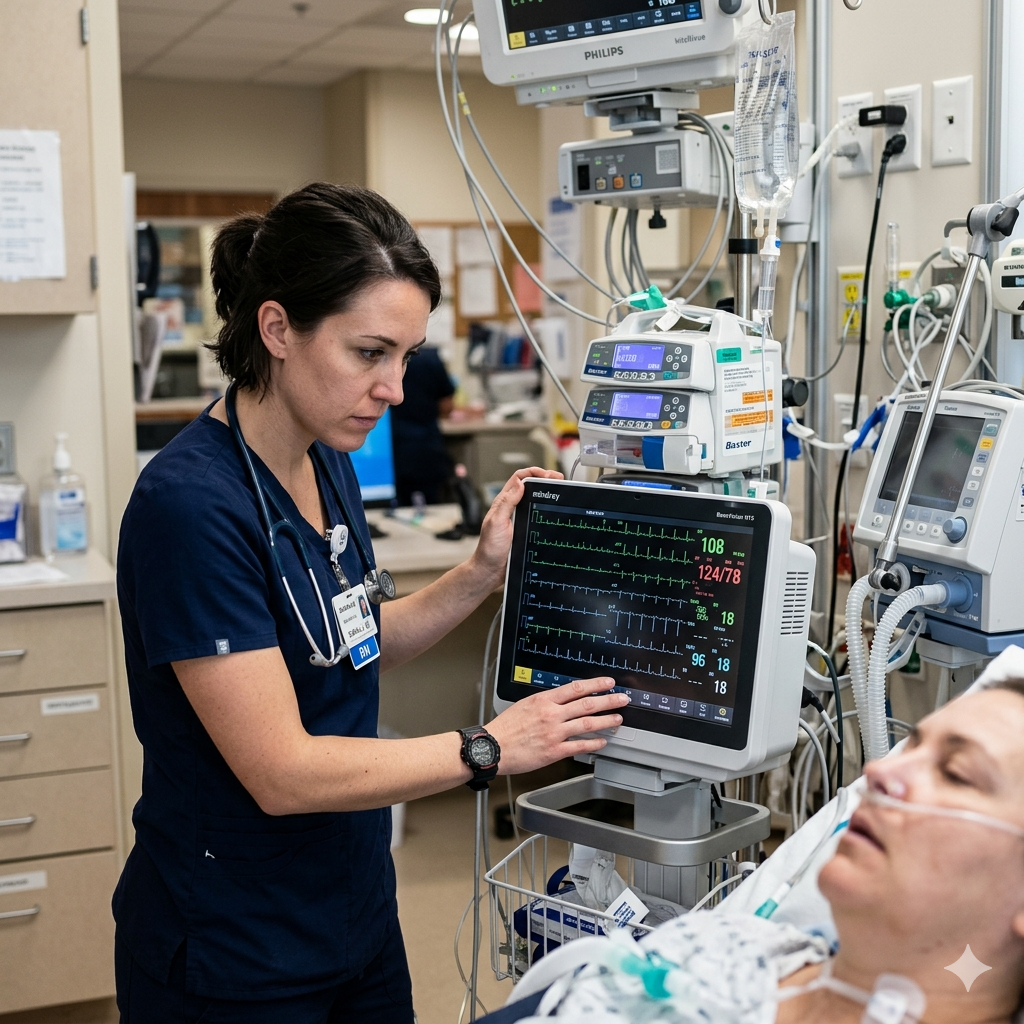
Ischemia does not always announce itself with the dramatic ST elevation that nurses are trained to identify first. Subendocardial ischemia — injury confined to the innermost layer of the myocardium — produces a quieter but equally dangerous EKG signature, and missing it costs lives. For every registered nurse working in a cardiac, telemetry, or critical care setting, understanding these patterns is non-negotiable. NCLEX candidates will encounter questions that test the ability to differentiate ST-elevation myocardial infarction (STEMI) from non-ST-elevation presentations, making subendocardial ischemia nursing knowledge essential for both exam success and real-world patient safety. Building familiarity with this topic — ideally supported by a comprehensive nursing bundle — gives the RN nurse a decisive clinical edge.
What Is Subendocardial Ischemia and Why Does It Matter?
The myocardium is not a uniform tissue. The subendocardium — the innermost myocardial layer — is the farthest from the coronary arteries that supply it and the most metabolically vulnerable. During periods of reduced oxygen delivery or increased demand, this region is the first to suffer ischemic injury.
Unlike transmural (full-thickness) ischemia, which typically produces ST elevation, subendocardial ischemia causes ST depression on the 12-lead EKG. This distinction carries major clinical implications. The nurse must recognize that ST depression does not mean a “smaller” problem — it signals active ischemia that can progress to a Non-ST-Elevation Myocardial Infarction (NSTEMI) or unstable angina, both of which carry substantial mortality risk.
Key facts every nursing professional should internalize:
- Subendocardial ischemia affects the innermost myocardial layer first
- It does not produce Q waves in the acute phase
- ST depression is the hallmark finding, not ST elevation
- The pattern can be diffuse, appearing in multiple leads simultaneously
- Troponin levels may rise if actual myocardial cell death occurs (NSTEMI)
EKG Patterns: Reading the Subendocardial Injury Signature
The 12-lead EKG remains the registered nurse’s most immediate diagnostic tool at the bedside. Understanding the specific patterns associated with subendocardial ischemia is a high-yield skill for both the NCLEX and clinical practice.
ST Depression
Horizontal or downsloping ST depression of ≥1 mm in two or more contiguous leads is the classic marker. Upsloping ST depression is considered less specific and may represent a normal variant, particularly during tachycardia.
- Horizontal ST depression: Flat segment at or below baseline — most concerning for ischemia
- Downsloping ST depression: Segment slopes downward from the J-point — high specificity for ischemic injury
- Upsloping ST depression: Less specific; may reflect rate-related changes
T-Wave Inversions
Symmetrical, deeply inverted T-waves in the precordial leads (particularly V1–V4) may accompany or follow ST depression. This pattern, sometimes called Wellens’ syndrome when seen in V2–V3 after chest pain resolution, signals critical proximal left anterior descending (LAD) artery stenosis and warrants immediate escalation.
Lead Distribution Clues
- Diffuse ST depression (multiple lead groups affected): Suggests global subendocardial ischemia, often due to demand ischemia (e.g., rapid atrial fibrillation, severe anemia, hypotension)
- Reciprocal ST depression in leads opposite an ST-elevation zone: This is not true subendocardial ischemia — it reflects the electrical mirror image of a STEMI elsewhere
The RN nurse should document the EKG findings precisely, note the time of acquisition, and compare with previous tracings whenever available.
NSTEMI vs. Unstable Angina: The Troponin Distinction
Clinically, subendocardial injury patterns fall under the umbrella of Acute Coronary Syndrome (ACS) without ST elevation. Two diagnoses share this EKG presentation:
| Feature | Unstable Angina | NSTEMI |
|---|---|---|
| ST Depression | Present | Present |
| T-Wave Inversion | May be present | May be present |
| Troponin | Negative | Positive (elevated) |
| Myocardial Cell Death | No | Yes |
| Risk Level | High | High to Very High |
The critical differentiator is troponin. When myocardial cells die — even in the subendocardial layer — troponin I or troponin T leaks into the bloodstream. Serial troponins (drawn at 0, 3, and 6 hours, or per institutional protocol) allow the nursing team to track this trend. A rising troponin pattern confirms NSTEMI even when the EKG shows only ST depression.
Nursing documentation of troponin trends, symptom onset time, and EKG changes forms the backbone of clinical decision-making in these patients.
Subendocardial Ischemia Nursing Assessment and Interventions
When a patient presents with chest discomfort and ST depression on telemetry or 12-lead EKG, the RN nurse must act with urgency and precision. This is a high-acuity situation that requires a systematic response.
Priority Nursing Assessment
- OPQRST for chest pain: Onset, Provocation, Quality, Radiation, Severity, Timing
- Vital signs: Blood pressure, heart rate, respiratory rate, oxygen saturation
- Skin: Diaphoresis, pallor, or cyanosis suggests hemodynamic compromise
- Lung sounds: New crackles may indicate early pulmonary edema
- Level of consciousness: Confusion or agitation signals poor cardiac output
Immediate Nursing Interventions
- Obtain a 12-lead EKG — immediately and with any change in symptoms
- Establish IV access — two large-bore peripheral IVs
- Supplemental oxygen if SpO₂ < 90% (avoid routine O₂ in normoxic patients per current AHA guidance)
- Continuous cardiac monitoring — document rhythm and any ST changes
- Administer aspirin (typically 325 mg PO) per provider order or standing protocol
- Draw labs: Troponin, BMP, CBC, coagulation panel, BNP as ordered
- NPO status — anticipate possible intervention (cardiac catheterization)
- Notify provider immediately — SBAR communication is essential
- Pain management: Nitrates per order; reassess pain on a 0–10 scale after each intervention
- Prepare for transfer to a higher level of care or cardiac catheterization lab if indicated
Medication administration requires close attention. Nitrates are contraindicated if the patient has taken a phosphodiesterase-5 inhibitor (e.g., sildenafil) within 24–48 hours or if systolic BP is below 90 mmHg. The RN nurse must verify these contraindications before administration.
Causes of ST Depression: Ischemic vs. Non-Ischemic
Not every ST depression represents coronary ischemia. NCLEX questions frequently test the nurse’s ability to distinguish ischemic patterns from mimics. Common non-ischemic causes of ST depression include:
- Digoxin effect: Characteristic “scooped” or sagging ST depression — not ischemia
- Left ventricular hypertrophy (LVH): Associated with strain pattern ST depression in lateral leads
- Right bundle branch block (RBBB) and Left bundle branch block (LBBB): Alter repolarization and produce secondary ST-T changes
- Hypokalemia: Causes ST depression with prominent U waves
- Hyperventilation: Can transiently flatten or depress ST segments
- Wolff-Parkinson-White (WPW): Delta waves and secondary ST changes
Clinical context is everything. The nurse who links EKG findings to the patient’s symptoms, history, vital signs, and labs — rather than interpreting the EKG in isolation — will provide the safest care.
💡 NCLEX Tips for Subendocardial Ischemia
- ST depression = subendocardial ischemia; ST elevation = transmural (full-thickness) injury — know this distinction cold
- A rising troponin with ST depression = NSTEMI; a negative troponin with the same EKG = unstable angina
- Wellens’ syndrome (deep T-wave inversions in V2–V3) signals proximal LAD stenosis — treat as high-priority
- Digoxin produces a scooped ST depression (“Salvador Dalí mustache”) — not ischemic
- The first nursing action for any suspected ACS is: 12-lead EKG + IV access + notify provider — in that order of documentation, simultaneously in practice
Patient Education and Discharge Planning
Patients who have experienced subendocardial ischemia require clear, thorough education before discharge. The registered nurse plays a central role in preparing the patient for safe self-management.
Key teaching points include:
- Medication adherence: Dual antiplatelet therapy (aspirin + clopidogrel or ticagrelor), statins, and beta-blockers are typically prescribed — emphasize that stopping these medications without provider guidance is dangerous
- Activity restrictions: Graduated return to activity; avoid strenuous exertion until cardiac rehabilitation or provider clearance
- When to call 911: Chest pain lasting more than 5 minutes, unrelieved by rest or nitroglycerin; shortness of breath; diaphoresis; or near-syncope
- Risk factor modification: Smoking cessation, blood pressure control, blood sugar management, dietary changes, and regular follow-up
- Cardiac rehabilitation: Encourage enrollment — evidence consistently supports improved outcomes
Document all teaching in the nursing record, and confirm patient and family understanding using the teach-back method.
Conclusion
Subendocardial ischemia nursing demands both EKG literacy and rapid clinical judgment. ST depression, T-wave inversions, and serial troponin trends are the cornerstone findings that guide assessment, priority interventions, and escalation decisions. The RN nurse who can confidently distinguish subendocardial injury from transmural infarction — and from non-ischemic mimics — provides care that is both safer and more effective.
For NCLEX candidates, mastering these patterns within the broader context of ACS is essential. Reinforce this knowledge with targeted practice using the NCLEX question bank at rn-nurse.com, and consider exploring the full cardiac nursing bundle available through RN-Nurse nursing courses to ensure complete preparation for exam day and clinical excellence beyond it.