
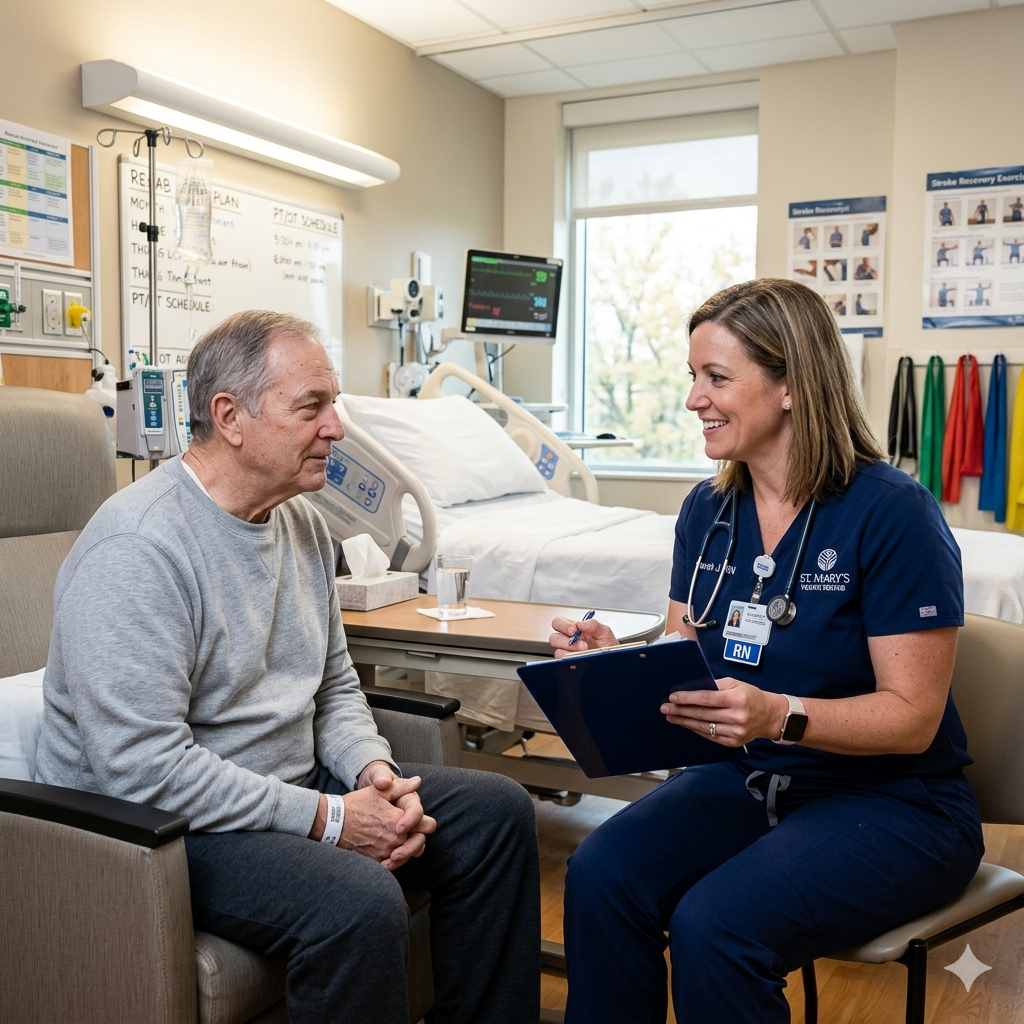
Stroke is one of the most life-altering neurological events a patient can experience, affecting motor function, cognition, speech, and emotional regulation. Yet one dimension of recovery is consistently overlooked in clinical practice: sexual health. Registered nurses and nursing students preparing for the NCLEX must understand that sexuality is a core component of human wellbeing — and that stroke survivors have a right to discuss it, explore it, and receive education around it. Sexual health after stroke nursing care demands both clinical knowledge and therapeutic communication skills to address this sensitive topic with competence and compassion.
Why Sexual Health After Stroke Matters in Nursing Practice
The World Health Organization defines sexual health as a state of physical, emotional, mental, and social wellbeing in relation to sexuality — not merely the absence of dysfunction. For stroke survivors, this dimension of recovery is rarely addressed during inpatient care or outpatient rehabilitation, despite research indicating that 50–75% of stroke survivors experience some form of sexual dysfunction.
As an RN nurse, understanding why this topic is neglected — and how to bridge that gap — is essential. Common barriers include:
- Nurse discomfort discussing sexual topics in clinical settings
- Assumption that elderly or disabled patients are no longer sexually active
- Time constraints during rehabilitation admissions
- Lack of institutional protocols for sexual health assessment
For patients, the silence can be even more damaging than the dysfunction itself. Stroke survivors often report that no healthcare provider ever raised the subject, leaving them to assume their sexual life was over. Nurses are positioned to change this narrative.
Pathophysiology: How Stroke Affects Sexual Function
Understanding the neurological basis of sexual dysfunction helps the nurse provide accurate patient education and tailor interventions appropriately.
Sexual response is governed by a complex interaction between the limbic system, hypothalamus, spinal cord, and peripheral nervous system. A cerebrovascular accident (CVA) can disrupt these pathways depending on lesion location, size, and hemisphere affected.
Common post-stroke sexual changes include:
- Decreased libido — related to depression, fatigue, or hormonal disruption
- Erectile dysfunction (ED) in male patients — reported in up to 64% of male stroke survivors
- Vaginal dryness and reduced arousal in female patients
- Orgasmic dysfunction — difficulty achieving or sustaining orgasm
- Altered sensation — due to sensory deficits from the stroke
- Spasticity or weakness — limiting position or movement during intercourse
- Incontinence fears — urinary or fecal, a major psychological barrier
- Aphasia and communication barriers — impacting intimacy and relational connection
Depression, which affects approximately 33% of stroke survivors, is itself a powerful suppressor of sexual desire — and antidepressant medications commonly prescribed post-stroke (especially SSRIs) may further impair arousal and orgasm.
Nursing Assessment: Asking the Right Questions
A nursing assessment that omits sexual health is incomplete. The registered nurse should integrate sexual health screening into the broader psychosocial and functional assessment. Timing matters — this conversation is typically more appropriate during rehabilitation or discharge planning phases than in the acute stroke unit.
Use a PLISSIT model as a clinical framework:
- P — Permission: Open the conversation by normalizing it. “Many patients who’ve had a stroke have questions about intimacy. Is that something you’d like to discuss?”
- LI — Limited Information: Provide basic facts about how stroke may affect sexual function
- SS — Specific Suggestions: Offer tailored strategies for positioning, energy conservation, and communication with partners
- IT — Intensive Therapy: Refer to sexual health specialists or counselors for complex cases
Key assessment questions include:
- Was the patient sexually active prior to stroke?
- Does the patient have a partner, and are they involved in care?
- Has the patient noticed changes in desire, sensation, or ability since stroke?
- Are there concerns about safety during sexual activity?
- Is the patient experiencing depression, anxiety, or relationship strain?
Document findings using the same clinical precision applied to mobility or swallowing assessments. This reinforces that sexual health is a legitimate domain of nursing care.
💡 NCLEX Tips for Sexual Health After Stroke
- The PLISSIT model is a high-yield framework — expect scenario questions where the nurse must choose the correct therapeutic approach
- Remember that depression is the most common psychological complication of stroke and directly suppresses sexual function
- SSRIs are first-line for post-stroke depression but can impair libido and orgasm — a key pharmacology connection for NCLEX
- Safety during sexual activity is a real nursing concern — teach patients to wait until medically cleared, typically 4–6 weeks post-stroke for stable patients
- Avoid responses that dismiss or redirect the patient’s sexual health concerns — therapeutic communication and patient advocacy are core NCLEX values
Nursing Interventions for Sexual Health After Stroke
Once the assessment is complete, the RN nurse implements individualized interventions based on the patient’s deficits, goals, and values.
1. Patient and Partner Education
Both the patient and their partner should be included in education when the patient consents. Key teaching points include:
- Sexual activity is generally safe for most stroke survivors after medical clearance
- Energy conservation techniques — such as resting before intercourse and avoiding large meals beforehand — reduce cardiac strain
- Modified positioning can accommodate hemiplegia, spasticity, or weakness (e.g., side-lying, use of pillows for support)
- Lubricants can address vaginal dryness in female patients
- Open communication between partners about fears, expectations, and changes is essential
2. Medication Review
A thorough medication reconciliation identifies agents contributing to sexual dysfunction:
| Drug Class | Effect on Sexual Function |
|---|---|
| SSRIs (e.g., sertraline, fluoxetine) | Decreased libido, delayed orgasm |
| Beta-blockers (e.g., metoprolol) | Erectile dysfunction |
| Antihypertensives (e.g., thiazides) | Reduced arousal, ED |
| Antispasmodics (e.g., baclofen) | Sedation, reduced desire |
Collaborate with the medical team to adjust agents where clinically appropriate, balancing stroke prevention with quality of life.
3. Referral to Specialists
Not all sexual health concerns are within the RN nurse’s scope to address fully. Make referrals to:
- Sex therapists or counselors for psychological dysfunction or relationship issues
- Urology for erectile dysfunction management (PDE-5 inhibitors, vacuum devices)
- Gynecology for hormonal therapies or pelvic floor rehabilitation
- Psychology or psychiatry for post-stroke depression
Including sexual health referrals in the discharge plan reflects comprehensive, patient-centered care — a principle heavily tested on NCLEX.
Psychosocial Nursing Considerations
Stroke fundamentally changes how patients see themselves. Body image disturbance, role performance changes, and relationship strain are common nursing diagnoses that intersect with sexual health.
Nursing interventions in this domain include:
- Acknowledging the patient’s feelings without minimizing them
- Encouraging gradual resumption of intimacy at a pace comfortable for both partners
- Addressing fear of recurrent stroke — a common reason patients avoid sexual activity despite medical clearance
- Supporting the partner’s psychological adjustment, as caregivers often experience their own grief, anxiety, and changes in relational identity
This is where the nursing bundle of therapeutic communication skills — active listening, open-ended questioning, reflection, and validation — becomes clinically essential. Students who master these skills demonstrate readiness for NCLEX scenarios involving psychosocial care.
Documentation and Interdisciplinary Communication
Sexual health discussions must be documented in the medical record with the same rigor as any other nursing assessment. Use objective, professional language:
- “Patient verbalized concern regarding sexual function since stroke. Education provided regarding safety, positioning adaptations, and energy conservation. Referral placed to outpatient counseling per patient request.”
During interdisciplinary rounds, advocate for sexual health to be included in the rehabilitation goal-setting process. Physical therapists address mobility, speech therapists address communication — nursing addresses the whole patient, including dimensions of intimate wellbeing.
Conclusion
Sexual health after stroke is a nursing priority that remains underaddressed in clinical practice. As a registered nurse, the ability to open this conversation with clinical confidence, provide evidence-based education, coordinate appropriate referrals, and document findings thoroughly defines excellence in stroke rehabilitation care. Mastering these competencies is equally critical for the NCLEX, which tests the nurse’s commitment to holistic, patient-centered care across all domains of human functioning.
Strengthen your knowledge with stroke-related NCLEX practice questions at rn-nurse.com/nclex-qcm/, and explore the full nursing bundle of medical-surgical courses at rn-nurse.com/nursing-courses/ to build the clinical reasoning skills every RN nurse needs.