
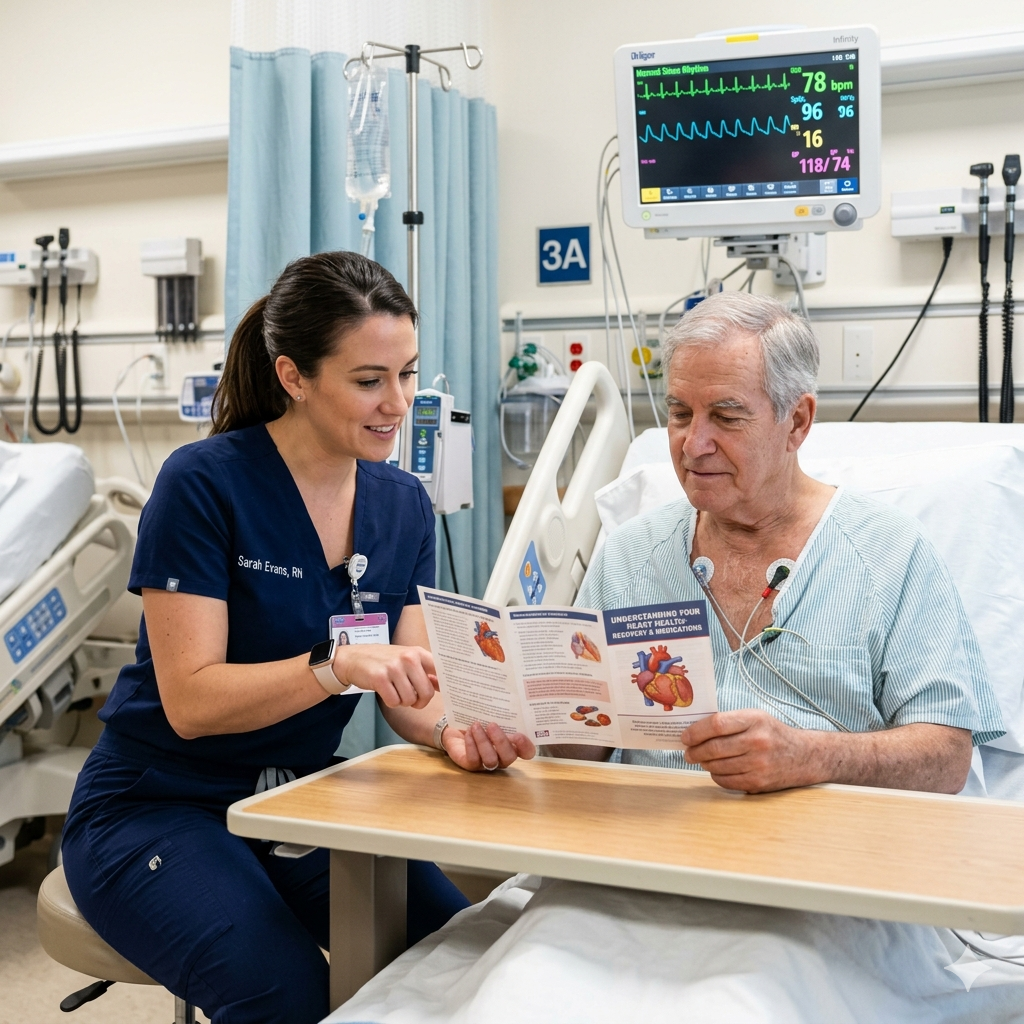
Sexual function after myocardial infarction is one of the most consistently overlooked areas of cardiac rehabilitation — and one of the most anxiety-provoking for patients. Despite its clear relevance to quality of life, the majority of patients discharged after an MI report that no nurse or physician addressed this topic before they left the hospital. For the registered nurse managing cardiac recovery, filling that gap is both a clinical responsibility and an NCLEX-tested priority. Understanding the physiological demands of sexual activity, the psychological barriers patients face, and the evidence-based guidance nurses must deliver transforms a difficult conversation into a critical piece of post-MI care.
The Metabolic Demand of Sexual Activity
A common patient fear after MI is that sexual activity will trigger another cardiac event. Nurses must equip themselves with the evidence to reassure — and appropriately counsel — patients about real risk.
Sexual activity with an established partner carries a metabolic demand of approximately 3–5 METs (metabolic equivalents), comparable to climbing two flights of stairs or walking briskly at 3–4 mph. Most patients who have undergone revascularization or medical management with an uneventful recovery can safely return to this level of exertion within four to six weeks post-MI.
The American Heart Association (AHA) recommends clearance for patients who achieve 3–5 METs without symptoms — chest pain, dyspnea, or ischemic EKG changes. Nurses can communicate this benchmark clearly during discharge education.
Key physiological considerations include:
- Heart rate during sexual activity typically peaks at 120–130 bpm for one to two minutes
- Sexual activity triggers an MI in fewer than 1% of cardiac patients per year
- Physically deconditioned patients and those engaging with a new partner carry higher risk
Nursing Assessment: Identifying High-Risk Patients
Not all post-MI patients carry the same level of sexual risk. A thorough nursing assessment guides the counseling level and determines whether the patient needs a cardiology referral before resuming activity.
The Princeton Consensus classification stratifies patients into three categories:
| Risk Category | Clinical Profile | Nursing Action |
|---|---|---|
| Low Risk | Stable angina, uncomplicated MI >6 weeks ago, mild HF (NYHA Class I) | Counsel and clear for sexual activity |
| Intermediate Risk | Moderate angina, recent MI (2–6 weeks), NYHA Class II HF | Refer for further cardiac evaluation (e.g., stress test) |
| High Risk | Unstable angina, severe HF (NYHA III–IV), uncontrolled arrhythmias | Defer sexual activity; treat cardiac condition first |
As a registered nurse, recognizing where a patient falls in this classification drives appropriate discharge planning. When in doubt, referring the patient to the cardiologist before counseling on resumption is the safe and defensible nursing choice.
Psychosocial Barriers and the Nurse’s Role
Beyond physiology, the psychological burden of resuming sexual activity post-MI is substantial — and the healthcare team frequently underestimates it.
Common patient concerns include:
- Fear of death or re-infarction during sex
- Performance anxiety, particularly in male patients who may develop erectile dysfunction secondary to medications or cardiovascular disease
- Partner anxiety — spouses and significant others often become overprotective, creating relational tension
- Depression — affecting up to 20–30% of post-MI patients and directly driving decreased libido and sexual avoidance
The RN nurse is often the most accessible member of the care team for these conversations. Nurses should normalize the discussion by initiating it — patients rarely bring it up first. A straightforward, non-judgmental approach reassures patients that this is an expected clinical topic, not a taboo one.
Suggested nursing language:
“Many patients wonder when it’s safe to resume sexual activity after a heart attack. I’d like to go over some guidelines with you and answer any questions you might have.”
This framing removes shame, signals clinical authority, and invites open dialogue. Including the partner in education sessions significantly improves outcomes and reduces partner-driven avoidance.
Medications That Affect Sexual Function After MI
Pharmacology plays a critical role in sexual function after myocardial infarction. Several first-line cardiac medications carry sexual side effects that the nursing team must address proactively.
Cardiologists prescribe beta-blockers (e.g., metoprolol, carvedilol) to virtually all post-MI patients. These agents associate with:
- Erectile dysfunction (ED) in male patients
- Decreased libido in both sexes
- Fatigue that indirectly reduces sexual interest
Antidepressants (e.g., SSRIs), which providers frequently initiate post-MI for depression management, can cause anorgasmia and decreased libido.
Nurses commonly encounter Phosphodiesterase-5 (PDE-5) inhibitors — sildenafil (Viagra), tadalafil — as treatments for post-MI erectile dysfunction. Nurses must teach patients a critical drug interaction:
⚠️ PDE-5 inhibitors are absolutely contraindicated with nitrates (e.g., nitroglycerin, isosorbide mononitrate). Concurrent use causes profound, potentially fatal hypotension. Patients on nitrates must not use sildenafil or tadalafil.
This is a high-yield NCLEX pharmacology point. Nurses should verify medication reconciliation carefully and explicitly document patient teaching about this interaction.
Patient Education: What to Teach Before Discharge
Structured discharge education on sexual activity meets the nursing bundle standard for post-MI care. Every patient leaving the hospital after a myocardial infarction should receive verbal and written instruction covering:
- Timing: Most uncomplicated MI patients may resume sexual activity in 4–6 weeks, provided they can climb two flights of stairs without symptoms
- Warning signs to stop immediately: Chest pain, palpitations, severe dyspnea, dizziness, or prolonged fatigue lasting more than 15 minutes after activity — all require immediate medical evaluation
- Positioning: Patients with decreased cardiac reserve may tolerate less physically demanding positions; nurses should discuss this sensitively and without judgment
- Environmental factors: Patients should avoid sexual activity after heavy meals, alcohol consumption, or exposure to extreme temperatures — all of which increase cardiac demand
- Medication review: Confirm the patient’s understanding of the nitrate-PDE5 inhibitor contraindication and document it in the nursing notes
Integrating this education into the nursing bundle at discharge ensures the team does not omit it under time pressure.
Connecting Sexual Health to Cardiac Rehabilitation
Cardiac rehabilitation (CR) carries a Class I recommendation post-MI and directly supports a safe return to sexual activity. Patients who complete CR demonstrate improved exercise capacity, better medication adherence, reduced depression, and measurable improvements in sexual function.
As a registered nurse, advocating for and reinforcing cardiac rehab enrollment is part of comprehensive post-MI care. Nurses should explain to patients that CR’s gradual exercise progression functions as a real-world “test” of cardiovascular readiness — including for sexual activity. Patients who tolerate a supervised treadmill session at 5 METs without symptoms have functionally cleared the threshold.
For nursing students preparing for the NCLEX, connecting cardiac rehabilitation to patient outcomes — functional capacity, mortality reduction, mental health improvement — covers a high-yield content area that appears across multiple question formats.
💡 NCLEX Tips for Sexual Function After MI
- A patient asks when they can resume sexual activity after an MI — the correct nursing response is to assess exercise tolerance (2 flights of stairs without symptoms) before advising 4–6 weeks.
- A patient on isosorbide mononitrate requests sildenafil for ED — the nurse’s priority action is to withhold and notify the provider; this is an absolute contraindication.
- Sexual activity demands approximately 3–5 METs — comparable to moderate exercise; this physiological fact forms the basis for clearance guidelines.
- Partner education is an essential nursing intervention — partner anxiety drives a leading cause of sexual avoidance post-MI.
- Nurses must screen all post-MI patients for depression; untreated depression directly impacts libido and sexual function.
Conclusion
Sexual function after myocardial infarction is a core component of comprehensive cardiac nursing care — not a peripheral concern. The registered nurse who initiates this conversation, accurately assesses risk, teaches medication safety, and connects patients to cardiac rehabilitation delivers whole-person care that directly improves quality of life and long-term cardiac outcomes. For the RN nurse studying for the NCLEX, mastering this content means understanding the intersection of pharmacology, physiology, and therapeutic communication in one high-stakes clinical scenario.
Strengthen your cardiac nursing knowledge with targeted NCLEX practice at rn-nurse.com/nclex-qcm/, or explore the full nursing bundle and cardiology courses at rn-nurse.com/nursing-courses/.