
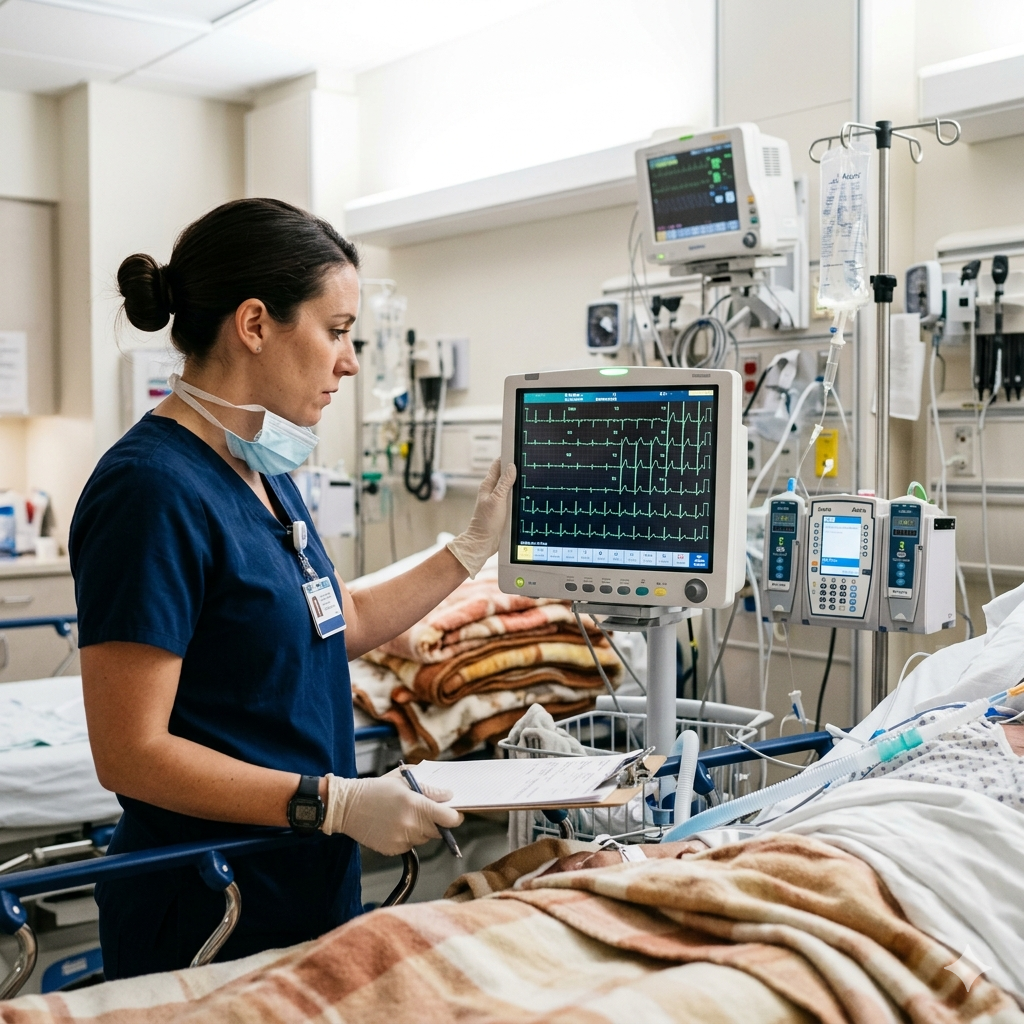
Few EKG findings carry the immediate clinical urgency of Osborn J waves — a hallmark cardiac sign that every registered nurse working in emergency or critical care must recognize without hesitation. These distinctive deflections appear on the electrocardiogram when core body temperature drops dangerously low, signaling that the heart is under profound thermal stress. For nursing students preparing for the NCLEX and RN nurses working in high-acuity settings, understanding Osborn J waves in hypothermia is not merely an academic exercise — it is a potentially life-saving clinical skill. This guide breaks down the pathophysiology, EKG recognition, nursing interventions, and NCLEX-tested priorities to ensure you are fully prepared.
What Are Osborn J Waves?
Osborn J waves — also called J waves, camel-hump sign, or hypothermic deflections — are positive deflections that appear at the J point of the ECG, which is the junction between the end of the QRS complex and the beginning of the ST segment. Named after cardiologist John J. Osborn, who described them in 1953, these waves are pathognomonic for significant hypothermia, though they can occasionally appear in hypercalcemia, Brugada syndrome, and early repolarization syndromes.
Key characteristics on the rhythm strip:
- Location: At the J point, between QRS and ST segment
- Morphology: Dome-shaped or hump-shaped positive deflection
- Leads: Most prominent in leads II, V5, and V6; also visible in lateral leads
- Size correlation: The amplitude of the J wave increases as core temperature decreases — larger waves indicate more severe hypothermia
- Associated findings: Sinus bradycardia, prolonged PR interval, prolonged QRS, prolonged QT interval, and eventually atrial fibrillation or ventricular fibrillation
An RN nurse reviewing a 12-lead EKG in the emergency department must be able to identify this pattern rapidly, as its presence demands immediate escalation of care.
Pathophysiology: Why Hypothermia Causes J Waves
To understand Osborn J waves, the nurse must first appreciate how hypothermia disrupts normal cardiac electrophysiology. The heart’s electrical system is exquisitely temperature-sensitive. As core body temperature falls below 35°C (95°F), ion channel function begins to deteriorate.
Specifically, hypothermia impairs the sodium-potassium ATPase pump and alters calcium and potassium channel kinetics within myocardial cells. This results in a delayed and heterogeneous repolarization across different layers of the myocardium — particularly between the epicardium and endocardium. The transient outward potassium current (Ito) — which is more prominent in the epicardium — is unmasked, creating an electrical voltage gradient at the end of the QRS complex that manifests as the J wave on the surface ECG.
This same heterogeneous repolarization creates an electrically unstable myocardium prone to life-threatening arrhythmias. As temperature continues to fall:
- Below 32°C (89.6°F): Atrial fibrillation becomes common
- Below 30°C (86°F): Risk of ventricular fibrillation increases sharply
- Below 25°C (77°F): Cardiac standstill or asystole may occur
This progression underscores why nursing recognition of J waves must trigger an immediate, structured clinical response.
Temperature Thresholds and EKG Changes: Nursing Quick Reference
Understanding the correlation between temperature and EKG changes equips the registered nurse to anticipate clinical deterioration and prioritize interventions appropriately.
| Core Temperature | Stage | EKG Findings |
|---|---|---|
| 32–35°C (89.6–95°F) | Mild Hypothermia | Sinus bradycardia, early J waves |
| 28–32°C (82.4–89.6°F) | Moderate Hypothermia | Prominent J waves, prolonged intervals, atrial fibrillation |
| < 28°C (82.4°F) | Severe Hypothermia | Large J waves, ventricular fibrillation risk, asystole |
| < 20°C (68°F) | Profound Hypothermia | Cardiac standstill |
This table is a high-yield resource for NCLEX preparation and should be part of every nurse’s critical care nursing bundle review. The guiding principle: as temperature falls, J wave amplitude rises and arrhythmia risk escalates.
Nursing Assessment: Recognizing Hypothermia at the Bedside
Before the EKG even confirms Osborn J waves in hypothermia, the astute nurse begins assessment at the bedside. Clinical presentation of hypothermia varies by severity:
Mild Hypothermia (32–35°C):
- Shivering (the body’s primary thermogenic defense)
- Tachycardia initially, progressing to bradycardia
- Confusion, slurred speech, impaired coordination
- Skin pale, cold, and possibly mottled
Moderate Hypothermia (28–32°C):
- Shivering stops — a dangerous sign of decompensation
- Progressive mental status changes, stupor
- Hypotension, bradycardia
- Muscle rigidity
Severe Hypothermia (< 28°C):
- Unresponsive or unconscious
- Fixed, dilated pupils (do not interpret as brain death — hypothermia mimics death)
- Absent or barely palpable pulses
- Apnea possible
A critical nursing pearl: “No one is dead until they are warm and dead.” Resuscitation must continue until core temperature is restored, as the hypothermic myocardium may be viable despite apparent cardiac arrest.
Priority Nursing Interventions for Hypothermia
Once Osborn J waves are identified and hypothermia is confirmed, nursing interventions must be systematic and rapid. The following priorities guide the RN nurse’s care:
1. Continuous Cardiac Monitoring Attach the patient to a continuous cardiac monitor immediately. Anticipate rhythm deterioration. Ventricular fibrillation in hypothermia may be refractory to defibrillation until core temperature rises above 30°C. Notify the provider and prepare the crash cart.
2. Core Temperature Measurement Oral and tympanic thermometers are unreliable in hypothermia. Use a rectal, esophageal, or bladder temperature probe capable of reading below 35°C. Standard thermometers will not capture profound hypothermia.
3. Passive External Rewarming (Mild Hypothermia)
- Remove wet clothing
- Apply warm blankets
- Warm the environment
- Provide warmed oral fluids if the patient is alert and able to swallow safely
4. Active External Rewarming (Moderate Hypothermia)
- Forced warm air blankets (e.g., Bair Hugger)
- Warm IV fluids: Normal saline warmed to 40–42°C
- Heat packs to axillae, groin, and neck — avoid direct skin application to prevent burns
5. Active Internal/Core Rewarming (Severe Hypothermia)
- Warmed humidified oxygen via ventilator or high-flow mask
- Warmed bladder irrigation
- Warmed pleural or peritoneal lavage in severe cases
- Extracorporeal membrane oxygenation (ECMO) or cardiopulmonary bypass — the gold standard for cardiac arrest due to hypothermia
6. Handle the Patient with Extreme Gentleness Unnecessary movement, jostling, or stimulation of the hypothermic patient can precipitate ventricular fibrillation. All nursing care — repositioning, line placement, transport — must be performed with deliberate care and minimal physical stimulation.
7. Avoid Medications Contraindicated in Hypothermia Many antiarrhythmic drugs are ineffective or harmful in hypothermia. Atropine, amiodarone, and vasopressors have limited efficacy below 30°C. Follow institutional hypothermia protocols and ACLS hypothermia algorithm guidance.
Osborn J Waves and the NCLEX: What Test-Takers Must Know
NCLEX questions on Osborn J waves typically fall within EKG interpretation, critical care prioritization, and emergency nursing scenarios. Nursing students who have not reviewed this topic as part of their nursing bundle may encounter it as an unfamiliar finding on exam day.
💡 NCLEX Tips for Osborn J Waves in Hypothermia
- Recognize the pattern: J waves appear at the J point — between QRS and ST — as a dome-shaped hump. Larger J waves = lower temperature.
- Temperature measurement matters: Always select rectal or esophageal temperature for accurate core temp in hypothermia — never oral or axillary.
- Rewarming sequence: Passive rewarming first for mild cases; active core rewarming for severe cases. Know the difference.
- Arrhythmia priority: V-fib risk rises sharply below 30°C. Continuous monitoring and crash cart readiness are nursing priorities.
- “Warm and dead” principle: Do not terminate resuscitation based on clinical appearance alone — rewarming must occur first.
Conclusion
Osborn J waves in hypothermia represent one of the most clinically significant EKG findings a nurse will encounter in critical care or emergency nursing. These characteristic J-point deflections are not just an academic finding — they are a direct warning that the patient’s myocardium is electrically unstable and at risk for fatal arrhythmias. Every registered nurse and RN nurse must be able to recognize this pattern, correlate it with core temperature data, and initiate a structured, protocol-driven rewarming response.
Mastering Osborn J waves strengthens both NCLEX performance and real-world clinical competency. Reinforce this knowledge with targeted practice questions at rn-nurse.com/nclex-qcm/ and explore our complete critical care nursing bundle at rn-nurse.com/nursing-courses/ to build the assessment and intervention skills that define expert nursing practice.