Introduction
Almost every nursery nurse sees jaundiced newborns. Most cases are harmless, yet a few can progress to brain injury if no one catches them in time. Jaundice affects more than half of term infants, and while most cases are benign, some progress to acute bilirubin encephalopathy or kernicterus. That balance makes nursing assessment so important. This guide covers the 2022 AAP updates, assessment skills, phototherapy care, and the teaching that keeps families safe after discharge. nih
Table of Contents
- What Is Neonatal Jaundice?
- Physiologic vs. Pathologic Jaundice
- Risk Factors
- Assessing for Jaundice
- The AAP 2022 Guideline
- Phototherapy
- Nursing Care During Phototherapy
- Escalation of Care
- Feeding and Hydration
- Complications
- Discharge Teaching
- NCLEX Tips and Memory Tricks
- Clinical Pearls
- Key Takeaways
- FAQs
- References
What Is Neonatal Jaundice?
Jaundice means yellow discoloration of the skin and sclera. Bilirubin causes it. Newborns make more bilirubin because they have more red blood cells that break down quickly. At the same time, their immature liver clears bilirubin slowly. As a result, bilirubin builds up in the blood and then deposits in the skin. Bilirubin can also cross the blood-brain barrier at high levels and injure the brain, which is why monitoring matters.
Physiologic vs. Pathologic Jaundice
| Feature | Physiologic | Pathologic |
|---|---|---|
| Onset | After 24 hours, usually day 2–3 | Within the first 24 hours |
| Peak | Around day 3–5, then falls | Rises quickly or stays high |
| Duration | Resolves within about 1–2 weeks | Persists beyond 2 weeks in term infants |
| Cause | Normal newborn bilirubin handling | Hemolysis, infection, liver or biliary disease, other illness |
| Concern | Low | High; needs prompt evaluation |
Also, consider two feeding-related patterns. Breastfeeding jaundice happens in the first week when intake is low and the baby loses more weight. Breast milk jaundice appears later, usually after the first week, in a thriving baby, and it’s generally benign. Nurses should never advise stopping breastfeeding without provider guidance.
Risk Factors
Watch closely when a baby has any of these:
- Gestational age under 40 weeks, jaundice in the first 24 hours, hemolysis from any cause, or a rapid rise in bilirubin chop
- A discharge bilirubin value close to the phototherapy threshold chop
- ABO or Rh incompatibility, or a positive direct Coombs test
- A sibling who needed phototherapy
- G6PD deficiency
- Cephalohematoma or significant bruising
- Poor feeding or excessive weight loss
- East Asian ancestry, which the 2022 guideline lists as a risk factor
- Prematurity, which also lowers the treatment threshold
Assessing for Jaundice
Nurses should visually assess every infant for jaundice at least every 12 hours after delivery until discharge. Use these tips: medscape
- Examine the baby in good natural light when possible
- Press gently on the skin to see the underlying color
- Note the pattern. Jaundice typically spreads from head to toe
- Check the sclera and the gums as well, because skin color can be harder to judge in darker skin tones
- Don’t rely on visual estimates to judge the level of bilirubin. Measure instead
The AAP reconfirmed universal bilirubin screening for newborns at 35 weeks or older. Clinicians use transcutaneous bilirubin (TcB) as a noninvasive screen and total serum bilirubin (TSB) to confirm. TSB is the definitive test for guiding phototherapy and escalation of care, including exchange transfusion. Most hospitals measure TcB or TSB 24 to 48 hours after birth, or before discharge. aafpmedscape
The AAP 2022 Guideline
The 2022 update changed practice in important ways:
- It provides hour-specific phototherapy thresholds based on gestational age and the presence of neurotoxicity risk factors, and infants with younger gestational age or risk factors have lower thresholds. aafp
- The thresholds rose modestly compared with 2004, because evidence shows neurotoxicity occurs at much higher bilirubin levels than previously assumed. aafp
- In one study, adopting the 2022 thresholds cut phototherapy use by more than half without compromising safety. nih
- It added an “escalation of care” concept for infants whose bilirubin approaches the exchange transfusion threshold. 2minutemedicine
Importantly, always use your facility’s current nomogram or app, since thresholds depend on age in hours.
Phototherapy
Phototherapy uses light, usually blue-green, to change bilirubin into forms the baby can excrete. It treats high bilirubin before it reaches dangerous levels. Teams can deliver it with overhead lights, LED units, or fiberoptic blankets, and sometimes at home for lower-risk infants. For home phototherapy, clinicians measure TSB daily, and they admit the baby if bilirubin rises, if the gap to the threshold narrows, or if TSB reaches at least 1 mg/dL above the threshold. medscape
Nursing Care During Phototherapy
- Expose as much skin as possible. Keep the baby in a diaper only, and make sure the light is positioned per the manufacturer’s directions
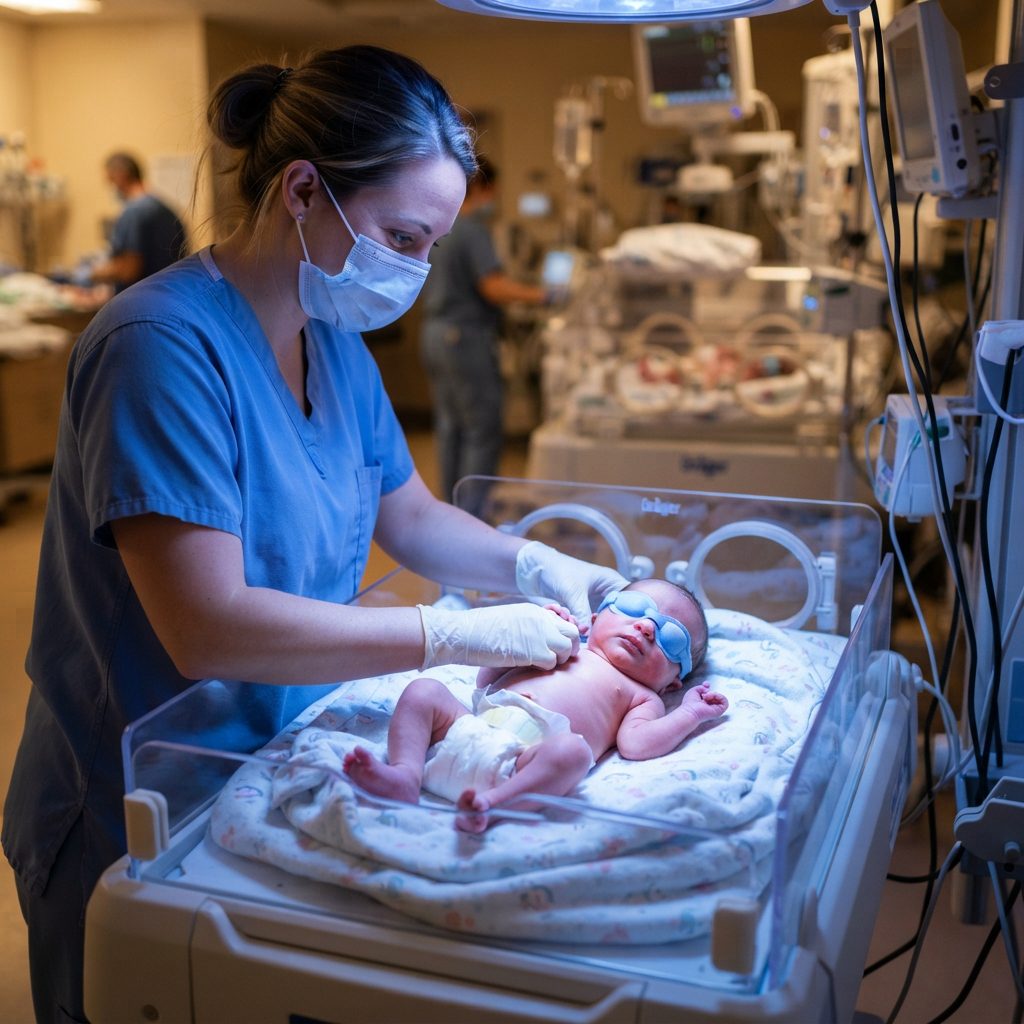
- Protect the eyes. Use properly fitted eye shields, and make sure they don’t cover the nose or cause pressure. Remove them during feeding and parent bonding, per policy
- Reposition regularly, typically every 2 to 3 hours, so all skin surfaces receive light
- Monitor temperature often, since phototherapy can cause overheating or chilling
- Support hydration: offer frequent feeds, usually 8 to 12 times a day, and follow the provider’s plan for supplementation
- Track intake and output: count wet diapers and stools. Loose, green stools are common and expected
- Weigh the baby per protocol
- Care for the skin: avoid lotions and oils, which can burn under the lights, and watch for rashes
- Check the eyes for irritation or discharge
- Support the parents: explain the treatment, encourage holding and feeding during breaks, and answer questions
- Monitor bilirubin on schedule, and document results and phototherapy hours
Clinicians base repeat bilirubin checks after phototherapy on the risk of rebound hyperbilirubinemia, and they may use TcB instead of TSB once at least 24 hours have passed since stopping. Many teams stop phototherapy when bilirubin falls at least 2 mg/dL below the threshold at which it started, but your facility policy and the provider decide. medscape
Escalation of Care
Some infants need urgent action. When bilirubin approaches within 2 mg/dL of the exchange transfusion threshold, guidelines call for intensive phototherapy and IV hydration, and they recommend transfer to a neonatal intensive care unit. Teams obtain STAT total and direct bilirubin, CBC, albumin, chemistries, and a type and crossmatch, and they measure TSB at least every 2 hours until escalation ends. 2minutemedicinemedscape
Exchange transfusion is rare, but it can prevent brain injury when other treatments aren’t enough.
Warning signs of acute bilirubin encephalopathy (report immediately):
- Lethargy or difficulty waking
- Poor feeding or poor suck
- High-pitched cry
- Low or high muscle tone, including arching of the neck and back
- Fever
- Seizures
Feeding and Hydration
Feeding helps the baby pass bilirubin through stool. Therefore:
- Encourage breastfeeding on cue, and at least 8 to 12 times in 24 hours
- Observe a feed, and look for a good latch and swallowing
- Refer to lactation support early
- Follow provider orders about supplementation, and avoid water or sugar water, which don’t help
- Teach parents to count wet and dirty diapers
- Reassure families that continuing to breastfeed is usually safe and helpful
Complications
- Acute bilirubin encephalopathy
- Kernicterus, with chronic brain injury, hearing loss, movement disorders, and developmental problems
- Dehydration and excessive weight loss
- Hypothermia or hyperthermia during phototherapy
- Skin rash and loose stools from phototherapy
- Parent anxiety and disrupted feeding
- Readmission after discharge
- “Bronze baby syndrome,” a rare complication in infants with high direct bilirubin
Discharge Teaching
- Explain what jaundice is and how long it may last
- Teach parents to look at the baby’s skin and eyes in daylight every day
- Reinforce feeding goals and diaper counts
- Review warning signs: deepening yellow color, poor feeding, sleepiness, fewer wet diapers, pale stools, dark urine, or fever
- Schedule follow-up per the baby’s risk level, often within 24 to 72 hours of discharge
- Explain that persistent jaundice beyond 2 weeks needs a visit with direct bilirubin testing, since liver or bile duct disease can be missed
- Provide contact numbers and a clear plan for urgent concerns
NCLEX Tips and Memory Tricks
- Jaundice in the first 24 hours is pathologic until proven otherwise.
- Protect the eyes, expose the skin, and increase feeds during phototherapy.
- Don’t apply lotions or oils under phototherapy lights.
- Loose green stools are expected.
- Lethargy, poor feeding, and a high-pitched cry suggest kernicterus.
- Do not stop breastfeeding unless the provider directs it.
- Mnemonic — “LIGHT”: Look for jaundice every 12 hours, Infant eyes protected, Give frequent feeds, Hydration and temperature monitored, Tell the provider about neurologic changes.
Clinical Pearls
- Don’t trust your eyes alone. Visual checks flag risk, but bilirubin numbers guide treatment.
- Check the sclera and gums on infants with darker skin, where skin color is harder to judge.
- Ask about stool and urine color at every follow-up. Pale stools and dark urine point to possible biliary disease.
Key Takeaways
- Most newborn jaundice is physiologic, but pathologic jaundice and severe hyperbilirubinemia need fast action.
- The AAP 2022 guideline supports universal screening, hour-specific thresholds, and escalation of care.
- Nurses assess every 12 hours, protect the eyes during phototherapy, support feeding, and monitor temperature and hydration.
- Warning signs of bilirubin neurotoxicity need immediate escalation, and discharge teaching prevents missed cases.
FAQs
How often should newborns be assessed for jaundice?
At least every 12 hours after delivery until discharge. medscape
What is the difference between physiologic and pathologic jaundice?
Physiologic jaundice appears after 24 hours, peaks around day 3 to 5, and resolves on its own. Pathologic jaundice begins in the first 24 hours, rises quickly, or lasts too long, and it needs evaluation.
What nursing care does a baby on phototherapy need?
Eye protection, maximum skin exposure, regular repositioning, temperature and weight monitoring, frequent feeds, careful skin care, and scheduled bilirubin checks.
What are the warning signs of kernicterus?
Lethargy, poor feeding, a high-pitched cry, abnormal muscle tone or arching, fever, and seizures.
Should mothers keep breastfeeding when the baby has jaundice?
Usually yes. Frequent feeding helps the baby clear bilirubin, and lactation support can improve intake. The provider decides if any supplementation is needed.
References
- American Academy of Pediatrics — Clinical Practice Guideline Revision: Management of Hyperbilirubinemia in the Newborn Infant 35 or More Weeks of Gestation (2022), summarized in Medscape
- American Family Physician (2023) — Neonatal Hyperbilirubinemia: Evaluation and Treatment
- 2 Minute Medicine — Neonatal Hyperbilirubinemia and Navigating the 2022 AAP Guideline Updates
- Cureus — Impact of the 2022 AAP Hyperbilirubinemia Guideline on Phototherapy Utilization: A Single-Center Pre-Post Study
- Children’s Hospital of Philadelphia — Neonates With Hyperbilirubinemia/Jaundice Clinical Pathway