
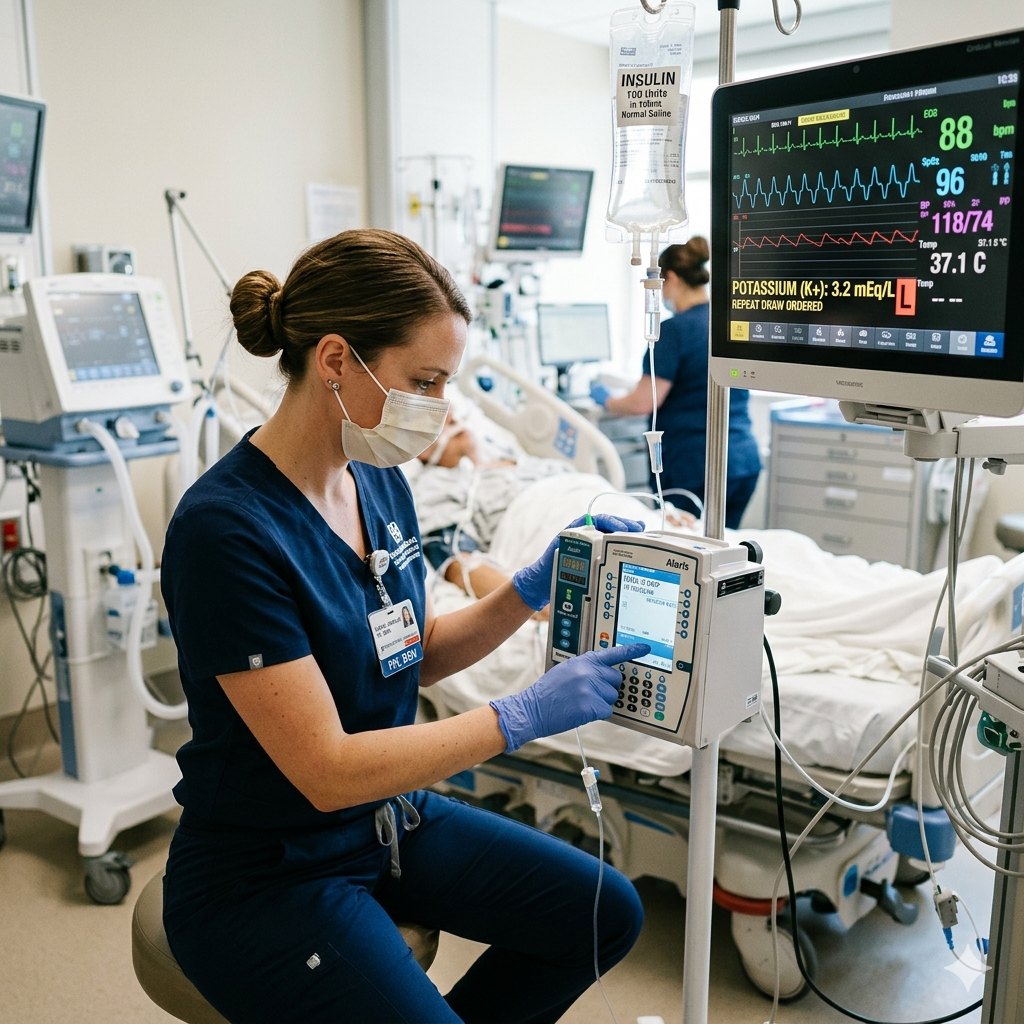
Potassium dysregulation is a life-threatening emergency that demands rapid, precise nursing action. In the ICU, hyperkalemia — a serum potassium level above 5.0 mEq/L — can trigger fatal cardiac arrhythmias within minutes. As a result, one of the most effective short-term interventions a registered nurse will administer in critical care is the insulin-glucose infusion, often called a GIK protocol (Glucose-Insulin-Potassium). Therefore, mastering the mechanism, monitoring parameters, and nursing interventions surrounding this therapy is essential for safe practice — and a high-yield topic for the NCLEX. Above all, every RN nurse working in critical care must understand why potassium spikes, how insulin drives it back into cells, and what to watch for at the bedside.
Why Potassium Rises: ICU Causes of Hyperkalemia
Before administering any intervention, the nurse must understand why the patient’s potassium is elevated. In the ICU, hyperkalemia rarely occurs in isolation — it is almost always the result of a compounding clinical picture.
Common ICU causes of hyperkalemia include:
- Acute kidney injury (AKI) or end-stage renal disease — impaired renal excretion is the leading cause
- Metabolic acidosis — as hydrogen ions move intracellularly, potassium is pushed extracellularly
- Rhabdomyolysis — massive cellular breakdown releases intracellular potassium
- Blood transfusions — stored packed red blood cells release potassium during storage
- Medication-induced — ACE inhibitors, ARBs, potassium-sparing diuretics, NSAIDs, and succinylcholine
- Burns, crush injuries, and tumor lysis syndrome — all involve large-scale cellular destruction
Understanding the root cause shapes the nursing plan. Although insulin-glucose therapy temporizes the crisis, it does not eliminate total body potassium. Therefore, identifying and addressing the underlying source remains a priority nursing action.
Mechanism of Action: How Insulin Shifts Potassium
Insulin’s ability to lower serum potassium has nothing to do with its glucose-lowering action — it is a separate, direct cellular effect. Specifically, when regular insulin is administered, it activates Na⁺/K⁺-ATPase pumps on cell membranes, particularly in muscle and liver cells. Consequently, this pump drives potassium from the extracellular space into the intracellular space, temporarily reducing serum levels.
The effect is rapid — onset occurs within 15–30 minutes, with peak effect at 30–60 minutes — and the duration lasts approximately 4–6 hours. For this reason, insulin-glucose therapy is the most reliable and fast-acting method for shifting potassium in an emergency, ahead of sodium bicarbonate or beta-2 agonists.
Why glucose is co-administered: Regular insulin lowers blood glucose as a side effect. Accordingly, in patients who are not already hyperglycemic (blood glucose >250 mg/dL), 50% dextrose (D50W) is given simultaneously to prevent hypoglycemia. However, in hyperglycemic patients, insulin is administered alone, since the existing elevated glucose provides sufficient protection.
A standard ICU protocol may read:
- 10 units of regular insulin IV + 25–50 g of dextrose IV (if glucose <250 mg/dL)
- Expected potassium reduction: 0.5–1.5 mEq/L
This is temporary redistribution, not elimination — therefore, the RN nurse must always pair this with a definitive treatment such as sodium polystyrene sulfonate, patiromer, or renal replacement therapy.
Insulin-Glucose Potassium ICU Nursing: Preparation and Administration
Safe administration of insulin-glucose therapy begins before the infusion is ever hung. First, the nurse must verify orders, confirm baseline values, and prepare the patient. Indeed, this is a core competency in any nursing bundle for critical care electrolyte management.
Pre-administration nursing checklist:
- Confirm serum potassium level (>5.5 mEq/L typically warrants treatment; >6.0 mEq/L is a critical value)
- Obtain a 12-lead EKG — cardiac changes are the primary indicator of severity
- Check blood glucose — document and report if <60 mg/dL or >300 mg/dL
- Verify IV access — a peripheral or central line must be patent
- Confirm the order includes both insulin and dextrose (unless glucose is >250 mg/dL)
- Perform independent double-check with a second RN nurse per institutional policy (insulin is a high-alert medication)
Administration:
- Administer regular insulin IV push over 5 minutes, followed by the dextrose bolus, OR as a concurrent infusion depending on protocol
- Label all lines and document time of administration clearly
- Continuous cardiac monitoring is mandatory throughout
EKG Changes in Hyperkalemia: What Every ICU Nurse Must Know
The EKG is the most critical real-time tool for assessing the severity of hyperkalemia. As a result, the registered nurse must be able to recognize progressive cardiac changes and escalate immediately.
EKG progression with rising potassium:
| Serum K⁺ Level | EKG Finding |
|---|---|
| 5.5–6.0 mEq/L | Peaked (tall, narrow) T waves — earliest sign |
| 6.0–6.5 mEq/L | Prolonged PR interval, widened QRS |
| 6.5–7.0 mEq/L | Flattened or absent P waves |
| >7.0 mEq/L | Sine wave pattern, ventricular fibrillation, asystole |
When any progression beyond peaked T waves is identified, the nurse must notify the provider immediately and anticipate calcium gluconate or calcium chloride administration — these agents stabilize the cardiac membrane within 1–3 minutes and are the first-line intervention when EKG changes are present. Importantly, calcium does not lower potassium; rather, it protects the heart while insulin-glucose therapy takes effect.
Post-Administration Monitoring: Preventing Hypoglycemia
The most dangerous nursing complication following insulin-glucose therapy is hypoglycemia. Consequently, glucose levels must be checked at regular intervals after administration.
Monitoring protocol (registered nurse responsibilities):
- Check blood glucose at 0, 30, 60, and 120 minutes post-administration
- Recheck serum potassium at 60–120 minutes to assess efficacy
- Monitor for hypoglycemia symptoms: diaphoresis, tachycardia, altered mental status, tremors
- Keep D50W at the bedside and ready for rapid treatment if glucose drops below 60 mg/dL
- Maintain continuous cardiac monitoring for a minimum of 2 hours
ICU patients are particularly vulnerable to hypoglycemia because many are sedated or unable to communicate symptoms. As a result, the RN nurse must rely entirely on objective monitoring. Moreover, anticipating this complication — and being positioned to treat it — is what separates safe critical care nursing from reactive care.
💡 NCLEX Tips for Insulin-Glucose Potassium ICU Nursing
- Peaked T waves are the earliest EKG sign of hyperkalemia — know this cold for NCLEX
- Insulin shifts potassium into cells — it does NOT eliminate it from the body
- Calcium gluconate/chloride stabilizes cardiac membranes but does NOT lower potassium levels
- Always give dextrose with insulin unless the patient is hyperglycemic (glucose >250 mg/dL)
- After GIK therapy, monitor blood glucose at 30-minute intervals — hypoglycemia is the top nursing complication
- For NCLEX priority questions: if the patient has EKG changes + hyperkalemia, calcium comes first, then insulin-glucose
Quick Reference: Hyperkalemia Management in the ICU
| Intervention | Mechanism | Onset | Duration | Nursing Note |
|---|---|---|---|---|
| Calcium gluconate/chloride | Membrane stabilization | 1–3 min | 30–60 min | Does NOT lower K⁺; protects heart |
| Regular insulin + D50W | Shifts K⁺ intracellularly | 15–30 min | 4–6 hrs | Monitor glucose q30 min |
| Sodium bicarbonate | Alkalosis shifts K⁺ into cells | 15–30 min | Variable | Used in acidosis |
| Albuterol (nebulized) | Beta-2 activation shifts K⁺ | 30 min | 2–4 hrs | Adjunct, not primary |
| Sodium polystyrene | Eliminates K⁺ via GI tract | Hours | Sustained | Definitive GI removal |
| Furosemide | Renal K⁺ excretion | 30–60 min | Variable | Only if kidneys functional |
| Hemodialysis | Removes K⁺ from body | 1–2 hrs | Immediate | Definitive; used in AKI/ESRD |
SBAR Communication for Hyperkalemia Escalation
Critical care nursing requires precise, confident communication. Therefore, when a potassium value returns as critical or EKG changes are identified, the nurse must use SBAR (Situation-Background-Assessment-Recommendation) to escalate clearly and efficiently.
Sample SBAR:
- Situation: “Mr. Torres in ICU bed 4 has a critical potassium of 6.8 mEq/L.”
- Background: “He has a history of AKI, is anuric, and received two units of PRBCs overnight.”
- Assessment: “His current EKG shows peaked T waves with widening QRS. He is on continuous telemetry.”
- Recommendation: “I am requesting orders for calcium gluconate and insulin-glucose therapy. I have IV access confirmed and D50W at bedside.”
Ultimately, this level of preparation reflects the standard every registered nurse in the ICU should consistently meet.
Conclusion
Insulin-glucose potassium ICU nursing is one of the most high-stakes interventions in critical care — demanding accurate assessment, precise administration, and vigilant post-treatment monitoring. Specifically, the RN nurse must understand the mechanism behind potassium shifting, recognize EKG changes before they become fatal, and protect against hypoglycemia after treatment. Furthermore, these concepts appear frequently on the NCLEX and directly reflect real-world practice in any ICU setting.
To build critical care confidence with structured study tools, explore the RN-Nurse.com NCLEX question bank to practice high-yield electrolyte and ICU scenarios. Additionally, review the complete nursing bundle for critical care content designed to take you from student to confident registered nurse.