
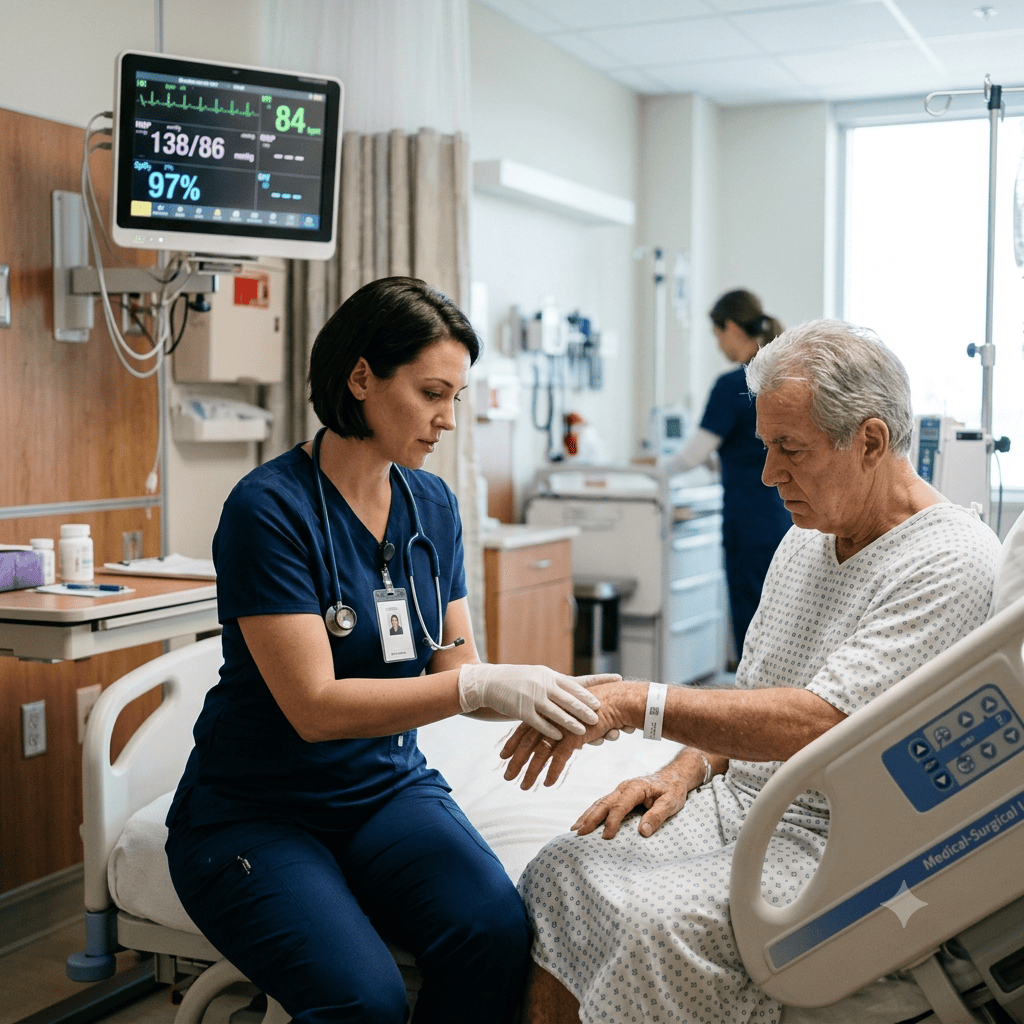
A patient in alcohol withdrawal can change dramatically within a single shift. Someone who looks a little shaky and anxious at 8 a.m. can be seizing, hallucinating, or dangerously disoriented by early afternoon. Nurses are the ones at the bedside catching that shift in real time, and the CIWA-Ar is the tool that turns a subjective gut feeling into an objective, trackable number.
This guide breaks down what the CIWA-Ar measures, how to score it correctly, and how to translate that score into safe, evidence-based nursing care — from the first tremor through the risk of delirium tremens.
Table of Contents
- What Is the CIWA-Ar?
- Causes and Risk Factors for Alcohol Withdrawal
- Pathophysiology
- Signs and Symptoms
- The 10 CIWA-Ar Assessment Items
- Scoring and Severity Ranges
- Diagnosis and Laboratory Workup
- Medical Treatment and Pharmacology
- Nursing Assessment
- Nursing Interventions
- Patient Education
- Complications
- Prevention
- Prognosis
- NCLEX Tips
- Memory Tricks
- Clinical Pearls
- Key Takeaways
- FAQs
- References
What Is the CIWA-Ar?
The Clinical Institute Withdrawal Assessment for Alcohol, Revised (CIWA-Ar), is a ten-item bedside tool nurses use to measure how severe a patient’s alcohol withdrawal is at any given moment. It was refined from earlier work by addiction researchers in the late 1980s and has since become the standard withdrawal-scoring instrument used across hospitals, detox units, and emergency departments. It’s free to use, publicly available, and quick to administer — most nurses can complete a full assessment in under five minutes once they know the tool.
Nine of the ten items are scored on a 0-to-7 scale using a mix of patient-reported symptoms and nurse observation. The tenth item, orientation and clouding of sensorium, is scored 0 to 4. Add them together and you get a total that reflects how much physiologic and neurologic stress the patient’s nervous system is under.
What makes the CIWA-Ar clinically powerful isn’t just the number — it’s what that number lets you do. Instead of medicating patients on a fixed schedule regardless of how they’re actually doing, hospitals can use symptom-triggered therapy: give benzodiazepines based on the patient’s real, measured symptom burden. Studies comparing the two approaches have found that symptom-triggered dosing guided by CIWA-Ar scoring tends to use less total medication and gets patients through withdrawal faster than scheduled dosing alone.
Causes and Risk Factors
Alcohol withdrawal syndrome shows up when someone who drinks heavily and consistently suddenly cuts back or stops. On admission, watch for these risk factors:
- Daily or near-daily heavy drinking over a long period
- A history of prior withdrawal seizures or delirium tremens
- Multiple past detoxifications, which sensitizes the brain to more severe withdrawal each time
- Concurrent use of benzodiazepines or other sedatives
- Poor nutritional status
- Older age, especially combined with liver disease
- A recent hospitalization or surgery that unexpectedly interrupted drinking
- Co-occurring psychiatric illness or use of multiple substances
Pathophysiology
Alcohol enhances the brain’s main inhibitory system (GABA) and suppresses its main excitatory system (glutamate, via NMDA receptors). With chronic exposure, the brain adapts — it dials down GABA sensitivity and ramps up NMDA activity just to maintain a normal baseline. Take the alcohol away suddenly, and that adaptation is left unopposed: inhibition drops, excitation spikes, and the nervous system tips into a hyperexcitable state. That’s the biological engine behind tremor, anxiety, sweating, and, at the extreme end, seizures and delirium.
Signs and Symptoms
Withdrawal tends to follow a rough timeline, though it varies from patient to patient:
- 6 to 12 hours after the last drink: tremor, anxiety, nausea, headache, sweating, trouble sleeping
- 12 to 24 hours: possible alcoholic hallucinosis — visual, auditory, or tactile hallucinations while the patient stays oriented
- 24 to 48 hours: the highest-risk window for generalized tonic-clonic seizures
- 48 to 96 hours: peak risk for delirium tremens, marked by severe confusion, agitation, major autonomic instability, and hallucinations combined with disorientation
The 10 CIWA-Ar Assessment Items
- Nausea and vomiting (0–7) — Ask the patient if they feel sick to their stomach or have vomited.
- Tremor (0–7) — Have the patient extend their arms and spread their fingers; observe for fine to severe shaking.
- Paroxysmal sweats (0–7) — Observe for anything from barely visible perspiration to drenching sweats.
- Anxiety (0–7) — Ask if the patient feels nervous; observe for anything from mild unease to acute panic.
- Agitation (0–7) — Observe behavior, ranging from restlessness to constant pacing or thrashing.
- Tactile disturbances (0–7) — Ask about itching, pins-and-needles, burning, or numbness, and rate any hallucinations of touch.
- Auditory disturbances (0–7) — Ask about sound sensitivity or hearing things that aren’t there.
- Visual disturbances (0–7) — Ask about light sensitivity or seeing things that aren’t there.
- Headache or head fullness (0–7) — Rate severity only; don’t score dizziness or lightheadedness under this item.
- Orientation and clouding of sensorium (0–4) — Assess the patient’s ability to state the date, their location, and complete simple tasks like serial subtraction.
Scoring and Severity Ranges
Exact cutoffs vary somewhat by facility, but general severity bands look like this:
| Score | Severity | Typical Action |
|---|---|---|
| Below 8–10 | Minimal to mild | Continue routine monitoring; medication usually not needed |
| 10–18 | Moderate | Early treatment is recommended — this is the best window to stop withdrawal from progressing |
| Above 18–20 | Severe | High risk for seizures and delirium tremens; expect frequent dosing and close monitoring |
The maximum possible score is 67. Many facility protocols start medication once the score hits around 8 to 10, and escalate PRN dosing once it climbs to 15 or higher — but always follow your own unit’s specific order set rather than assuming these numbers apply everywhere.
One important caveat: medications like beta-blockers, clonidine, or dexmedetomidine blunt the autonomic symptoms the CIWA-Ar relies on — heart rate, blood pressure, sweating. If a patient is on one of these, their score can look falsely reassuring even as withdrawal is actually worsening underneath. Flag this clearly in your documentation and communicate it during handoff.
Diagnosis and Laboratory Workup
Alcohol withdrawal is diagnosed clinically, based on history and the CIWA-Ar trend, but labs help rule out mimics and catch complications early:
- Blood alcohol level, to correlate symptom timing with the last known drink
- Basic metabolic panel, watching for low potassium, magnesium, or phosphorus
- Liver function tests
- Complete blood count
- Blood glucose, since hypoglycemia can mimic or worsen withdrawal symptoms
- Urine toxicology screen to catch co-ingested substances
- ECG if there’s a cardiac history or significant electrolyte imbalance
Medical Treatment and Pharmacology
Benzodiazepines are first-line because they act on the same GABA receptors as alcohol:
- Long-acting agents (diazepam, chlordiazepoxide) self-taper over time and are often preferred when liver function is normal.
- Shorter-acting agents with fewer active metabolites (lorazepam, oxazepam) are safer choices in patients with significant liver impairment or in older adults.
Adjunct therapies:
- Thiamine, given before or alongside glucose to avoid triggering Wernicke encephalopathy
- Folic acid and a general multivitamin
- IV fluids and repletion of magnesium, potassium, and phosphorus
- Phenobarbital in some protocols for withdrawal that isn’t responding well to benzodiazepines
- Alpha-2 agonists (clonidine, dexmedetomidine) or beta-blockers used as adjuncts for lingering autonomic symptoms — never as standalone therapy, since they don’t prevent seizures or delirium tremens on their own
- Antipsychotics used sparingly, only for breakthrough agitation or hallucinations, because they lower the seizure threshold
Nursing Assessment
Score the CIWA-Ar at intervals set by clinical acuity and facility protocol — commonly every one to four hours — and chart the trend, not just the isolated number. Ongoing assessment should also include:
- Vital signs — heart rate, blood pressure, temperature, respiratory rate, oxygen saturation — checked more frequently during peak withdrawal
- Level of consciousness, orientation, and pupil size
- Watching for prodromal seizure signs: worsening tremor, hyperreflexia, myoclonic jerks
- The hallucination subscales — auditory, visual, and tactile — reassessed at each scoring interval
- Fall risk and skin integrity, especially with heavy sweating and agitation
- Nutritional and hydration status
- Confusion Assessment Method (CAM) findings, charted to track the course of any emerging delirium
Nursing Interventions
- Put seizure and fall precautions in place for every patient on the CIWA-Ar protocol.
- Give symptom-triggered or scheduled benzodiazepines exactly as ordered, and reassess the patient’s response before the next scheduled score.
- Notify the provider if the score keeps climbing despite ordered dosing, if new focal neurologic findings appear, or if hallucinations persist.
- Cut down environmental stimulation — dim the lights, keep the room quiet, reorient the patient frequently — to ease agitation and hallucinations.
- Stay calm, nonjudgmental, and present; withdrawal is frightening and disorienting, and your demeanor matters.
- Track intake and output closely, and correct dehydration or electrolyte problems promptly.
- Give thiamine before or together with any dextrose-containing fluids.
- Loop in psychiatry per facility protocol if hallucinations continue after the autonomic symptoms have settled.
- Reassess pain, sleep, and general comfort — unaddressed discomfort can inflate agitation scores independent of true withdrawal severity.
- Chart the trajectory, not just the single number; a score climbing from 6 to 9 to 14 matters more than any one snapshot.
Patient Education
- Explain why vital signs and CIWA-Ar scores are being checked so often, so the patient understands the frequent check-ins rather than feeling over-monitored.
- Reassure the patient that their symptoms are being actively tracked and that medication is available if things escalate.
- Talk through why thiamine and good nutrition matter for preventing long-term neurologic complications.
- Discuss relapse-prevention resources and outpatient or inpatient treatment options before discharge.
- With the patient’s consent, bring family or support people into discharge planning conversations.
Complications
- Alcohol withdrawal seizures, typically generalized tonic-clonic
- Delirium tremens — severe autonomic instability, profound confusion, and hallucinations, with real mortality risk if it goes untreated
- Wernicke encephalopathy and Korsakoff syndrome from thiamine deficiency
- Aspiration, falls, and injury during agitation or an active seizure
- Dehydration and electrolyte derangement
- Cardiac arrhythmias driven by the autonomic surge
Prevention
- Identify at-risk patients early using a validated screening tool at admission
- Start a CIWA-Ar protocol proactively rather than waiting for symptoms to become obvious
- Supplement thiamine and nutrition before deficiency becomes symptomatic
- Reconcile medications carefully to catch other sedative use that could complicate the withdrawal course
- Keep the care team aligned on withdrawal risk at every handoff
Prognosis
Most patients with mild to moderate withdrawal who get timely, symptom-triggered treatment recover fully within a matter of days. Severe withdrawal involving seizures or delirium tremens carries more risk and often needs closer monitoring, sometimes in an ICU, but outcomes are generally good when it’s caught early and treated aggressively. The longer-term outlook depends heavily on whether the patient engages with alcohol use disorder treatment once the acute episode has resolved.
NCLEX Tips
- Remember that a CIWA-Ar score around 8 to 10 is a common threshold for starting medication in many protocols — but always go with the specific order set given in a question stem rather than a memorized number.
- Benzodiazepines are first-line treatment; antipsychotics are adjuncts only, never monotherapy, because they lower the seizure threshold.
- Give thiamine before or with glucose-containing fluids to avoid precipitating Wernicke encephalopathy — a classic NCLEX sequencing point.
- Disorientation plus hallucinations plus severe autonomic instability points to delirium tremens, a medical emergency.
- If a question mentions a patient taking a beta-blocker or clonidine, remember these can mask autonomic symptoms and make the CIWA-Ar score look falsely reassuring.
Memory Tricks
“TRAP-VAT-HO” for the 10 CIWA-Ar items: Tremor, Restlessness (agitation), Anxiety, Paroxysmal sweats, Visual disturbances, Auditory disturbances, Tactile disturbances, Headache, Orientation — plus nausea and vomiting.
“Thiamine unlocks the door before glucose walks in” — a quick way to remember thiamine goes first, to prevent Wernicke encephalopathy.
Clinical Pearls
- A trend matters more than a single number — a patient climbing from 6 to 9 to 14 needs escalation, even before crossing into the “severe” range.
- Tachycardia and hypertension can be blunted by cardiac or antihypertensive medications, so don’t rely on vital signs alone to rule out worsening withdrawal.
- Alcoholic hallucinosis (hallucinations with intact orientation) is different from delirium tremens (hallucinations with disorientation), and the distinction changes both urgency and treatment.
- Always weigh the CIWA-Ar score against your overall clinical impression — a calm, articulate patient can still be under-scored if subtle symptoms slip past.
Key Takeaways
- The CIWA-Ar is a ten-item, validated bedside tool for objectively scoring alcohol withdrawal severity.
- Nine items are scored 0 to 7; orientation is scored 0 to 4; the maximum total is 67.
- Most protocols trigger medication around a score of 8 to 10, escalating at higher thresholds per facility policy.
- Symptom-triggered therapy guided by CIWA-Ar tends to use less total benzodiazepine and shortens treatment time compared with fixed dosing.
- Frequent reassessment, seizure and fall precautions, thiamine administration, and clear provider communication are the core nursing responsibilities.
FAQs
What is a normal CIWA-Ar score? A score below about 8 to 10 generally reflects minimal to mild withdrawal that doesn’t typically need medication, though monitoring continues per protocol.
What CIWA-Ar score requires medication? Most facility protocols start treatment around a total score of 8 to 10, with many escalating PRN dosing once the score reaches 15 or higher — always confirm the exact threshold in your facility’s order set.
How often should CIWA-Ar be assessed? Frequency is matched to clinical acuity and facility protocol, commonly every one to four hours, with tighter intervals during periods of rising symptoms or peak withdrawal risk.
What are the 10 items on the CIWA-Ar scale? Nausea/vomiting, tremor, paroxysmal sweats, anxiety, agitation, tactile disturbances, auditory disturbances, visual disturbances, headache/head fullness, and orientation/clouding of sensorium.
What is the difference between CIWA and CIWA-Ar? The CIWA-Ar is a shortened, refined version of the original CIWA scale, built to be faster to administer while keeping its validity and reliability between different raters.
How long does alcohol withdrawal last? Acute symptoms usually peak within 24 to 72 hours and resolve over five to seven days, though the exact timeline varies with drinking history and individual physiology.
What is symptom-triggered therapy? An approach where benzodiazepine dosing is based on the patient’s real-time CIWA-Ar score instead of a fixed schedule, individualizing treatment and often reducing total medication exposure.
References
- Sullivan, J.T., Sykora, K., Schneiderman, J., Naranjo, C.A., & Sellers, E.M. (1989). Assessment of alcohol withdrawal: the revised Clinical Institute Withdrawal Assessment for Alcohol scale (CIWA-Ar).
- NursingCenter. Clinical Institute Withdrawal Assessment of Alcohol Scale – Revised (CIWA-Ar) Pocket Card, 2025.
- University of Maryland School of Medicine, Emergency Medicine. CIWA-Ar Assessment Tool.
- Regions Hospital Trauma Program. Alcohol Withdrawal Assessment Scoring Guidelines (CIWA-Ar).
- Wikipedia. Clinical Institute Withdrawal Assessment for Alcohol.
This article is for educational purposes for nursing students and healthcare professionals and does not replace facility-specific protocols or clinical judgment.