Introduction
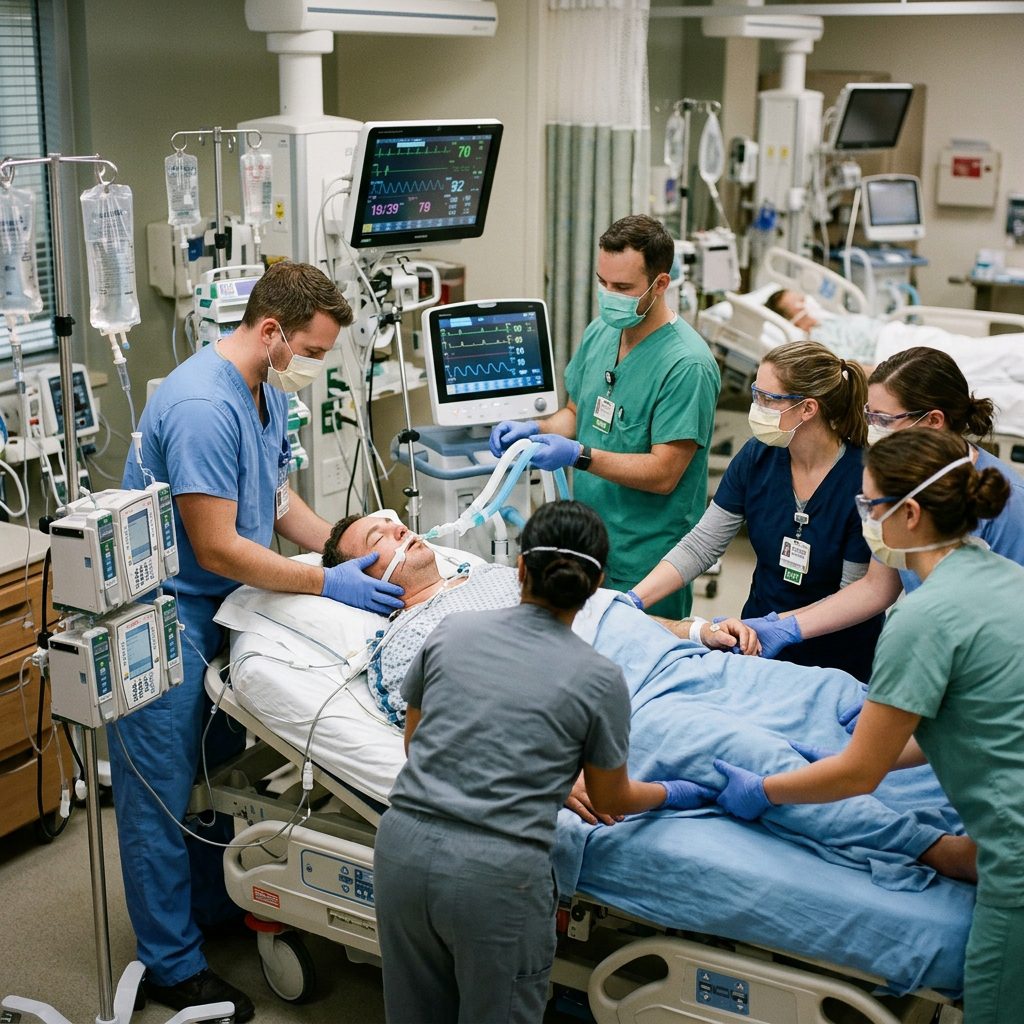
ARDS is one of the most demanding conditions ICU nurses manage. The lungs fill with inflammatory fluid, oxygen levels fall, and the patient depends on a ventilator to survive. Here’s the key point: the ventilator itself can injure the lungs if settings are wrong. As a result, lung-protective ventilation is the cornerstone of care, and nurses watch every number closely. This guide covers the diagnosis, ventilator strategy, proning, and the nursing priorities that improve survival.
Table of Contents
- What Is ARDS?
- Causes and Risk Factors
- Pathophysiology
- Berlin Severity Criteria
- Signs and Symptoms
- Nursing Assessment
- Lung-Protective Ventilation
- Prone Positioning
- Other Therapies
- Nursing Interventions
- Complications
- NCLEX Tips and Memory Tricks
- Clinical Pearls
- Key Takeaways
- FAQs
- References
What Is ARDS?
Acute respiratory distress syndrome (ARDS) is a severe form of acute hypoxemic respiratory failure. Widespread inflammation damages the alveolar-capillary membrane, so fluid leaks into the air sacs. Unlike cardiogenic pulmonary edema, heart failure doesn’t cause it. Instead, ARDS develops within about a week of a known trigger, with bilateral lung opacities on imaging.
Causes and Risk Factors
- Pneumonia, including viral causes
- Sepsis, the most common systemic cause
- Aspiration of gastric contents
- Trauma and major surgery
- Pancreatitis
- Massive transfusion
- Inhalation injury and near-drowning
Pathophysiology
First, the inciting injury triggers an inflammatory surge. Next, capillary leak floods the alveoli with protein-rich fluid. Then, surfactant breaks down, and the alveoli collapse. Finally, the lungs become stiff and heavy, so gas exchange fails. Importantly, the injury is uneven. Healthy lung tissue sits beside collapsed tissue, which is why overdistending the healthy portions causes further damage.
Berlin Severity Criteria
The Berlin definition grades severity by the PaO2/FiO2 ratio, measured with at least 5 cm H2O of PEEP:
| Severity | PaO2/FiO2 |
|---|---|
| Mild | 200–300 |
| Moderate | 100–200 |
| Severe | Below 100 |
A lower ratio means worse oxygenation. Therefore, nurses should know how to calculate it from the ABG and current FiO2.
Signs and Symptoms
- Severe, rapidly worsening dyspnea
- Tachypnea and increased work of breathing
- Hypoxemia that responds poorly to supplemental oxygen
- Crackles on auscultation
- Tachycardia and, in severe cases, cyanosis
- Bilateral infiltrates on chest imaging
Nursing Assessment
- Monitor respiratory rate, effort, breath sounds, and oxygen saturation continuously
- Review ABG results and calculate the PaO2/FiO2 ratio
- Track ventilator parameters: tidal volume, plateau pressure, PEEP, and FiO2
- Assess hemodynamics, since high airway pressures can lower blood pressure
- Check sedation depth and ventilator synchrony
- Watch urine output and fluid balance, because fluid overload worsens lung edema
Lung-Protective Ventilation
Lung-protective ventilation is the best-supported treatment for ARDS. Key targets include:
- Low tidal volume: 4–8 mL/kg of predicted body weight, not actual weight
- Plateau pressure: keep it below 30 cm H2O
- Adequate PEEP: it keeps alveoli open and prevents repeated collapse and reopening
- Permissive hypercapnia: clinicians accept higher CO2 and some acidosis to protect the lungs, because the goal is healing rather than perfect blood gases
Predicted body weight depends on height and sex. As a result, a tall patient gets a larger absolute tidal volume than a short one, even if both weigh the same.
Prone Positioning
Proning improves oxygenation and spreads lung stress more evenly. Guidelines recommend it for moderate to severe ARDS when the PaO2/FiO2 ratio stays below 150. Current recommendations call for prolonged sessions, with the ATS advising more than 12 hours a day and the ESICM advising at least 16 consecutive hours. Clinicians start it early, after a short stabilization period on lung-protective settings.
Nursing priorities for proning:
- Assemble a trained team, because the procedure typically needs five or six people with one leader directing
- Secure the endotracheal tube, lines, and drains before turning
- Protect pressure points, especially the face, chest, knees, and genitals
- Turn the head side to side about every four hours, and reposition the arms
- Provide extra sedation if the patient needs it to tolerate the position
- Stay ready to return the patient supine quickly for cardiac arrest or airway loss
- Monitor for pressure injuries, facial edema, and tube displacement
Other Therapies
- Neuromuscular blockers: the ATS suggests them for early severe ARDS to improve synchrony
- Conservative fluid strategy: once the patient is stable, avoid fluid overload
- VV-ECMO: guidelines conditionally recommend it for severe, refractory hypoxemia
- High-frequency oscillatory ventilation: guidelines advise against routine use
Nursing Interventions
- Verify ventilator settings against orders at every shift and after every change
- Maintain the head of the bed elevated 30 degrees when supine to reduce aspiration
- Perform oral care and follow the ventilator-associated pneumonia bundle
- Suction only when needed, using closed-circuit systems to avoid losing PEEP
- Assess sedation and analgesia often, and aim for the lightest sedation that keeps the patient safe
- Give DVT prophylaxis and stress-ulcer prophylaxis as ordered
- Start early mobility when the patient is stable enough
- Support the family with clear updates, since ARDS often means a long ICU stay
Complications
- Ventilator-induced lung injury and pneumothorax
- Ventilator-associated pneumonia
- Pressure injuries, particularly with proning
- Multi-organ failure
- ICU-acquired weakness and delirium
- Long-term cognitive and physical impairment after survival
- Death, since ARDS still carries high mortality in severe cases
NCLEX Tips and Memory Tricks
- Low tidal volumes protect the lungs. Choose 4–8 mL/kg predicted body weight over higher volumes.
- Remember that plateau pressure should stay below 30 cm H2O.
- Severe ARDS with PaO2/FiO2 below 150 calls for proning.
- Permissive hypercapnia is intentional, so don’t treat the high CO2 reflexively.
- Mnemonic — “LUNGS”: Low tidal volume, Under 30 plateau pressure, Need for PEEP, Get them prone, Sedation and safety monitoring.
Clinical Pearls
- Use predicted body weight, not actual weight, when you check a tidal volume. Many errors come from this simple mix-up.
- A sudden drop in oxygen saturation after turning prone often means a displaced or kinked tube. Check the airway first.
- Don’t chase a normal pH. Accepting a modest acidosis spares the lungs from higher pressures and volumes.
Key Takeaways
- ARDS is acute hypoxemic respiratory failure with bilateral infiltrates, graded by the PaO2/FiO2 ratio.
- Low tidal volumes (4–8 mL/kg PBW) and plateau pressures below 30 cm H2O are the foundation of treatment.
- Prolonged prone positioning improves outcomes in moderate to severe ARDS and depends on skilled team coordination.
- Nursing vigilance prevents complications such as pneumonia, pressure injuries, and tube displacement.
FAQs
What tidal volume is used for ARDS?
Guidelines recommend 4–8 mL/kg of predicted body weight, with plateau pressure kept below 30 cm H2O.
How long should an ARDS patient stay in the prone position?
Guidelines recommend prolonged sessions, with the ATS advising more than 12 hours a day and the ESICM advising at least 16 consecutive hours, for moderate to severe ARDS.
What is the PaO2/FiO2 ratio and why does it matter in ARDS?
It compares arterial oxygen to the oxygen fraction delivered. A lower ratio means worse lung function, and it defines ARDS severity and guides decisions like proning.
Why do clinicians allow high carbon dioxide levels in ARDS?
Permissive hypercapnia protects the lungs by allowing lower tidal volumes and pressures, even though it causes some acidosis.
What are the nursing priorities when proning a patient?
Use a trained team, secure all tubes and lines, protect pressure points, rotate the head regularly, manage sedation, and stay ready to return the patient supine in an emergency.
References
- Critical Care Science (2025) — Application of New ARDS Guidelines at the Bedside
- Medscape — Acute Respiratory Distress Syndrome Guidelines Summary (ATS and ESICM)
- Intensive Care Medicine (2026) — Prone Positioning in ARDS
- NursingCenter (Wolters Kluwer) — Proning Therapy for Patients with ARDS (2025)
- Nursing CE Central — Prone Position in ARDS
RELATED ARTICLES: