
Introduction
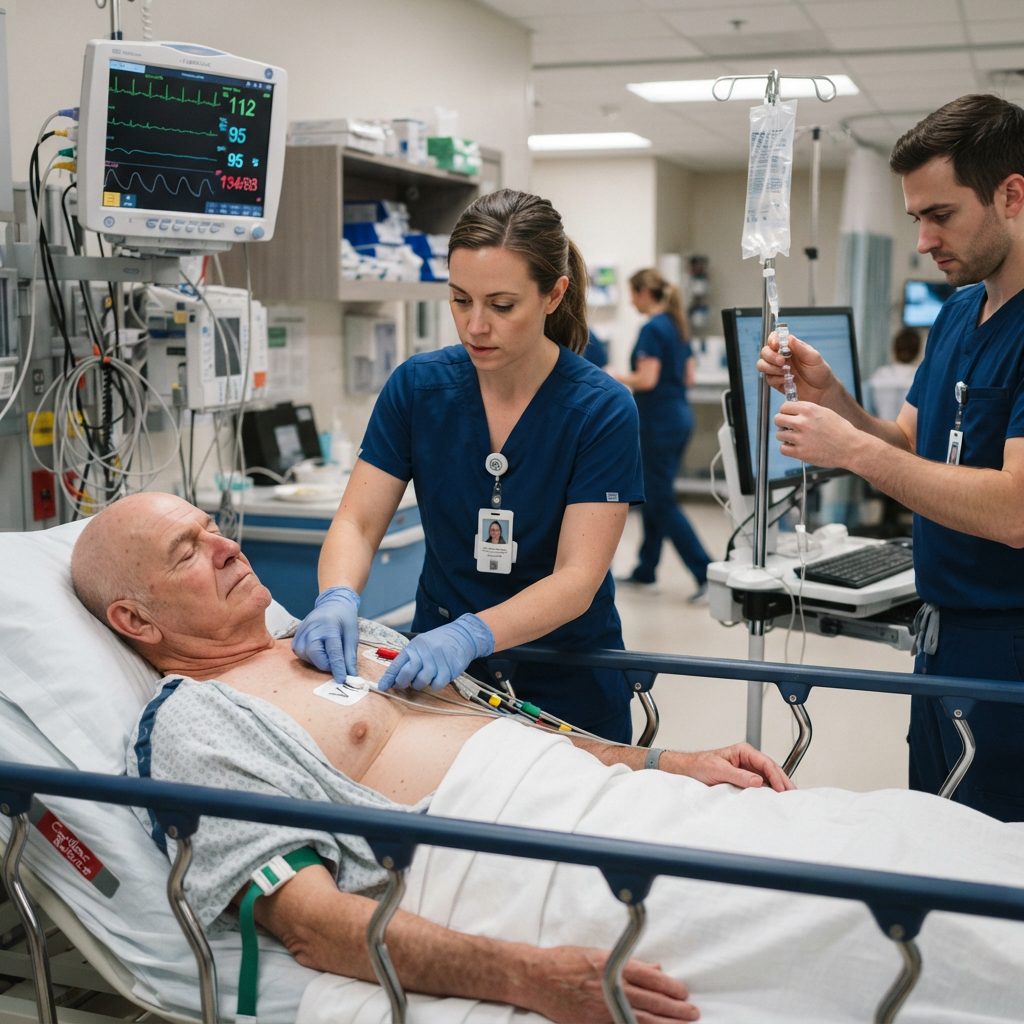
A heart attack is one of the clearest examples of “time is muscle.” Every minute of delay can mean more damaged heart tissue. Nurses often make the first assessment, place the first ECG leads, and give the first medications. As a result, your actions shape outcomes. This guide covers the 2025 guideline updates, the key assessment skills, the care that follows reperfusion, and the teaching that protects patients after discharge.
Table of Contents
- What Is Acute Myocardial Infarction?
- Types of Acute Coronary Syndrome
- Signs and Symptoms
- Atypical Presentations
- Initial Nursing Assessment
- ECG and Diagnostic Testing
- Emergency Management
- Medications
- Reperfusion and Post-PCI Care
- Complications
- Nursing Interventions Throughout the Stay
- Discharge Teaching
- NCLEX Tips and Memory Tricks
- Clinical Pearls
- Key Takeaways
- FAQs
- References
What Is Acute Myocardial Infarction?
Myocardial infarction (MI) means heart muscle dies because blood flow stops. A blood clot on a ruptured plaque in a coronary artery usually causes it. Without oxygen, muscle cells begin to die within minutes. Therefore, fast restoration of blood flow limits damage and saves lives.
Types of Acute Coronary Syndrome
MI belongs to a group of conditions called acute coronary syndromes (ACS). ACS covers a spectrum that includes unstable angina, NSTEMI, and STEMI. nih
| Type | ECG | Troponin | Urgency |
|---|---|---|---|
| Unstable angina | May be normal or show ST depression or T-wave changes | Not elevated | High |
| NSTEMI | ST depression, T-wave inversion, or non-specific changes | Elevated | High; invasive strategy based on risk |
| STEMI | ST-segment elevation (or equivalent) | Elevated, though treatment doesn’t wait | Immediate reperfusion |
Patients with STEMI need immediate angiography and PCI, or thrombolysis if timely PCI isn’t feasible. nih
Signs and Symptoms
- Chest pressure, tightness, or heaviness, often lasting more than a few minutes
- Pain spreading to the left arm, jaw, neck, back, or shoulders
- Shortness of breath
- Cold sweat and pallor
- Nausea or vomiting
- Lightheadedness or syncope
- Sense of impending doom or anxiety
- Pain not relieved by rest or nitroglycerin
Atypical Presentations
Not every MI looks like the movie version. Women, older adults, and patients with diabetes often show subtler signs, such as:
- Unusual fatigue
- Shortness of breath without chest pain
- Nausea, indigestion, or upper abdominal discomfort
- Jaw, neck, or back pain
- Confusion or weakness in older adults
So keep a low threshold for an ECG. Don’t dismiss symptoms because they “don’t sound cardiac.”
Initial Nursing Assessment
- Check airway, breathing, circulation, and level of consciousness
- Measure vital signs, including blood pressure in both arms if aortic dissection is possible
- Assess pain: onset, location, quality, radiation, severity, and associated symptoms
- Ask about allergies, anticoagulant use, recent drug use, and erectile dysfunction medications
- Place the patient on continuous cardiac monitoring and pulse oximetry
- Start IV access
- Review medical history and risk factors, including hypertension, diabetes, smoking, high cholesterol, and family history
- Listen to the heart and lungs, and note jugular vein distension, edema, and perfusion
ECG and Diagnostic Testing
ECG: The guideline recommends acquiring and interpreting a 12-lead ECG within 10 minutes of first medical contact in suspected ACS. If the first ECG doesn’t show STEMI, clinicians repeat it, especially when suspicion stays high, symptoms persist, or the patient worsens. A nondiagnostic first ECG doesn’t rule out ACS. 2025 ACC/AHA ACS Guideline · Troponin Toolbox +2
Special leads: ST depression in leads V1 to V3 may signal an evolving posterior STEMI, so teams should obtain a posterior lead ECG when needed. A right-sided ECG helps identify right ventricular involvement in inferior MI. jordan-cardiac
Troponin: Clinicians measure cardiac troponin as soon as possible, preferably with a high-sensitivity assay, and repeat it after 1 to 2 hours with high-sensitivity tests or after 3 to 6 hours with conventional tests when the first result isn’t diagnostic. If the ECG shows STEMI, teams proceed to reperfusion without waiting for troponin results. medscapemedscape
Other tests: CBC, electrolytes, creatinine, glucose, lipids, coagulation tests, chest X-ray, and echocardiography.
| Coronary Territory | Leads with Changes | Common Artery |
|---|---|---|
| Inferior | II, III, aVF | Right coronary |
| Anterior | V1–V4 | Left anterior descending |
| Lateral | I, aVL, V5–V6 | Left circumflex |
| Posterior | ST depression V1–V3 (confirm with posterior leads) | RCA or circumflex |
Emergency Management
- Keep the patient at rest, and stay with them
- Give aspirin unless contraindicated. The guideline lists an oral loading dose of 162 to 325 mg, and the patient should chew non-enteric-coated aspirin. bvdkgialai
- Give oxygen only if saturation falls below 90% or the patient is in respiratory distress, according to current guidance
- Give nitroglycerin for ongoing ischemic pain if blood pressure allows, and avoid it with hypotension, suspected right ventricular infarction, or recent use of erectile dysfunction drugs
- Use opioids cautiously for severe pain unrelieved by nitrates, since they can mask symptoms and may affect outcomes
- Prepare for reperfusion: For STEMI within 12 hours, guidelines target first medical contact to device time of 90 minutes or less at a PCI-capable hospital, or 120 minutes or less when transfer is needed. medscape
- If PCI isn’t available in time, prepare for fibrinolytic therapy, and screen for contraindications
Medications
- Antiplatelets: Dual antiplatelet therapy with aspirin plus a P2Y12 inhibitor, with ticagrelor or prasugrel preferred over clopidogrel for most patients, continues for at least 12 months in patients without high bleeding risk. Clinicians avoid prasugrel in patients with a history of stroke or TIA. linksmedicusmedscape
- Bleeding protection: A proton pump inhibitor is recommended for patients at risk of gastrointestinal bleeding. linksmedicus
- Anticoagulants: heparin or alternatives as ordered during PCI or fibrinolysis
- Beta-blockers: commonly started early in stable patients without heart failure, shock, or bradycardia
- High-intensity statin: begin before discharge
- ACE inhibitor or ARB: often for reduced ejection fraction, diabetes, or hypertension
- Other drugs: sublingual or IV nitroglycerin, antiarrhythmics, and diuretics as indicated
Reperfusion and Post-PCI Care
Guidelines recommend complete revascularization in patients with STEMI or NSTE-ACS, with the method chosen based on the complexity of coronary disease and comorbidities. medscape
After PCI, nurses should:
- Monitor vital signs and heart rhythm frequently
- Check the access site (radial or femoral) for bleeding, hematoma, swelling, and pain
- Assess distal pulses, color, temperature, and sensation of the limb
- Follow bed rest and limb positioning orders, especially after femoral access
- Encourage fluids as ordered to flush contrast, and monitor urine output and creatinine for contrast-related kidney injury
- Watch for recurrent chest pain, which may signal stent thrombosis or reocclusion
- Monitor for reperfusion arrhythmias
- Give antiplatelet medications on time, and stress the importance of adherence
Complications
- Ventricular fibrillation and other arrhythmias, especially in the first hours
- Heart failure and pulmonary edema
- Cardiogenic shock
- Right ventricular infarction with hypotension and clear lungs
- Papillary muscle rupture with acute mitral regurgitation
- Ventricular septal rupture
- Free wall rupture and cardiac tamponade
- Pericarditis, including Dressler syndrome later
- Bleeding from antithrombotic therapy
- Contrast-induced kidney injury
- Depression and anxiety
Nursing Interventions Throughout the Stay
- Keep continuous telemetry on, and respond to rhythm changes promptly
- Reassess pain often, and report any new or worsening pain
- Keep emergency equipment, including a defibrillator, readily available
- Monitor blood pressure, heart rate, oxygen saturation, urine output, and mental status
- Report new murmurs, crackles, low blood pressure, or signs of shock immediately
- Schedule rest periods, cluster care, and slowly advance activity
- Provide stool softeners if ordered, so patients avoid straining
- Support emotional needs, since fear and anxiety are common
- Begin teaching early, not only on the day of discharge
- Coordinate with cardiology, pharmacy, nutrition, and cardiac rehabilitation
Discharge Teaching
- Medications: explain each drug, why it matters, and never stop antiplatelets without talking to the cardiologist
- Nitroglycerin: teach correct use, storage, and when to call 911, usually if pain doesn’t ease after the first dose
- Warning signs: chest pain, shortness of breath, fainting, or palpitations require emergency care. Patients should call 911 and shouldn’t drive themselves
- Cardiac rehabilitation: strongly encourage referral and attendance
- Lifestyle: stop smoking, eat a heart-healthy diet, exercise as advised, manage weight, and control blood pressure, cholesterol, and glucose
- Activity: review gradual return to daily activities, work, driving, and sexual activity per provider guidance
- Mood: screen for depression, and offer support
- Follow-up: schedule appointments and lab tests
NCLEX Tips and Memory Tricks
- ECG within 10 minutes of arrival with chest pain.
- Don’t wait for troponin to treat STEMI.
- Aspirin 162–325 mg chewed is the first medication unless contraindicated.
- Oxygen only if saturation is below 90% or the patient is in respiratory distress.
- Avoid nitroglycerin with hypotension, suspected RV infarct, or recent PDE-5 inhibitor use.
- Report ventricular arrhythmias and new murmurs immediately.
- Mnemonic — “HEART”: History and pain assessment, ECG in 10 minutes, Aspirin and antiplatelets, Reperfusion urgently for STEMI, Teaching and secondary prevention.
Clinical Pearls
- A normal first ECG doesn’t rule out MI. Repeat it when symptoms continue or change.
- Ask about erectile dysfunction medicines before giving nitroglycerin. This question can prevent a dangerous drop in blood pressure.
- A new arrhythmia, murmur, or sudden hypotension after MI can signal a mechanical complication. Notify the provider immediately.
- Don’t let a patient leave without hearing, in plain words, why they must take their antiplatelet medicine every day.
Key Takeaways
- Acute MI is a time-critical emergency, and the ECG should happen within 10 minutes of first medical contact.
- STEMI needs immediate reperfusion, while NSTEMI and unstable angina need risk-based care.
- Aspirin, dual antiplatelet therapy, anticoagulation, and statins form the medication foundation.
- After PCI, nurses watch the access site, rhythm, kidney function, and recurrent pain.
- Discharge teaching on medications, rehab, and lifestyle reduces the chance of another event.
FAQs
How quickly should an ECG be done for suspected MI?
The guideline recommends acquiring and interpreting a 12-lead ECG within 10 minutes of first medical contact. troponin
What is the difference between STEMI and NSTEMI?
STEMI shows ST-segment elevation on the ECG and signals a fully blocked artery needing immediate reperfusion. NSTEMI shows other ECG changes with elevated troponin and receives risk-based invasive care.
Why is aspirin given in a heart attack?
Aspirin blocks platelet clumping, which limits clot growth in the coronary artery. The guideline recommends a loading dose of 162 to 325 mg, chewed if non-enteric-coated. bvdkgialai
What nursing care is needed after PCI?
Frequent vital signs and rhythm monitoring, access site and distal pulse checks, hydration and kidney monitoring, observation for recurrent chest pain, and on-time antiplatelet therapy.
What are the atypical symptoms of MI?
Fatigue, shortness of breath, nausea, indigestion, jaw or back pain, and confusion, especially in women, older adults, and patients with diabetes.
References
- 2025 ACC/AHA/ACEP/NAEMSP/SCAI Guideline for the Management of Patients With Acute Coronary Syndromes (Circulation, 2025)
- Medscape — Acute Coronary Syndromes: AHA/ACC 2025 Guideline Summary
- European Society of Cardiology/Clinical Cardiology — What US Cardiology Can Learn From the 2023 ESC Guidelines for ACS
- Troponin.org — 2025 ACC/AHA ACS Guideline Toolbox
- LinksMedicus — 2025 ACC/AHA Guideline for the Management of Patients With ACS
RELATED ARTICLES: