
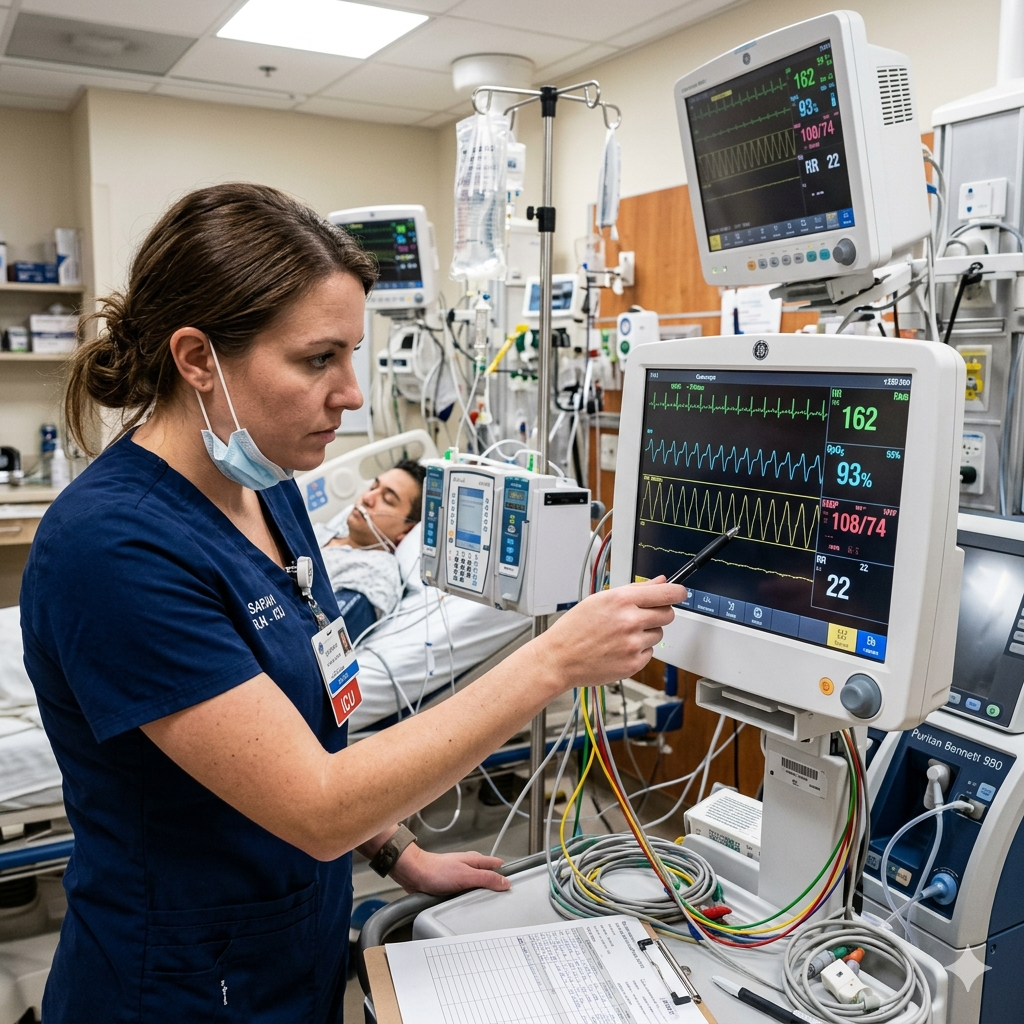
Wide-complex tachycardias are among the most clinically urgent rhythms a registered nurse will encounter. When the monitor alarms and the QRS complex is wide, one of the most critical questions becomes: is this ventricular tachycardia (VT) or something else? Two EKG findings — fusion beats and capture beats — cut through that uncertainty and serve as near-definitive evidence of VT. Every nurse preparing for NCLEX and every RN nurse working in a cardiac or critical care setting must understand these findings, what causes them, and what to do when they appear.
What Is Ventricular Tachycardia and Why It Matters for Nursing
Ventricular tachycardia is a life-threatening dysrhythmia defined as three or more consecutive ventricular beats at a rate greater than 100 beats per minute. The QRS complex is typically wide (greater than 0.12 seconds) because the electrical impulse originates in the ventricles rather than following the normal conduction pathway through the bundle of His and Purkinje fibers.
VT can be monomorphic (uniform QRS morphology) or polymorphic (varying QRS shape, as in Torsades de Pointes). Sustained VT — lasting longer than 30 seconds — is a medical emergency. The patient may tolerate it hemodynamically (stable VT) or deteriorate rapidly into pulseless VT requiring immediate defibrillation.
For nursing practice and NCLEX purposes, the challenge arises when distinguishing VT from supraventricular tachycardia (SVT) with aberrant conduction, which can produce a similar wide-complex pattern. This is where fusion beats and capture beats become invaluable diagnostic tools.
Understanding Atrioventricular Dissociation in VT
To understand fusion and capture beats, nurses must first grasp atrioventricular (AV) dissociation. In ventricular tachycardia, the ventricles fire independently from the atria. The SA node continues generating sinus impulses at its own rate, but these impulses cannot reliably conduct through to the ventricles, which are being driven by the ectopic ventricular focus.
This means the atria and ventricles are beating independently — the P waves march through at their own rate, and the wide QRS complexes fire at the ventricular rate. On a rhythm strip, P waves may be visible between QRS complexes, hidden within them, or buried entirely. Identifying AV dissociation on a 12-lead EKG strongly supports a diagnosis of VT and is a high-yield concept for the NCLEX EKG cardiology section.
Fusion Beats in Ventricular Tachycardia: Definition and Recognition
A fusion beat occurs when a sinus impulse conducts partially into the ventricles at the same time a ventricular ectopic beat fires. The two wavefronts — one descending from above via the normal conduction system and one arising from the ventricle — collide and merge, producing a QRS complex that is neither fully normal nor fully ventricular in morphology.
On the rhythm strip, a fusion beat looks like a hybrid: the QRS is narrower than the pure VT complexes but wider than a normal sinus beat. It literally represents two simultaneous electrical forces meeting in the myocardium.
Key nursing recognition points:
- The fusion beat QRS is intermediate in morphology between the sinus QRS and the VT QRS
- It appears at a rate consistent with the ventricular tachycardia cycle
- A preceding P wave may be visible, arriving just before the fusion beat
- The beat occurs “on time” relative to the VT cycle length
Fusion beats are considered a Dressler beat and, when identified, are highly specific for VT. Their presence confirms that AV dissociation is occurring and that sinus conduction is attempting — though failing completely — to capture the ventricles.
Capture Beats in Ventricular Tachycardia: Definition and Recognition
A capture beat (also called a sinus capture beat) occurs when a sinus impulse successfully and fully conducts through the AV node and captures the ventricles during a moment when the ventricular focus is momentarily suppressed or delayed. The result is a single, normally-conducted QRS complex — narrow and normal-looking — interrupting the parade of wide ventricular complexes.
The capture beat is essentially a “breakthrough” of normal conduction during VT. It demonstrates that the AV node and bundle branches are intact and functioning; the ventricles simply have not been under sinus control because the VT focus has been dominating.
Key nursing recognition points:
- The capture beat QRS appears narrow and normal — a striking contrast to the surrounding wide complexes
- It arrives earlier than expected (it “captures” the ventricles ahead of the next VT beat)
- A clear preceding P wave is visible with a normal or near-normal PR interval
- The surrounding rhythm resumes VT immediately after the capture beat
Capture beats are pathognomonic for VT — they do not occur in SVT with aberrancy. Identifying even one capture beat on a rhythm strip confirms the diagnosis. This is an extremely high-yield NCLEX EKG concept, and nursing students should memorize both the appearance and significance of this finding.
Comparison Table: Fusion Beats vs. Capture Beats
| Feature | Fusion Beat | Capture Beat |
|---|---|---|
| QRS morphology | Hybrid (intermediate width) | Normal (narrow) |
| Origin | Simultaneous sinus + ventricular | Sinus only (full capture) |
| Preceding P wave | May be present | Clearly visible, normal PR |
| Timing | On time with VT cycle | Early (interrupts VT cycle) |
| Diagnostic significance | Strongly supports VT | Pathognomonic for VT |
| Also called | Dressler beat | Sinus capture beat |
Nursing Assessment and Response to Ventricular Tachycardia
When a registered nurse identifies a wide-complex tachycardia and observes fusion or capture beats on the rhythm strip, VT must be treated as the working diagnosis. Immediate nursing priorities follow the patient’s hemodynamic status.
For stable VT (patient is alert, has a pulse, adequate BP):
- Notify the provider immediately using SBAR communication
- Obtain a 12-lead EKG to document the rhythm
- Establish IV access if not already present
- Anticipate antiarrhythmic therapy: amiodarone, lidocaine, or procainamide per protocol
- Prepare for synchronized cardioversion if pharmacologic therapy fails
- Monitor oxygen saturation and apply supplemental oxygen as needed
- Document rhythm strips at regular intervals
For unstable VT or pulseless VT:
- Activate the rapid response or code team immediately
- Begin CPR for pulseless VT
- Defibrillate (unsynchronized shock) for pulseless VT per ACLS guidelines
- Synchronized cardioversion for unstable VT with a pulse
- Administer epinephrine per ACLS protocol if pulseless
Every nurse and RN nurse working in cardiac monitoring, telemetry, or the ICU should be familiar with the ACLS VT algorithm. These protocols are frequently tested on NCLEX and form the backbone of critical care nursing bundle competencies.
NCLEX Tips for Fusion and Capture Beats in VT
💡 NCLEX Tips: Fusion & Capture Beats in Ventricular Tachycardia
- Capture beats are pathognomonic for VT — if you see one narrow QRS interrupting wide complexes, that rhythm is VT until proven otherwise.
- Fusion beats look “in between” — hybrid QRS morphology, neither fully normal nor fully ventricular.
- AV dissociation + wide complex + rate >100 = VT — memorize this triad.
- Stable vs. unstable VT determines nursing action — always assess the patient before the monitor.
- A capture beat requires an identifiable P wave with a normal PR interval — absence of a visible P wave rules it out.
Putting It Together: Why These Beats Matter in Clinical Nursing Practice
The clinical stakes of misidentifying VT as SVT with aberrancy — or vice versa — are significant. Treating SVT with agents designed for VT (such as verapamil) when the rhythm is actually VT can cause hemodynamic collapse. Fusion and capture beats give the bedside nurse and the clinical team objective EKG evidence to guide correct diagnosis and treatment.
For nursing students preparing for NCLEX and practicing nurses sharpening their EKG skills, mastering these concepts is non-negotiable. Incorporating them into a structured nursing bundle study plan — alongside rhythm identification, ACLS algorithms, and pharmacology review — ensures high-yield readiness for both the exam and the clinical environment.
Conclusion
Fusion beats and capture beats in ventricular tachycardia are not just EKG curiosities — they are critical diagnostic markers that every nurse must recognize. Fusion beats indicate competing sinus and ventricular wavefronts merging in the myocardium, while capture beats represent a single successful breakthrough of normal sinus conduction during VT. Both findings confirm AV dissociation and point directly to VT as the diagnosis.
Mastering these rhythm strip findings will sharpen clinical decision-making, support accurate nursing assessment, and improve NCLEX performance. Deepen your EKG knowledge and practice interpreting rhythm strips with our full cardiology nursing bundle at rn-nurse.com/nursing-courses/, and reinforce your learning with NCLEX-style practice questions at rn-nurse.com/nclex-qcm/.