
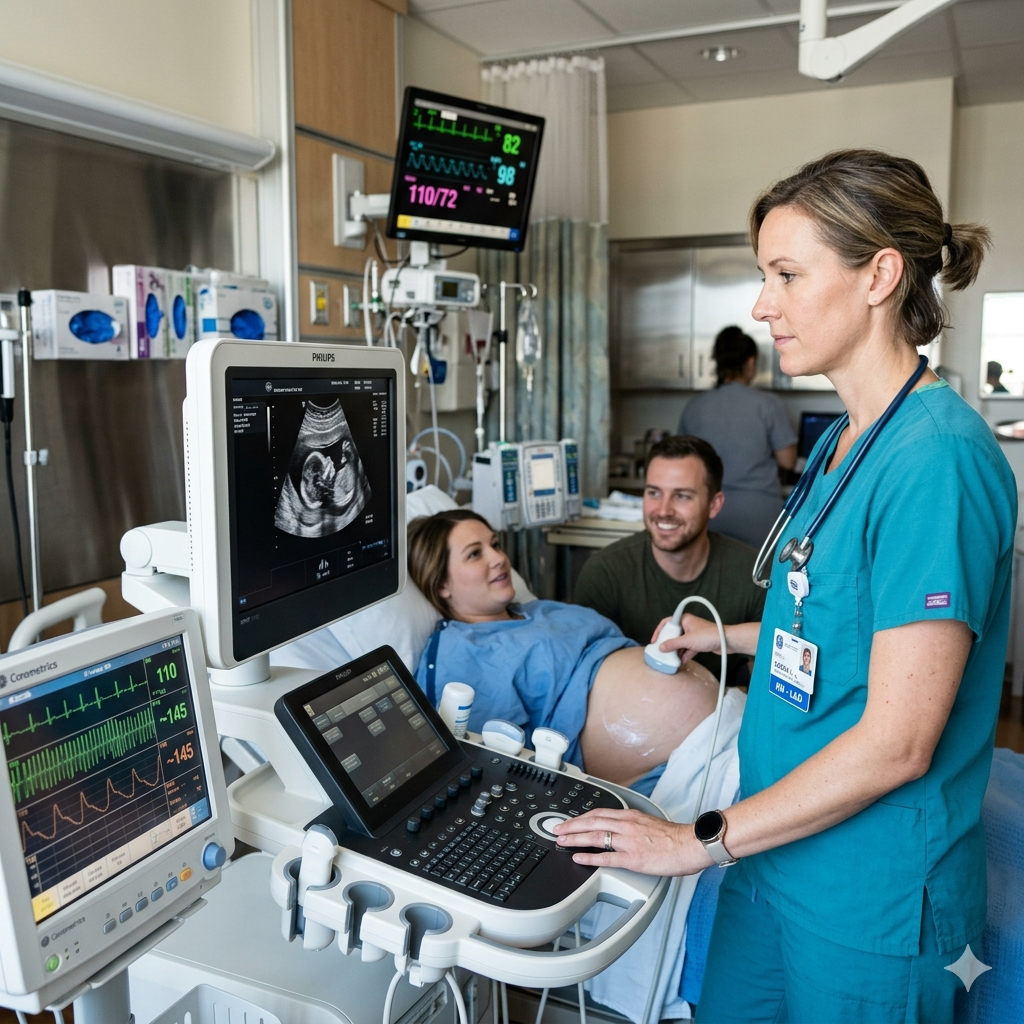
Fetal well-being assessment is one of the most critical responsibilities a registered nurse carries in the antepartum and intrapartum setting. Among the tools available, fetal biophysical profile (BPP) interpretation stands out as a comprehensive, evidence-based method for evaluating fetal oxygenation and neurological function. For nursing students preparing for the NCLEX and practicing RN nurses working in labor and delivery or antepartum units, understanding how to interpret a BPP — and what to do with the results — is non-negotiable clinical knowledge.
What Is the Fetal Biophysical Profile?
The biophysical profile (BPP) is an antepartum surveillance tool that combines real-time ultrasound assessment with electronic fetal monitoring to evaluate five distinct fetal parameters. First introduced by Manning and colleagues in 1980, it remains a cornerstone of high-risk obstetric care today.
The BPP is typically ordered when there is a concern for uteroplacental insufficiency, post-term pregnancy, decreased fetal movement, or maternal conditions such as diabetes, hypertension, or preeclampsia. A registered nurse caring for these patients must understand both the mechanics and the clinical significance of the BPP score.
Each of the five components is scored 0 or 2, yielding a maximum total score of 10. There are no partial scores — a component either meets criteria within the observation window or it does not.
The Five Components of the BPP and Scoring Criteria
Every RN nurse in obstetrics must memorize the five BPP components and what constitutes a normal (score of 2) versus abnormal (score of 0) finding for each.
1. Fetal Breathing Movements (FBM)
- Normal (2 points): At least one episode of rhythmic fetal breathing lasting ≥30 seconds within a 30-minute observation window
- Abnormal (0 points): No breathing episode, or episodes totaling less than 30 seconds
Clinical note: Fetal breathing is paradoxically the most sensitive — and most vulnerable — indicator. Hypoxia suppresses the fetal breathing center in the CNS first. Maternal smoking or hyperglycemia can also temporarily reduce FBM.
2. Fetal Movement (FM)
- Normal (2 points): ≥3 discrete body or limb movements within 30 minutes
- Abnormal (0 points): Fewer than 3 movements
Fetal movement reflects intact neuromuscular function. Nursing students should know that fetal sleep cycles (typically 20–40 minutes) can transiently reduce movement — the observation window accounts for this.
3. Fetal Tone (FT)
- Normal (2 points): ≥1 episode of active extension with return to flexion (limbs, trunk, or hand opening/closing)
- Abnormal (0 points): Slow extension, partial return to flexion, or absent movement
Fetal tone is the last BPP component to be lost in the setting of progressive hypoxia, making an abnormal tone score particularly ominous. A fetus in a fixed, hyperextended posture warrants urgent nursing escalation.
4. Amniotic Fluid Volume (AFV)
- Normal (2 points): At least one pocket of amniotic fluid measuring ≥2 cm in two perpendicular planes
- Abnormal (0 points): No pocket ≥2 cm identified
Oligohydramnios (decreased fluid) signals chronic uteroplacental insufficiency, as a hypoxic fetus reduces renal perfusion and therefore urine output — the primary source of amniotic fluid in the second and third trimesters. This is the only non-CNS component of the BPP, and it reflects chronic rather than acute fetal status.
5. Non-Stress Test (NST)
- Normal (2 points): Reactive NST — ≥2 accelerations of ≥15 bpm lasting ≥15 seconds within 20 minutes
- Abnormal (0 points): Non-reactive NST
The NST component directly assesses the fetal autonomic nervous system’s response to movement. As part of any nursing bundle for antepartum fetal surveillance, the NST is typically performed first. If it is reactive, the ultrasound components may still be assessed depending on the clinical picture.
BPP Score Interpretation and Nursing Actions
Fetal biophysical profile interpretation requires the nurse to understand not just the number, but the clinical urgency attached to each score range.
| BPP Score | Interpretation | Recommended Action |
|---|---|---|
| 8–10 | Normal; low risk for fetal asphyxia | Routine management; repeat per clinical indication |
| 6 | Equivocal; possible fetal asphyxia | Repeat BPP in 4–6 hours; consider delivery if ≥36 weeks or abnormal AFV |
| 4 | Abnormal; suspect fetal compromise | Deliver if ≥36 weeks; intensive evaluation if <36 weeks |
| 0–2 | Strongly abnormal; high risk for asphyxia | Expedite delivery regardless of gestational age |
Key nursing consideration: A score of 8/10 with oligohydramnios is NOT reassuring, even though the numerical score appears normal. The presence of decreased amniotic fluid alone may warrant delivery planning. The registered nurse must report this finding promptly to the obstetric provider.
A score of 8/8 on ultrasound with a non-reactive NST is generally considered reassuring if the four ultrasound parameters are met — the NST can be affected by fetal sleep state or medications such as magnesium sulfate or narcotics.
Modified BPP: A Common Clinical Shortcut
In many busy antepartum units, nurses will encounter the modified BPP, which combines only two components:
- The NST (acute marker)
- The amniotic fluid index (AFI) (chronic marker)
A modified BPP is considered normal when the NST is reactive AND the AFI is >5 cm (or a single deepest pocket ≥2 cm). It is abnormal if either component is abnormal.
The modified BPP is faster to perform, making it practical for twice-weekly surveillance in high-risk pregnancies. Nursing students should know this distinction for the NCLEX, as questions may test whether a student can differentiate between the full BPP and the modified version.
Nursing Responsibilities During and After the BPP
Understanding fetal biophysical profile interpretation is only part of the RN nurse’s role. Clinical follow-through is equally essential.
Before the BPP:
- Verify the provider’s order and indication
- Explain the procedure to the patient — reassure her that ultrasound is non-invasive and safe
- Assist the patient into a comfortable, semi-reclined position
- Confirm gestational age and clinical history (reason for BPP, maternal conditions)
During the BPP:
- Support the patient emotionally; maternal anxiety is common during surveillance testing
- Document the time observation begins; the standard window is 30 minutes
- Notify the provider if the fetus does not meet criteria within 30 minutes — some institutions allow extension to 40 minutes
After the BPP:
- Communicate results using SBAR (Situation, Background, Assessment, Recommendation) to the obstetric provider
- Document score components individually (e.g., FBM: 2, FM: 2, FT: 2, AFV: 0, NST: 2 = total 8/10)
- Implement provider orders promptly, especially in cases of equivocal or abnormal scores
- Provide patient education on the findings and next steps
For students building their clinical knowledge base, reviewing these surveillance tools as part of a comprehensive nursing bundle is highly recommended before sitting the NCLEX.
Why Fetal Tone and Breathing Are Lost First in Hypoxia
One of the most high-yield concepts for the NCLEX related to BPP interpretation is the order in which biophysical activities are lost as fetal oxygenation deteriorates. Understanding this sequence reflects fetal neurological development and the concept of brain-sparing during hypoxic stress.
The order of fetal CNS development — and therefore the order of BPP loss in hypoxia — is:
- NST / Heart Rate Reactivity — lost first (most recently developed, most oxygen-sensitive)
- Fetal Breathing Movements — lost second
- Fetal Movement — lost third
- Fetal Tone — lost last (earliest CNS function to develop, most resistant)
This means that an absent fetal tone on BPP is the most alarming single finding and represents severe, potentially prolonged hypoxia. Conversely, an isolated non-reactive NST may be a transient finding related to fetal sleep or medication effect.
💡 NCLEX Tips for Fetal Biophysical Profile
- Each BPP component is scored 0 or 2 — there are no scores of 1. Total possible = 10.
- A score of 6 is equivocal and requires repeat testing or delivery planning.
- Oligohydramnios with a score of 8/10 is still concerning — do not dismiss it.
- Fetal tone is the last parameter lost in hypoxia; absent tone = severe compromise.
- The modified BPP = NST + AFI only (not the full five-component assessment).
- A non-reactive NST alone does not equal an abnormal BPP if all four ultrasound components are normal.
High-Risk Conditions That Warrant BPP Surveillance
Registered nurses in OB settings routinely care for patients requiring serial BPP testing. Conditions commonly associated with BPP surveillance include:
- Gestational or pregestational diabetes mellitus — vascular compromise can impair placental function
- Chronic hypertension and preeclampsia — placental insufficiency is a hallmark
- Intrauterine growth restriction (IUGR) — BPP helps distinguish compensated from decompensated fetal status
- Post-term pregnancy (≥41–42 weeks) — placental aging increases fetal risk
- Decreased fetal movement reported by the patient
- Oligohydramnios or polyhydramnios identified on prior ultrasound
- Multiple gestation with suspected twin-to-twin transfusion syndrome
Nursing documentation in these cases should include the BPP score, gestational age, clinical indication, and provider notification with response. Accurate, timely charting protects both the patient and the nurse.
Conclusion
Fetal biophysical profile interpretation is a core competency for any RN nurse working in antepartum or labor and delivery settings — and a high-yield topic for the NCLEX. Mastery of the five components, their scoring criteria, the clinical significance of each score range, and the nurse’s role in assessment and communication prepares both students and practicing nurses to advocate effectively for maternal-fetal safety.
Whether caring for a patient with preeclampsia, IUGR, or a post-term pregnancy, the ability to accurately interpret and act on BPP findings can directly impact outcomes. Build your obstetric nursing knowledge with targeted practice questions and a structured nursing bundle designed for NCLEX success.
Practice your skills with NCLEX-style OB questions at 👉 https://rn-nurse.com/nclex-qcm/ or explore our full obstetric nursing courses at 👉 https://rn-nurse.com/nursing-courses/.