
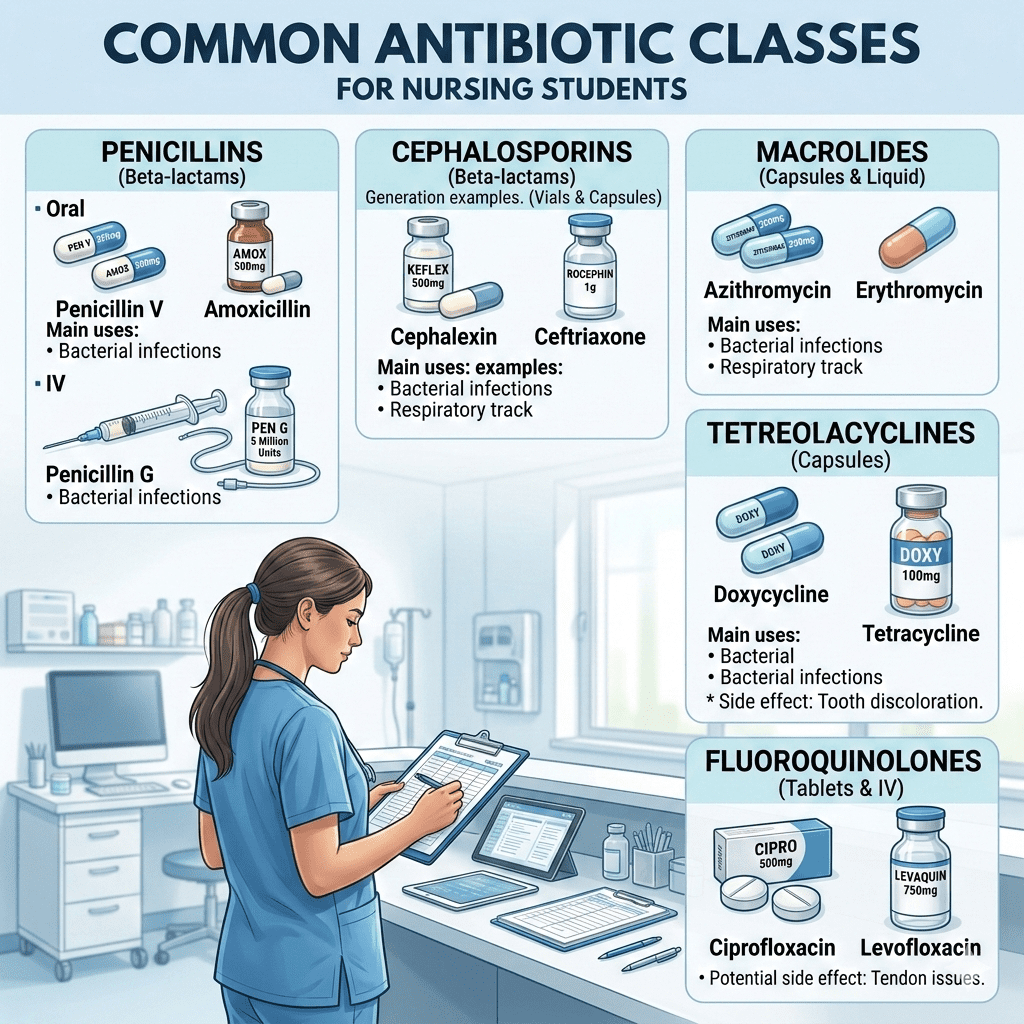
Antibiotics are among the most frequently administered medications in healthcare, making them essential knowledge for every nurse, registered nurse (RN), and nursing student preparing for the NCLEX. Because antibiotic therapy impacts patient safety, infection control, and clinical outcomes, understanding how these medications work—and what to monitor—remains a core nursing responsibility. Additionally, nurses must apply critical thinking throughout therapy to prevent complications and ensure optimal results.
This guide covers the most common antibiotic classes and the key nursing considerations that belong in every nursing bundle, study notebook, or NCLEX prep plan.
✅ 1. Penicillins (e.g., amoxicillin, penicillin G)
Penicillins treat common infections such as ear infections, respiratory infections, and skin infections. Although generally safe, they are known for causing allergic reactions more than other antibiotic groups.
✅ Nursing Considerations
- Assess for allergies, especially to penicillin or cephalosporins.
- Monitor for rash, hives, or anaphylaxis.
- Encourage patients to complete the full course—even if symptoms improve.
- Give on an empty stomach unless otherwise prescribed.
✅ NCLEX Tip
If a patient reports throat swelling, wheezing, or difficulty breathing, stop the antibiotic immediately and prepare emergency interventions.
✅ 2. Cephalosporins (e.g., ceftriaxone, cephalexin)
Cephalosporins share a similar structure to penicillins and are commonly used for pneumonia, UTIs, and surgical prophylaxis.
✅ Nursing Considerations
- Watch for cross-sensitivity with penicillins.
- Assess kidney function, especially in older adults.
- Avoid alcohol with some cephalosporins due to disulfiram-like reactions.
✅ NCLEX Tip
If a patient on ceftriaxone reports a severe reaction but also has a documented penicillin allergy, think “possible cross-allergy.”
✅ 3. Macrolides (e.g., azithromycin, clarithromycin, erythromycin)
Macrolides are commonly prescribed for respiratory infections and atypical infections. They are useful alternatives for patients allergic to penicillins.
✅ Nursing Considerations
- Monitor for GI upset, which is common.
- Avoid administration with QT-prolonging drugs.
- Evaluate liver function with long-term use.
✅ NCLEX Tip
If the patient reports palpitations or fainting, evaluate immediately for arrhythmias.
✅ 4. Fluoroquinolones (e.g., ciprofloxacin, levofloxacin)
These broad-spectrum antibiotics treat UTIs, skin infections, and respiratory infections. However, they carry serious potential side effects.
✅ Nursing Considerations
- Monitor for tendon pain or swelling — risk of tendon rupture.
- Avoid giving with antacids, calcium, or iron (reduces absorption).
- Stay alert for CNS effects such as confusion or agitation.
✅ NCLEX Tip
Fluoroquinolones are not recommended for children due to joint toxicity.
✅ 5. Tetracyclines (e.g., doxycycline, tetracycline)
Tetracyclines are used for acne, Lyme disease, and respiratory infections.
✅ Nursing Considerations
- Avoid giving to children under 8 and pregnant patients.
- Do not take with milk, iron, or antacids.
- Instruct patients to avoid direct sunlight (photosensitivity).
✅ NCLEX Tip
If the question mentions teeth discoloration, suspect tetracycline use in children.
✅ 6. Aminoglycosides (e.g., gentamicin, tobramycin)
Aminoglycosides are powerful antibiotics used for severe infections such as sepsis. Because they are potent, careful monitoring is essential.
✅ Nursing Considerations
- Monitor peak and trough levels to prevent toxicity.
- Watch closely for nephrotoxicity and ototoxicity.
- Assess urinary output and hearing changes regularly.
✅ NCLEX Tip
Ringing in the ears (tinnitus) is an early sign of potential ototoxicity.
✅ 7. Sulfonamides (e.g., TMP-SMX/Bactrim)
These antibiotics are often used for UTIs, respiratory infections, and skin infections.
✅ Nursing Considerations
- Encourage hydration to prevent kidney crystal formation.
- Monitor for Stevens-Johnson syndrome (rare but life-threatening).
- Assess for sulfa allergies.
✅ NCLEX Tip
A rash + fever while taking sulfonamides requires immediate evaluation.
✅ 8. Glycopeptides (e.g., vancomycin)
Vancomycin is essential for treating MRSA and severe infections. It requires special monitoring and careful dosing.
✅ Nursing Considerations
- Monitor trough levels before administration.
- Infuse slowly to avoid Red Man Syndrome.
- Assess kidney function regularly.
✅ NCLEX Tip
If flushing, hypotension, or rash appear during infusion, stop the infusion and notify the provider.
✅ General Nursing Responsibilities for All Antibiotics
To ensure safe practice, every RN nurse should follow these essential steps:
- Check the Five Rights before administration.
- Review allergies and past reactions.
- Monitor labs such as CBC, kidney function, and therapeutic drug levels.
- Evaluate the patient’s response to therapy.
- Educate patients on adherence and side effects.
These responsibilities appear frequently in nursing bundles and are essential NCLEX topics.
✅ Final Thoughts
Understanding common antibiotics and their nursing implications strengthens clinical judgment, improves patient outcomes, and boosts NCLEX readiness. Moreover, nurses who master antibiotic safety can identify complications early and prevent life-threatening errors. As a result, this topic belongs in every nursing bundle and every RN nurse’s essential knowledge base.
FAQ
The most common antibiotics include penicillins, cephalosporins, macrolides, tetracyclines, aminoglycosides, fluoroquinolones, sulfonamides, and glycopeptides. Nurses must be familiar with their uses, side effects, and major risks for safe administration and NCLEX success.
Prevention includes verifying allergies, applying the Five Rights of medication administration, checking lab values, assessing kidney and liver function, monitoring for adverse reactions, and ensuring proper dosing intervals.
Education improves adherence, prevents incomplete treatments, and reduces antibiotic resistance. Nurses should explain side effects, timing, food interactions, and the importance of finishing the entire prescription.