
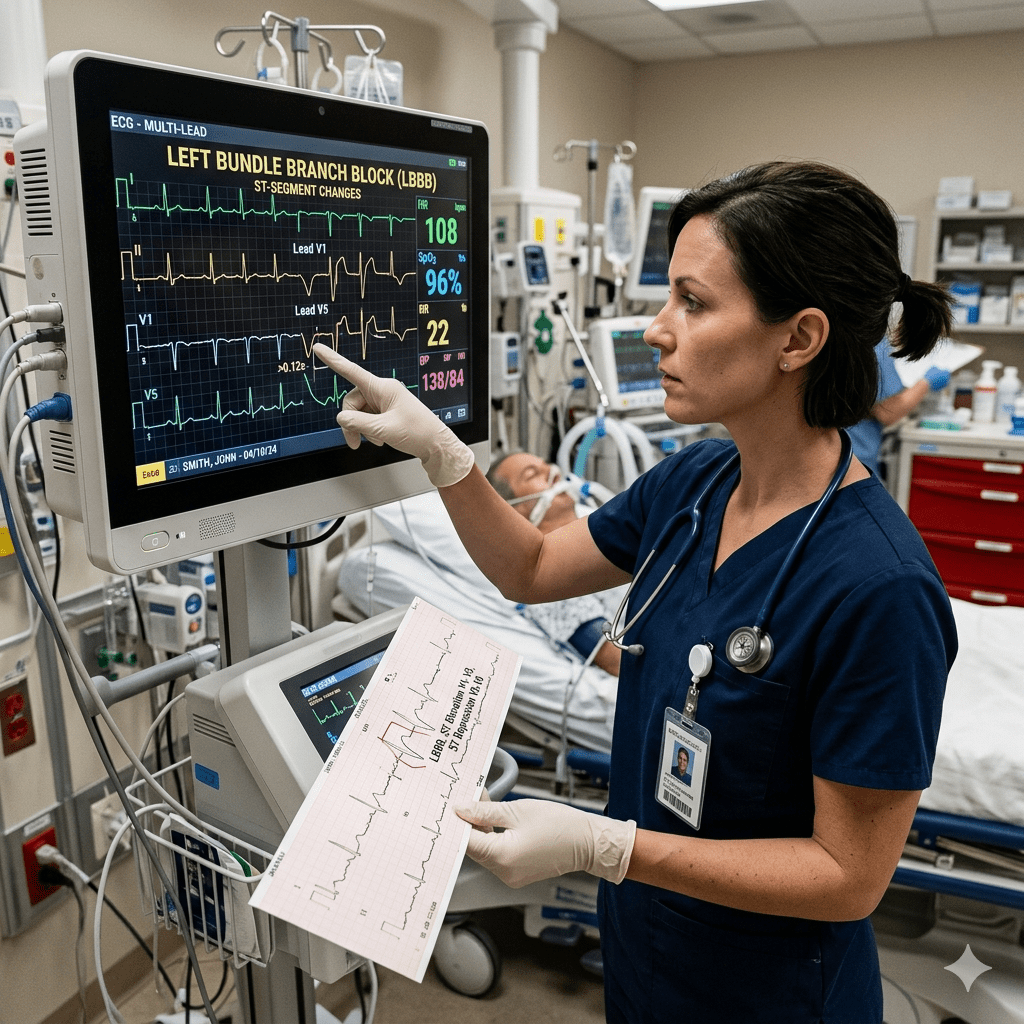
Detecting a myocardial infarction (MI) on an electrocardiogram (ECG) is usually straightforward when classic ST-segment elevation is present. However, diagnosis becomes more challenging when a patient has a left bundle branch block (LBBB). In this situation, the normal electrical pattern of the heart is altered, which can hide or mimic signs of a heart attack.
To help clinicians identify a myocardial infarction in patients with LBBB, experts developed the Sgarbossa Criteria, a set of ECG findings that suggest an acute MI even when bundle branch block is present. Understanding these criteria is important for every nurse and registered nurse (RN nurse) working in emergency or cardiac care settings.
Because ECG interpretation and myocardial infarction recognition are essential topics in modern nursing, the Sgarbossa Criteria are often discussed in advanced cardiac training and frequently appear in NCLEX preparation materials and many nursing bundle study guides.
This article explains left bundle branch block, the Sgarbossa Criteria, and the role of nurses in recognizing these critical ECG findings.
Understanding Left Bundle Branch Block
A left bundle branch block occurs when electrical conduction through the left bundle branch of the heart is delayed or blocked. As a result, the left ventricle receives electrical signals later than normal.
This abnormal conduction causes changes on the ECG, including:
- Wide QRS complexes (greater than 0.12 seconds)
- Altered ST segments and T waves
- Delayed activation of the left ventricle
Because these ECG changes distort the normal ST-segment pattern, diagnosing a myocardial infarction becomes much more difficult.
For the RN nurse, recognizing the presence of LBBB is the first step in interpreting the ECG accurately.
Why Detecting MI in LBBB Is Challenging
In patients without conduction abnormalities, myocardial infarction often produces ST-segment elevation on the ECG. However, in patients with LBBB, the ST segments are already abnormal because ventricular depolarization occurs differently.
Therefore, the typical ECG signs of a heart attack may be masked.
This challenge led to the development of the Sgarbossa Criteria, which help clinicians detect MI despite the presence of LBBB.
Understanding these criteria helps the registered nurse recognize potential cardiac emergencies more quickly.
What Are the Sgarbossa Criteria?
The Sgarbossa Criteria are three ECG findings that help identify myocardial infarction in patients with left bundle branch block.
Each criterion reflects abnormal ST-segment changes relative to the direction of the QRS complex.
The criteria include:
- Concordant ST elevation of at least 1 mm in leads with a positive QRS complex
- Concordant ST depression of at least 1 mm in leads V1, V2, or V3
- Excessively discordant ST elevation of at least 5 mm in leads with a negative QRS complex
Each of these findings increases the likelihood that an acute myocardial infarction is occurring.
Because these ECG patterns can indicate a life-threatening condition, rapid recognition is essential.
Concordant ST Elevation
The first Sgarbossa criterion involves ST-segment elevation that moves in the same direction as the QRS complex.
Normally in LBBB, ST segments tend to move in the opposite direction of the QRS complex. Therefore, when ST elevation appears concordant with the QRS complex, it becomes a strong indicator of myocardial infarction.
This finding is considered the most specific sign of MI in patients with LBBB.
The nurse reviewing ECG strips should carefully look for this pattern when evaluating cardiac rhythms.
Concordant ST Depression in V1–V3
The second Sgarbossa criterion focuses on ST depression in leads V1, V2, or V3.
When ST depression occurs in these leads and aligns with the QRS direction, it may indicate posterior myocardial infarction.
Although less specific than concordant ST elevation, this finding still raises suspicion for acute coronary occlusion.
The RN nurse monitoring ECG changes should promptly report these findings to the healthcare team.
Excessively Discordant ST Elevation
The third criterion involves excessive ST elevation in the opposite direction of the QRS complex.
Some ST elevation is expected in LBBB due to abnormal ventricular conduction. However, elevation greater than 5 mm is considered abnormal and may indicate myocardial infarction.
Although this criterion is less specific than the first two, it remains clinically important.
Careful ECG analysis helps the registered nurse recognize these abnormal patterns.
Modified Sgarbossa Criteria
Over time, researchers developed modified Sgarbossa Criteria to improve diagnostic accuracy.
Instead of using a fixed ST elevation measurement, the modified criteria compare ST elevation relative to the size of the preceding S wave.
This adjustment improves sensitivity for detecting myocardial infarction in patients with LBBB.
Although detailed calculations may be performed by physicians or cardiologists, awareness of these updated criteria helps enhance advanced nursing knowledge.
Nursing Responsibilities in ECG Monitoring
The nurse plays an essential role in cardiac monitoring and early recognition of myocardial infarction.
Key responsibilities include:
- Continuously monitoring ECG rhythms
- Recognizing bundle branch block patterns
- Identifying abnormal ST-segment changes
- Assessing patient symptoms such as chest pain or shortness of breath
- Communicating urgent findings to the healthcare team
Because myocardial infarction can progress rapidly, prompt reporting is critical.
The RN nurse often serves as the first professional to detect subtle ECG abnormalities.
Importance for NCLEX Preparation
Cardiac rhythm interpretation and myocardial infarction recognition are major topics in nursing education. As a result, the Sgarbossa Criteria may appear in advanced NCLEX questions related to cardiac emergencies.
Students preparing for the exam should understand:
- ECG characteristics of left bundle branch block
- Signs of myocardial infarction
- Basic interpretation of ST-segment changes
- Priority nursing actions during cardiac emergencies
Learning these concepts helps future registered nurses develop strong clinical judgment skills.
How Nursing Study Bundles Help Students
Many nursing students rely on structured study resources when reviewing complex ECG topics.
A well-designed nursing bundle often includes:
- ECG rhythm interpretation charts
- Simplified explanations of cardiac conduction
- Visual guides for identifying myocardial infarction
- NCLEX-style practice questions
These tools help future RN nurses quickly recognize life-threatening cardiac conditions.
Final Thoughts
Detecting myocardial infarction in patients with left bundle branch block can be challenging because abnormal ventricular conduction alters the normal ECG pattern. The Sgarbossa Criteria provide an important tool for identifying MI in these complex situations.
By recognizing concordant ST elevation, concordant ST depression, and excessively discordant ST elevation, clinicians can detect possible myocardial infarction even when bundle branch block is present.
For the nurse, understanding these ECG findings strengthens cardiac assessment skills and improves patient safety. The registered nurse plays a crucial role in monitoring ECG rhythms and recognizing early signs of cardiac emergencies.
For students preparing for the NCLEX, learning the Sgarbossa Criteria is an important part of advanced cardiac nursing knowledge. With continued practice and the support of organized resources like a nursing bundle, future registered nurses can develop the expertise needed to identify critical ECG abnormalities and respond quickly to life-threatening situations.