Rhabdomyolysis is a life-threatening breakdown of skeletal muscle tissue that releases toxic intracellular contents — most dangerously myoglobin — directly into the bloodstream. When myoglobin reaches the kidneys in high concentrations, it precipitates in the renal tubules and drives the cascade toward acute kidney injury (AKI). For the registered nurse working in the ICU, emergency department, or medical-surgical unit, recognizing rhabdomyolysis early and implementing aggressive preventive nursing interventions is essential — both in clinical practice and on the NCLEX. Missing this diagnosis can mean irreversible renal failure, dangerous electrolyte crises, and death. Every RN nurse must be fluent in the pathophysiology, risk factors, labs, and management priorities that form the foundation of rhabdomyolysis acute kidney injury prevention.
Pathophysiology: Why Rhabdomyolysis Destroys the Kidneys
Understanding the mechanism is key for every registered nurse. When muscle cells are injured — whether from trauma, prolonged immobility, drug toxicity, or extreme exertion — the cell membrane fails and releases its contents into circulation. The three most dangerous byproducts are:
- Myoglobin — a heme-containing protein that is directly nephrotoxic
- Potassium — causing life-threatening hyperkalemia
- Phosphate — contributing to hypocalcemia as calcium binds to released phosphate
Myoglobin filters through the glomerulus but precipitates in the acidic, concentrated environment of the renal tubules. This blocks tubular flow, induces oxidative injury, and triggers acute tubular necrosis — the primary mechanism of AKI in rhabdomyolysis. Renal vasoconstriction from hypovolemia further reduces perfusion and accelerates tubular damage.
The hallmark clinical sign every nurse must recognize is cola-colored or dark brown urine — a direct result of myoglobinuria. This single finding in a patient with muscle pain, weakness, and a relevant history demands immediate action.
High-Risk Populations and Common Causes
Rhabdomyolysis acute kidney injury prevention begins with identifying at-risk patients before symptoms escalate. Common causes include:
Traumatic:
- Crush injuries, compartment syndrome, prolonged immobilization (e.g., post-fall found down)
- Burns and electrical injuries
Non-Traumatic:
- Drug-induced: statins (especially high-dose), cocaine, alcohol, antipsychotics causing neuroleptic malignant syndrome
- Exertional: marathon runners, military recruits, patients with sickle cell trait
- Infectious/inflammatory: viral myositis, polymyositis
- Metabolic: severe hypokalemia, hyponatremia, hypothyroidism
The nursing assessment for any patient presenting post-trauma, found unresponsive on the floor, or with significant drug or alcohol history must include rhabdomyolysis as a differential. Early identification is the most powerful tool a nurse has to prevent AKI.
Critical Lab Values Every RN Nurse Must Monitor
Laboratory surveillance is central to nursing management. The following values drive clinical decision-making and are high-yield for the NCLEX:
| Lab / Finding | Normal Range | Rhabdomyolysis Finding |
|---|---|---|
| Creatine Kinase (CK) | 22–198 U/L | >1,000 U/L (often >10,000 U/L) |
| Myoglobin (serum) | <90 mcg/L | Markedly elevated |
| BUN | 7–20 mg/dL | Elevated (AKI marker) |
| Creatinine | 0.6–1.2 mg/dL | Elevated (AKI marker) |
| Potassium | 3.5–5.0 mEq/L | Elevated — risk for arrhythmia |
| Calcium | 8.5–10.5 mg/dL | Decreased |
| Phosphate | 2.5–4.5 mg/dL | Elevated |
| Urine myoglobin | Negative | Positive (cola-colored urine) |
Creatine kinase (CK) is the gold standard marker — values greater than five times the upper limit of normal confirm muscle injury. The RN nurse must trend CK levels every 6–12 hours to assess whether the condition is improving or progressing toward renal failure. Rising or persistently elevated CK despite treatment signals inadequate fluid resuscitation.
Nursing Interventions for Rhabdomyolysis Acute Kidney Injury Prevention
Aggressive, evidence-based nursing intervention is the cornerstone of rhabdomyolysis acute kidney injury prevention. The primary goals are to dilute myoglobin in the tubules, maintain adequate renal perfusion, and correct life-threatening electrolyte imbalances.
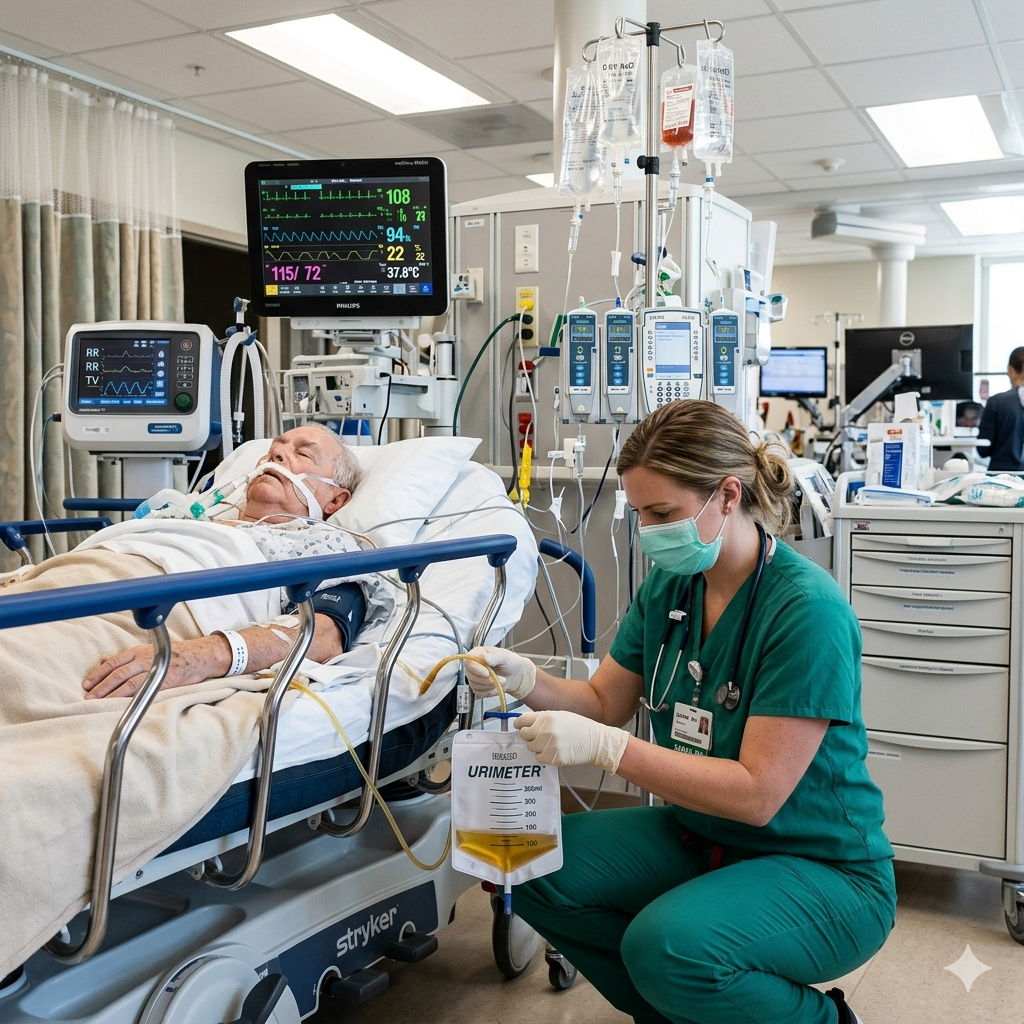
1. Aggressive IV Fluid Resuscitation Isotonic crystalloids — typically 0.9% Normal Saline — are infused at rates of 200–1,000 mL/hour in the acute phase. The registered nurse must target a urine output of 200–300 mL/hour until CK levels trend downward. Strict intake and output documentation is mandatory. A Foley catheter is inserted to enable accurate hourly urine monitoring.
2. Urine pH Monitoring (Urinary Alkalinization) Some protocols use sodium bicarbonate added to IV fluids to alkalinize the urine to a pH >6.5. Alkaline urine reduces myoglobin precipitation in the tubules. The nurse monitors urine pH with each void and watches for signs of alkalosis and hypocalcemia related to bicarbonate administration.
3. Electrolyte Management
- Hyperkalemia is the most immediately life-threatening complication. Continuous cardiac monitoring is essential. The nurse watches for peaked T-waves, widened QRS, or sine wave pattern. Interventions include calcium gluconate (cardiac membrane stabilization), insulin/dextrose, sodium bicarbonate, and kayexalate or patiromer.
- Hypocalcemia is managed symptomatically unless the patient is symptomatic or hyperkalemic — avoid empiric calcium replacement, as it can cause calcium-phosphate deposition in damaged muscle.
4. Avoid Nephrotoxic Agents The RN nurse reviews the medication administration record and flags NSAIDs, aminoglycosides, contrast agents, and ACE inhibitors for provider discussion, as these further compromise renal perfusion in an already-vulnerable patient.
5. Dialysis Readiness When oliguria or anuria persists despite adequate fluid resuscitation, continuous renal replacement therapy (CRRT) or intermittent hemodialysis may be required. The nurse anticipates this need and coordinates with nephrology early.
Nursing Assessment Priorities
Systematic, frequent assessment allows the nurse to detect deterioration before it becomes catastrophic. Prioritize:
- Urine color and output every hour — dark or tea-colored urine is an emergency finding
- Vital signs — hypotension reflects inadequate volume resuscitation; tachycardia may signal arrhythmia
- Cardiac rhythm — continuous telemetry for hyperkalemia-related dysrhythmias
- Neuromuscular status — muscle pain (myalgia), weakness, swelling, and signs of compartment syndrome
- Mental status — altered mentation may indicate uremic encephalopathy or severe electrolyte disturbance
- Fluid balance — assess for signs of fluid overload (crackles, peripheral edema) when aggressive IV fluids are administered
A thorough nursing bundle approach — integrating serial labs, hemodynamic monitoring, hourly output checks, and medication reconciliation — provides the structured framework needed to prevent AKI progression.
💡 NCLEX Tips for Rhabdomyolysis & AKI Prevention
- Cola-colored urine + muscle pain + elevated CK = rhabdomyolysis until proven otherwise — act immediately.
- The priority nursing intervention is aggressive IV fluid resuscitation targeting urine output of 200–300 mL/hr.
- Hyperkalemia is the most immediately dangerous electrolyte abnormality — always prioritize cardiac monitoring.
- CK levels, not myoglobin, are the primary marker used to trend disease progression in clinical practice.
- On the NCLEX, if a patient is found unresponsive on the floor for an unknown period of time, always suspect rhabdomyolysis — prolonged immobility = muscle compression = cell death.
Conclusion
Rhabdomyolysis acute kidney injury prevention demands prompt recognition, aggressive fluid management, and meticulous nursing surveillance. Every registered nurse must know the hallmark signs — dark urine, elevated CK, myalgia, and dangerous electrolyte shifts — and respond with urgency. The RN nurse who understands the pathophysiology and acts decisively on early warning signs can prevent reversible muscle injury from becoming permanent renal failure. Mastering this content is also essential for the NCLEX, where rhabdomyolysis scenarios frequently test priority-setting, fluid management, and lab interpretation.
To sharpen your clinical decision-making and practice high-yield questions like these, explore the nursing bundle and NCLEX question bank at rn-nurse.com/nclex-qcm/ or browse the full course library at rn-nurse.com/nursing-courses/.