
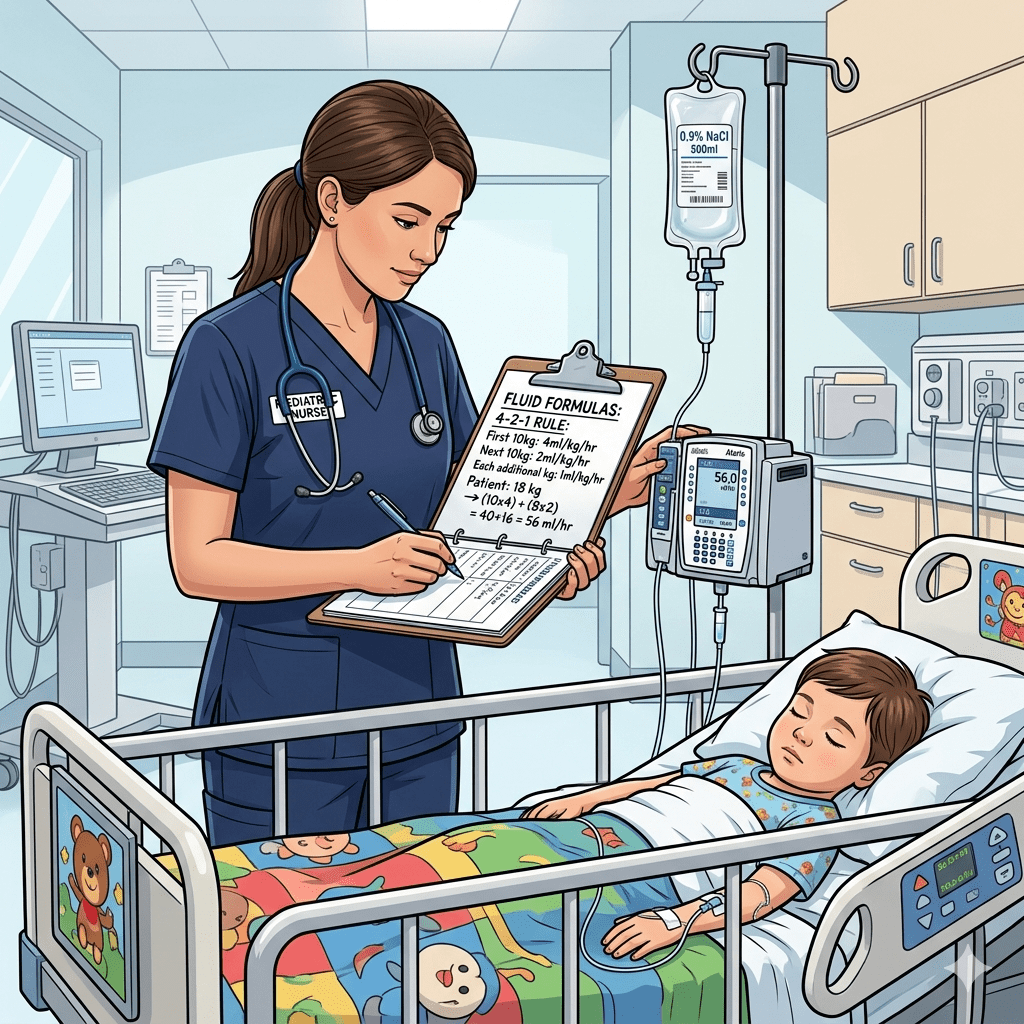
Fluid management is one of the most essential skills every nurse must master when caring for children. Because pediatric patients have a higher percentage of body water, they are especially vulnerable to fluid imbalances. Therefore, even small fluid losses can quickly lead to dehydration if not addressed properly. For this reason, accurate fluid calculations remain a major focus in NCLEX preparation and daily clinical practice.
In pediatric care, understanding fluid formulas allows the registered nurse (RN nurse) to determine how much fluid a child needs for maintenance, replacement, or emergency treatment. Additionally, these calculations frequently appear on the NCLEX and are commonly included in many nursing bundle study resources used by nursing students.
Throughout this guide, we will explain the most important pediatric fluid calculation formulas, how they work, and when nurses should apply them in real clinical situations.
Why Fluid Calculations Are Critical in Pediatrics
Children differ significantly from adults when it comes to fluid balance. As a result, pediatric nursing requires careful attention to hydration and electrolyte management.
Several physiological factors explain why fluid calculations are so important:
- Children have higher metabolic rates
- Their kidneys are less mature
- They lose fluids quickly through fever, vomiting, and diarrhea
- Even small fluid losses can cause serious dehydration
Because of these characteristics, the registered nurse must calculate maintenance fluids carefully to maintain electrolyte balance and prevent complications.
Furthermore, fluid calculation questions frequently appear on the NCLEX, making this topic essential for every nursing student preparing for the exam.
The Holliday–Segar Method (4-2-1 Rule)
The most commonly used formula for pediatric maintenance fluids is the Holliday–Segar method, often referred to as the 4-2-1 rule. In clinical practice, this rule allows the RN nurse to estimate hourly fluid requirements based on the child’s weight.
Formula
- First 10 kg: 4 mL/kg/hr
- Second 10 kg: 2 mL/kg/hr
- Each kg above 20 kg: 1 mL/kg/hr
Using this rule, a nurse can quickly determine the appropriate IV fluid rate for pediatric patients.
Example Calculation
Consider a child who weighs 18 kg.
First, calculate the fluid requirement for the initial 10 kg:
4 × 10 = 40 mL/hr
Next, calculate the remaining 8 kg:
2 × 8 = 16 mL/hr
Finally, add both values together:
40 + 16 = 56 mL/hr
Therefore, the maintenance fluid rate is 56 mL/hr.
Because this calculation method is widely used in hospitals, it is also frequently tested on the NCLEX. Consequently, nursing students should practice it regularly.
Daily Maintenance Fluid Calculation (100-50-20 Rule)
Another widely used pediatric nursing formula is the 100-50-20 rule, which estimates the total daily fluid requirement instead of the hourly rate.
Formula
- First 10 kg → 100 mL/kg/day
- Second 10 kg → 50 mL/kg/day
- Remaining weight → 20 mL/kg/day
After calculating the daily total, the registered nurse can divide the amount by 24 hours to determine the hourly infusion rate.
Example
Assume a child weighs 25 kg.
First, calculate the fluid requirement for the first 10 kg:
100 × 10 = 1000 mL
Next, calculate the second 10 kg:
50 × 10 = 500 mL
Then calculate the remaining 5 kg:
20 × 5 = 100 mL
Adding all values together gives the total daily fluid requirement:
1000 + 500 + 100 = 1600 mL/day
To determine the hourly rate:
1600 ÷ 24 = 66.7 mL/hr
Thus, the IV infusion rate should be approximately 67 mL/hr.
This method is commonly used in pediatric units and frequently appears in NCLEX questions for nursing students.
Body Surface Area Method (Advanced Calculation)
In certain hospital environments, pediatric fluid requirements may be calculated using Body Surface Area (BSA). Compared with weight-based formulas, this method can provide more precise results. Therefore, it is often used in pediatric oncology or critical care settings.
The calculation compares the child’s body surface area with the standard adult value.
General Formula
Fluid requirement =
(BSA / 1.73) × Adult maintenance fluid
Although this formula appears less often on the NCLEX, advanced nursing practice may rely on it when precise medication or fluid dosing is required.
Dehydration Replacement Calculations
Sometimes a child arrives at the hospital already dehydrated. In such cases, the nurse must calculate additional fluid replacement beyond the standard maintenance requirements.
Steps for Calculation
- Determine the percentage of dehydration
- Multiply this percentage by the child’s body weight
- Convert the result into fluid volume
Example
Child weight = 10 kg
Dehydration level = 5%
First calculate the fluid loss:
5% × 10 kg = 0.5 kg
Next convert the weight loss into fluid volume:
0.5 kg = 500 mL
Therefore, the child has a 500 mL fluid deficit that must be replaced.
Meanwhile, the RN nurse must also provide maintenance fluids according to hospital protocols. This concept frequently appears in NCLEX pediatric nursing questions.
Key Nursing Tips for Pediatric Fluid Calculations
When calculating pediatric fluids, patient safety must always remain the top priority. Consequently, every registered nurse should follow strict clinical precautions.
Important safety practices include:
- Always verify the child’s weight in kilograms
- Double-check calculations before starting IV fluids
- Monitor urine output carefully
- Watch for signs of fluid overload
- Reassess hydration status regularly
Additionally, many nursing bundle study guides include practice problems that help students master these formulas before taking the NCLEX.
Common NCLEX Questions About Pediatric Fluids
The NCLEX often evaluates a nurse’s ability to apply pediatric fluid formulas in realistic scenarios. For example, exam questions may ask the RN nurse to:
- Calculate hourly IV fluid rates
- Determine daily maintenance fluid requirements
- Identify levels of dehydration
- Recognize symptoms of fluid overload
Therefore, practicing these calculations not only improves exam performance but also strengthens real-world nursing skills.
How Nursing Study Bundles Help Students Master Fluid Calculations
Many students initially struggle with pediatric fluid formulas. Fortunately, structured resources such as a nursing bundle can simplify the learning process.
A comprehensive nursing bundle often includes:
- Simplified pediatric formulas
- Step-by-step calculation guides
- NCLEX-style practice questions
- Quick reference sheets for clinical settings
As a result, future registered nurses can review essential formulas quickly before exams or during clinical rotations.
Final Thoughts
Pediatric fluid calculation formulas are essential knowledge for every nurse working with children. Because pediatric patients are highly sensitive to hydration changes, precise calculations are critical for safe patient care.
By mastering formulas such as the 4-2-1 rule, the 100-50-20 rule, and dehydration replacement calculations, the RN nurse can confidently manage pediatric hydration needs.
Ultimately, regular practice is the best way to prepare for NCLEX questions and real clinical situations. With the help of well-structured study tools like a nursing bundle, every future registered nurse can develop the skills needed to provide safe and effective pediatric nursing care.