
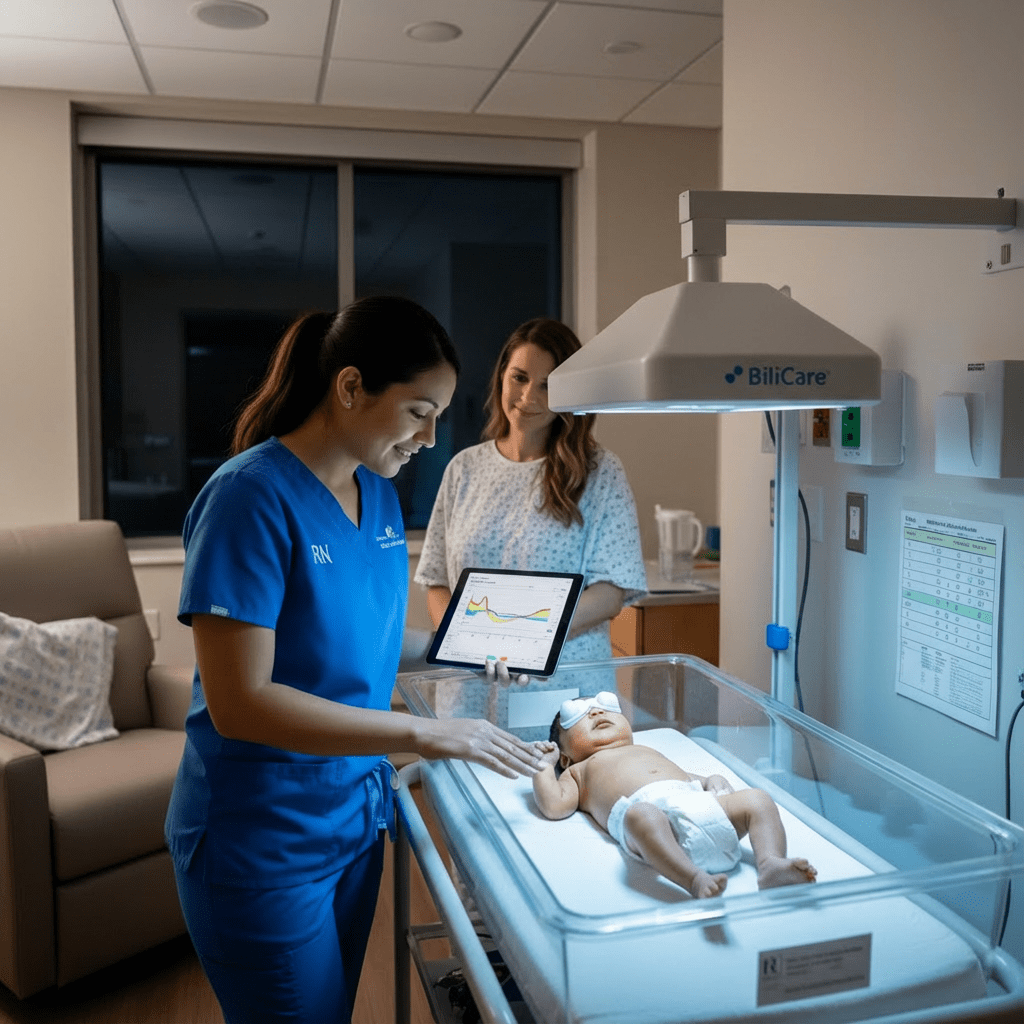
Neonatal jaundice is one of the most common conditions seen in newborn care. Because bilirubin levels can rise quickly, every nurse, especially a registered nurse (RN nurse) working in postpartum, NICU, pediatrics, or community health, must know how to assess jaundice and initiate timely interventions. Moreover, neonatal jaundice frequently appears in NCLEX exam questions, which makes it an essential topic in every nursing bundle and study plan.
This article simplifies the causes, assessment, and phototherapy care responsibilities for all nursing students and practicing nurses.
🟡 What Is Neonatal Jaundice?
Neonatal jaundice is the yellowish discoloration of a newborn’s skin and sclera caused by elevated bilirubin. Because newborn livers are still immature, they sometimes cannot process bilirubin fast enough.
Common Causes
- Physiologic jaundice (most common, appears after 24 hours)
- Breastfeeding jaundice (dehydration or low intake)
- Hemolytic disorders (ABO/Rh incompatibilities)
- Prematurity
- G6PD deficiency
- Cephalohematoma or birth trauma
Understanding these causes helps every nurse recognize high-risk infants early—an essential skill tested often on the NCLEX.
🔍 Nursing Assessment for Neonatal Jaundice
1. Visual Assessment
A registered nurse checks:
- Yellowing of the skin (starting from face → chest → abdomen → legs)
- Yellow sclera
- Poor feeding or lethargy
Apply the blanch test: gently press the skin; if it appears yellow when it lightens, jaundice is likely.
2. Risk Factor Identification
The RN nurse reviews:
- Gestational age
- Blood type incompatibilities
- Feeding patterns
- Weight loss percentage
These assessments help nurses detect severe hyperbilirubinemia early.
3. Bilirubin Levels
Nurses monitor:
- Total serum bilirubin (TSB)
- Transcutaneous bilirubin (TcB)
Nurses plot values on the bilirubin nomogram to determine whether phototherapy is required. Expect several NCLEX questions about interpreting these charts.
4. Neurological Assessment
Severe jaundice may progress to acute bilirubin encephalopathy. Nurses monitor for:
- High-pitched cry
- Hypotonia or hypertonia
- Poor suck
- Backward arching (opisthotonus)
Immediate intervention prevents kernicterus, which is why it appears in NCLEX pediatric safety questions.
💡 When Is Phototherapy Needed?
Phototherapy begins when bilirubin levels reach treatment thresholds based on:
- Age in hours
- Risk category (premature, Coombs-positive, hemolysis)
- Bilirubin values
The registered nurse must verify that the infant meets criteria using the neonatal jaundice nomogram.
🔦 Nursing Care During Phototherapy
Phototherapy is one of the safest and most effective treatments, but it requires careful nursing monitoring.
1. Protect the Eyes
Cover the infant’s eyes with phototherapy goggles and ensure they fit correctly.
2. Maintain Temperature
Because infants under phototherapy lose more heat and fluids, the nurse monitors thermoregulation closely.
3. Increase Feeding
Frequent feeding improves bilirubin excretion. Encourage breastfeeding every 2–3 hours.
4. Monitor Hydration
Check:
- Wet diapers (6–8/day)
- Stool frequency
- Skin turgor
Dehydration is a common NCLEX trick question.
5. Monitor Skin Integrity
Turn the newborn every 2 hours to prevent breakdown.
6. Measure Bilirubin Levels
Recheck TSB or TcB according to hospital policy. The RN nurse documents trends carefully.
7. Keep the Infant Undressed
Expose maximum skin surface while protecting the eyes and genital area.
🍼 Parent Teaching for Home Phototherapy
Many newborns go home with phototherapy blankets. The nurse must teach parents to:
- Keep the device on continuously unless feeding or bathing
- Track feedings and diaper output
- Watch for yellowing that worsens
- Schedule outpatient bilirubin checks
Providing clear and simple instructions improves safety and reduces hospital readmissions.
🚨 When to Notify the Provider
An NCLEX-danger sign appears when:
- Jaundice starts within the first 24 hours
- Bilirubin rises rapidly
- Poor feeding or dehydration occurs
- Baby becomes lethargic or difficult to wake
- There are signs of bilirubin encephalopathy
The registered nurse must act quickly in these situations.
📘 Why Neonatal Jaundice Matters for NCLEX
The NCLEX frequently tests:
- When to start phototherapy
- How to assess jaundice
- Parent teaching
- Bilirubin levels interpretation
- Complications of untreated hyperbilirubinemia
Studying neonatal jaundice is a smart move for any nurse preparing for exams or updating their nursing bundle knowledge.
⭐ Conclusion
Neonatal jaundice is common, but timely assessment and proper phototherapy can prevent severe complications. Every nurse, especially an RN nurse, must understand jaundice risk factors, bilirubin monitoring, and safe phototherapy care. This knowledge supports safe neonatal practice and strengthens every registered nurse’s NCLEX preparation.
❓ FAQ
Neonatal jaundice occurs because newborns have immature livers that cannot process bilirubin efficiently. Common causes include physiologic jaundice, breastfeeding jaundice, prematurity, ABO/Rh incompatibility, and birth trauma.
A registered nurse checks skin color, sclera, feeding patterns, hydration, and bilirubin levels. Nurses often use visual inspection, blanch tests, nomograms, and TcB/TSB measurements.
Phototherapy begins when bilirubin levels reach treatment thresholds based on age in hours, gestational age, risk category, and bilirubin measurements.
Yes. Phototherapy is extremely safe when nurses protect the infant’s eyes, maintain hydration, monitor temperature, and track bilirubin levels.
Most newborns need phototherapy for 24–48 hours, depending on bilirubin levels and how quickly they respond. Nurses reassess bilirubin frequently to determine duration.