
A High-Yield NCLEX Guide for the Nurse, Registered Nurse, and RN Nurse
Long QT Syndrome prolongs ventricular repolarization, increasing the risk for Torsades de Pointes—a life-threatening polymorphic ventricular tachycardia.
For every nurse, registered nurse, and RN nurse, recognizing prolonged QT intervals and the dangerous rhythm Torsades de Pointes (TdP) is critical in emergency, telemetry, and ICU nursing practice. This topic is frequently tested on the NCLEX and commonly encountered in medication-related cardiac events.
Understanding the QT interval can prevent sudden cardiac arrest.
What Is the QT Interval?
The QT interval represents:
- Ventricular depolarization (QRS)
- Ventricular repolarization (T wave)
Because heart rate affects QT length, nurses use the corrected QT (QTc).
QT Correction Formula (Bazett’s Formula)
QTc=QT/√RRQTc = QT / √RRQTc=QT/√RR
This formula adjusts the QT interval based on heart rate.
Normal QTc Values
- Men: ≤ 440 ms
- Women: ≤ 460 ms
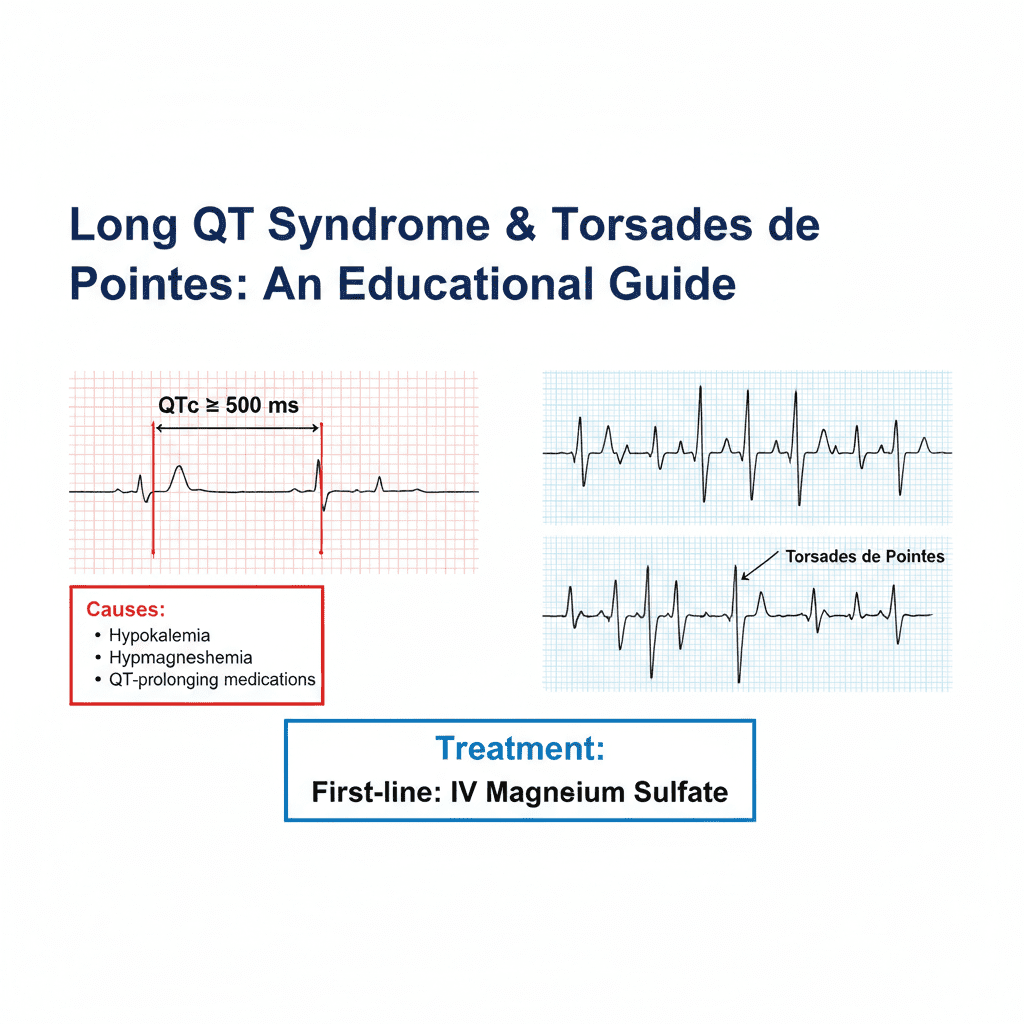
- High risk: ≥ 500 ms
For the RN nurse, a QTc ≥ 500 ms significantly increases Torsades risk.
What Is Long QT Syndrome?
Long QT Syndrome (LQTS) is a disorder of delayed ventricular repolarization.
It can be:
1️⃣ Congenital
Genetic ion channel mutations
2️⃣ Acquired (More Common in Nursing Practice)
Caused by:
- Medications
- Electrolyte imbalances
- Bradycardia
- Structural heart disease
For the bedside nurse, acquired causes are most frequently encountered.
Medications That Prolong QT (NCLEX Favorite)
High-risk drug categories include:
- Antiarrhythmics (amiodarone, sotalol)
- Macrolide antibiotics
- Fluoroquinolones
- Antipsychotics
- Antiemetics (ondansetron)
Every registered nurse administering QT-prolonging medications should review baseline ECGs and electrolytes.
What Is Torsades de Pointes?
Torsades de Pointes (TdP) is a specific form of polymorphic ventricular tachycardia that occurs in the setting of prolonged QT.
ECG Appearance:
- Twisting QRS complexes
- Polymorphic VT
- Rate 150–250 bpm
- Waxing and waning amplitude
It may self-terminate — or deteriorate into ventricular fibrillation.
For the cardiac nurse, this is a medical emergency.
Why Prolonged QT Is Dangerous
When QT is prolonged:
- Early afterdepolarizations can occur
- Ventricular irritability increases
- R-on-T phenomenon may trigger TdP
This concept is high-yield for the NCLEX.
Electrolytes and Long QT
Electrolyte imbalances are common reversible causes.
High-Risk Abnormalities:
- Hypokalemia
- Hypomagnesemia
- Hypocalcemia
In cardiac nursing, correcting electrolytes is a core prevention strategy.
Nursing Bundle for Long QT and Torsades Risk
A structured cardiac nursing bundle includes:
- Continuous telemetry monitoring
- QTc measurement documentation
- Review of medication list
- Daily electrolyte monitoring
- Magnesium repletion if indicated
- Immediate response to ventricular dysrhythmias
For the RN nurse, proactive monitoring prevents arrest.
Emergency Management of Torsades de Pointes
If TdP occurs:
Stable Patient:
- IV magnesium sulfate (first-line treatment)
Unstable Patient:
- Immediate defibrillation
Magnesium works even if serum magnesium is normal.
This is a classic NCLEX question.
Clinical Scenario Example (NCLEX Style)
A patient receiving IV ondansetron develops a QTc of 520 ms on telemetry.
What should the nurse do first?
Correct answer:
- Notify provider and review medications
Key point for the registered nurse:
Prevention is safer than emergency intervention.
Long QT vs Other Rhythms
| Feature | Long QT | Torsades | VT |
|---|---|---|---|
| QTc Prolonged | Yes | Yes | Not required |
| Twisting QRS | No | Yes | No |
| Magnesium Treatment | Preventive | First-line | Sometimes |
Understanding rhythm differentiation is essential in advanced nursing care.
Red Flags Every Nurse Must Recognize
Immediate escalation required if:
- QTc ≥ 500 ms
- Syncope with prolonged QT
- Frequent PVCs in prolonged QT patient
- Bradycardia with QT prolongation
For the experienced RN nurse, pattern recognition saves lives.
High-Yield NCLEX Pearls
✔️ QTc ≥ 500 ms increases TdP risk
✔️ Magnesium is first-line for Torsades
✔️ Hypokalemia worsens QT prolongation
✔️ Many medications prolong QT
✔️ Torsades = twisting polymorphic VT
The NCLEX frequently tests drug-induced QT prolongation and emergency response.
Advanced Clinical Insight for the Registered Nurse
Patients at highest risk:
- ICU patients on multiple QT-prolonging drugs
- Patients with electrolyte depletion
- Post-cardiac surgery patients
- Patients with bradycardia
For cardiac-focused nursing, daily QT monitoring is as important as vital signs in high-risk populations.
Final Thoughts for the Nurse and RN Nurse
Long QT Syndrome is often silent — until it becomes Torsades de Pointes.
Recognizing prolonged QT:
- Prevents ventricular dysrhythmias
- Guides safe medication administration
- Reduces cardiac arrest risk
- Strengthens NCLEX readiness
For every registered nurse, mastering QT assessment is a cornerstone of safe cardiac nursing practice.
When you see a prolonged QT interval —
Don’t wait for Torsades.
Prevent it.