
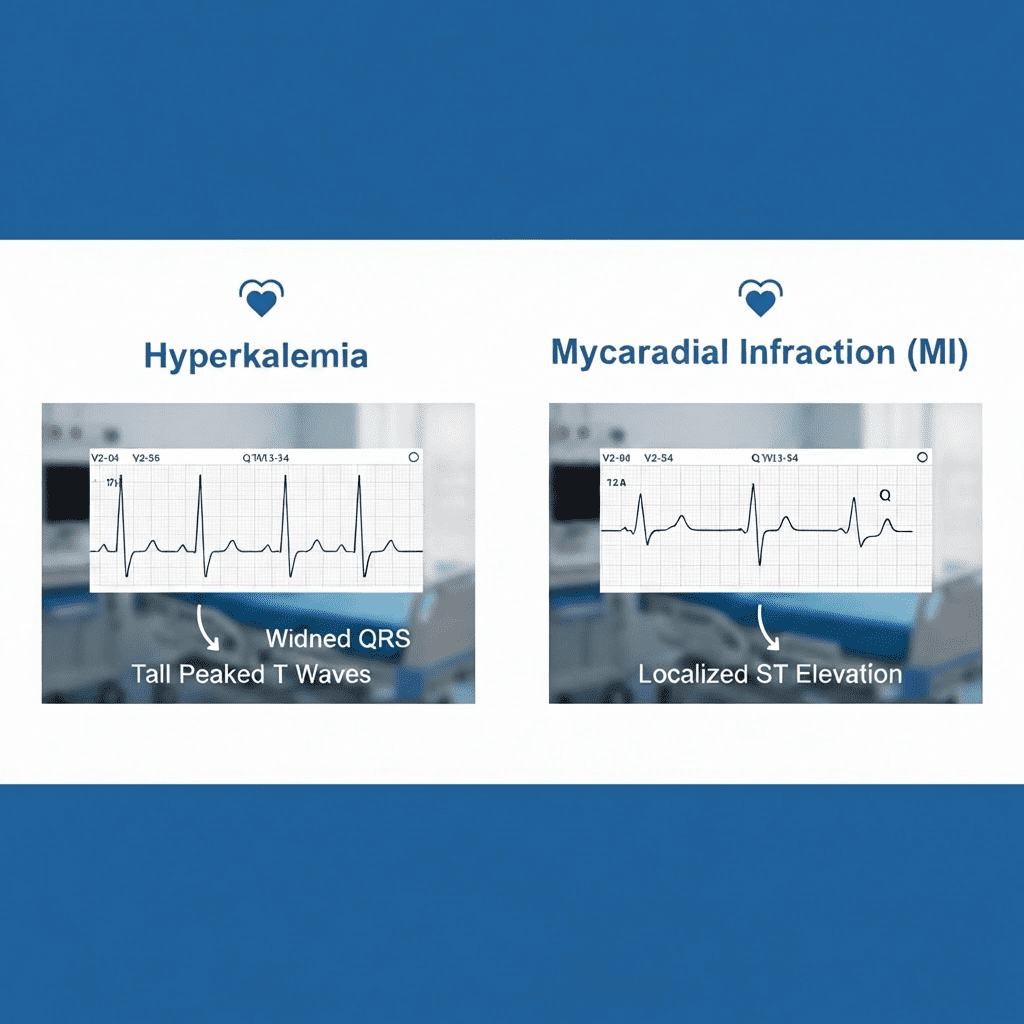
Understanding hyperkalemia vs MI ECG differences is critical for every nurse, especially when preparing for the NCLEX. These two life-threatening conditions can produce similar ECG findings — but the treatments are completely different.
Differentiating hyperkalemia from myocardial infarction (MI) on ECG can prevent fatal treatment errors and save a patient’s life.
Whether you’re a nursing student, a new registered nurse, or reviewing your cardiac section inside a comprehensive nursing bundle, this simplified guide will help you master the concept quickly.
Why Nurses Must Differentiate Hyperkalemia vs MI
Both conditions may present with:
- Chest discomfort
- Weakness
- Cardiac rhythm changes
- Abnormal ECG findings
However, the treatment priorities are very different:
- Myocardial infarction (MI) → Requires urgent reperfusion (PCI or thrombolytics)
- Hyperkalemia → Requires rapid potassium stabilization
For an RN nurse, giving the wrong treatment can worsen the patient’s condition.
What Is Hyperkalemia?
Hyperkalemia occurs when:
Serum potassium > 5.0 mEq/L
It is commonly tested on the NCLEX and frequently seen in hospital nursing practice.
Common Causes (High-Yield for NCLEX)
- Renal failure
- ACE inhibitors
- Potassium-sparing diuretics
- Tissue breakdown (burns, trauma)
- Metabolic acidosis
As a registered nurse, always review medications and kidney function in at-risk patients.
Hyperkalemia ECG Changes (Think: Peaked and Wide)
ECG changes progress as potassium rises.
Early Hyperkalemia
- Tall, narrow peaked T waves
- Shortened QT interval
Moderate Hyperkalemia
- Flattened or absent P waves
- Prolonged PR interval
- Widened QRS complex
Severe Hyperkalemia
- Very wide QRS
- Sine-wave pattern
- Ventricular fibrillation or asystole
Nursing Pearl for NCLEX
Hyperkalemia affects the entire ECG globally — not just specific leads.
What Is Myocardial Infarction (MI)?
A myocardial infarction (MI) occurs when a coronary artery becomes blocked, leading to heart muscle ischemia and necrosis.
Early recognition by a nurse or RN nurse significantly improves patient survival.
MI ECG Changes (Think: Localized Damage)
Unlike hyperkalemia, MI changes are localized to specific leads.
Classic ECG Findings
- ST-segment elevation (STEMI)
- ST depression (NSTEMI/ischemia)
- Pathological Q waves
- T wave inversion
Lead Localization (NCLEX Favorite)
- Inferior MI → II, III, aVF
- Anterior MI → V1–V4
- Lateral MI → I, aVL, V5–V6
This regional pattern helps the registered nurse distinguish MI from electrolyte abnormalities.
Hyperkalemia vs MI ECG Comparison Table
| Feature | Hyperkalemia | Myocardial Infarction (MI) |
|---|---|---|
| T Waves | Tall, narrow, peaked | Broad (hyperacute) or inverted |
| ST Elevation | Rare, diffuse | Localized |
| QRS Complex | Progressively widens | Usually normal early |
| P Waves | Flattened or absent | Present |
| Distribution | Global | Regional |
| Primary Cause | Electrolyte imbalance | Coronary blockage |
This comparison is excellent for quick revision inside your nursing bundle or during last-minute NCLEX prep.
Clinical Clues: How Nurses Can Tell the Difference
ECG is important — but clinical context is essential in nursing practice.
Hyperkalemia Clues
- History of kidney disease
- Recent medication changes
- Muscle weakness
- No classic crushing chest pain
MI Clues
- Severe chest pain
- Pain radiating to arm or jaw
- Sweating (diaphoresis)
- Elevated troponin levels
A skilled registered nurse always combines ECG findings with labs and symptoms.
Treatment Differences (Critical for NCLEX)
Hyperkalemia Treatment
- IV calcium gluconate
- Insulin + Dextrose (D50)
- Albuterol
- Sodium bicarbonate (if acidosis)
- Dialysis (severe cases)
MI Treatment
- Aspirin
- Nitroglycerin
- Oxygen (if needed)
- PCI (preferred)
- Antiplatelet and anticoagulant therapy
⚠️ Thrombolytics do NOT treat hyperkalemia.
⚠️ Delayed MI treatment increases heart muscle damage.
This is why ECG differentiation is heavily tested on the NCLEX.
NCLEX Practice Question
A patient with renal failure reports weakness. ECG shows tall peaked T waves in multiple leads and widening QRS. What is the nurse’s priority action?
A. Prepare for cardiac catheterization
B. Administer IV calcium gluconate
C. Give nitroglycerin
D. Start thrombolytics
Correct Answer: B
This question format frequently appears in cardiac sections of a structured nursing bundle.
Final Takeaways for Nurses
For every RN nurse and nursing student:
- Hyperkalemia = Peaked T waves + Wide QRS + Global changes
- MI = ST elevation + Q waves + Localized changes
- Always correlate ECG with labs and symptoms
- Both conditions require immediate intervention
Mastering ECG interpretation strengthens your confidence as a registered nurse and improves your success on the NCLEX.