
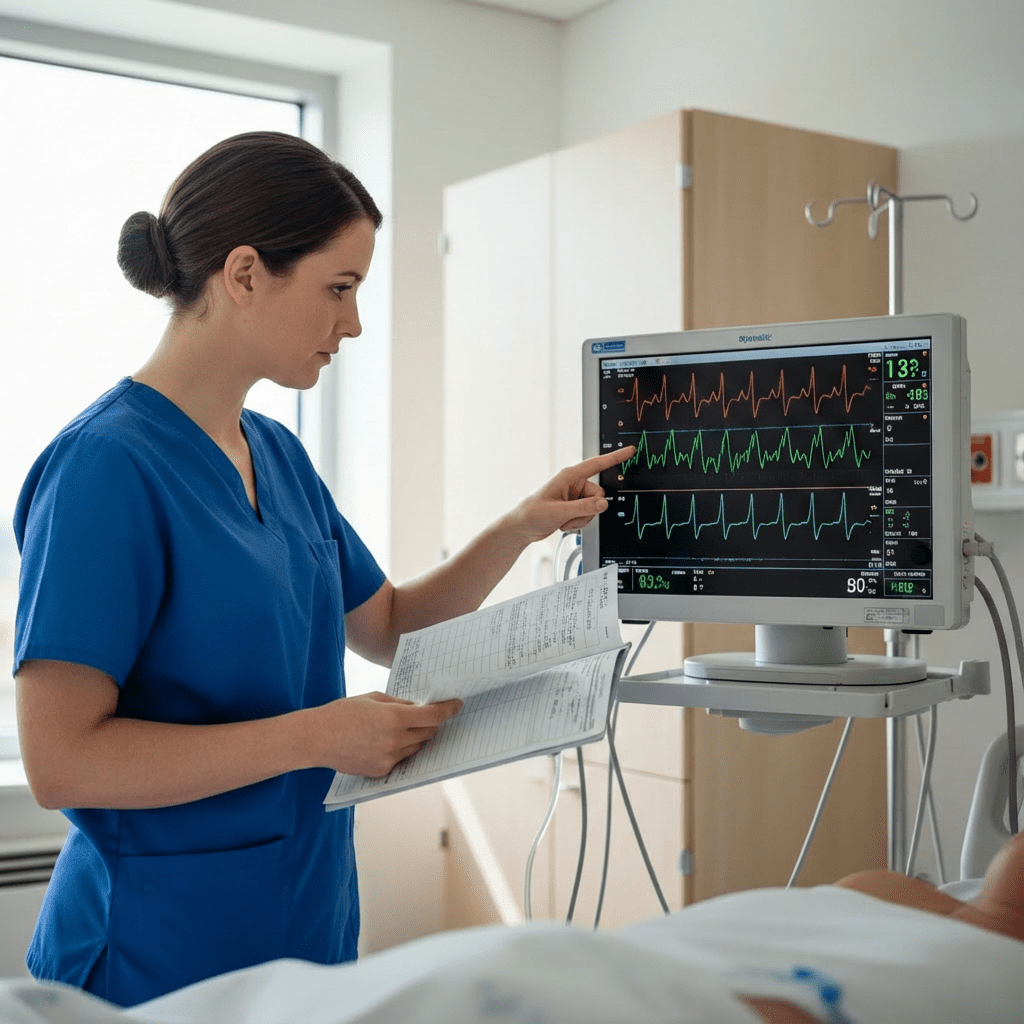
Cardiac rhythm interpretation is one of the most essential skills for any registered nurse, especially those working in emergency, telemetry, and critical care. Complex rhythms can seem intimidating at first, but with the right step-by-step approach, every RN nurse can confidently identify abnormalities and take fast, appropriate action.
This breakdown is designed to support your clinical practice, strengthen your NCLEX preparation, and fit perfectly into your nursing bundle study materials.
⭐ Why Complex Rhythm Interpretation Matters for Nurses
Accurate rhythm reading improves patient outcomes, prevents complications, and helps nurses detect life-threatening arrhythmias before they escalate. Additionally, the NCLEX frequently tests rhythm interpretation and the corresponding nursing interventions.
Whether you’re a new nurse or refreshing your knowledge, using a systematic approach ensures you never miss important details.
🪬 Step-by-Step Method for Analyzing Complex Rhythms
Below is the universal method used by expert cardiac nurses:
1. Assess the Regularity
Start by scanning the entire rhythm strip.
- Are the R-R intervals consistent?
- Do any beats look early, late, or dropped?
Irregular rhythms may indicate atrial fibrillation, heart blocks, PACs, or PVCs.
2. Calculate the Heart Rate
An RN nurse must determine if the rate is:
- Bradycardic (<60 bpm)
- Normal (60–100 bpm)
- Tachycardic (>100 bpm)
A fast or slow rate changes the entire interpretation and guides nursing priorities.
3. Examine the P-Waves
Ask yourself:
- Are P-waves present?
- Do they look normal?
- Is there one P for every QRS?
Abnormalities may indicate atrial rhythms, junctional rhythms, or AV node dysfunction.
4. Measure the PR Interval
A key step for NCLEX rhythm questions.
Normal PR = 0.12–0.20 seconds
A prolonged PR suggests 1st-degree heart block, while variable PR intervals indicate Mobitz I or II blocks.
5. Measure the QRS Complex
A registered nurse should check if the QRS is narrow or wide.
- Narrow QRS → rhythm likely atrial or junctional
- Wide QRS → ventricular rhythm or BBB (Bundle Branch Block)
Abnormal QRS findings are common in complex rhythms like VTach or BBB patterns.
6. Evaluate the QT Interval
This step is often overlooked by new nurses.
- Prolonged QT increases the risk of Torsades de Pointes
- Electrolyte imbalances and many medications affect QT
This is an NCLEX-favorite concept.
7. Analyze the T-Waves
T-wave morphology provides clues about:
- Hyperkalemia
- Hypokalemia
- Ischemia
- Ventricular strain
Peaked, inverted, or flattened T-waves must always be reported.
8. Consider Clinical Context
A rhythm is never just a rhythm. A nurse must also consider:
- Patient symptoms
- Medications (beta-blockers, digoxin, antiarrhythmics)
- Electrolyte levels
- History of cardiac disease
This helps determine whether the rhythm is compensatory, deteriorating, or life-threatening.
9. Identify the Rhythm
Once all pieces are evaluated, match the findings with common rhythm patterns:
- SVT
- Atrial flutter or fibrillation
- Ventricular tachycardia
- Heart blocks
- Junctional tachycardia
- Multifocal atrial tachycardia
- Torsades de Pointes
The step-by-step method ensures accuracy every time.
10. Determine Nursing Priorities
Depending on the rhythm, nursing care may include:
- Checking vital signs
- Applying oxygen
- Preparing for cardioversion
- Administering antiarrhythmics
- Correcting electrolytes
- Notifying the provider
- Initiating CPR (if in arrest rhythm)
A structured response saves lives.
🧠 NCLEX Tips for Complex Rhythms
- Always treat the patient, not just the monitor.
- If you see a wide and fast rhythm → think ventricular tachycardia.
- If the rhythm is irregularly irregular → think atrial fibrillation.
- Dropped QRS + constant PR → Mobitz II, a high-risk block.
- No P-waves with regular rhythm → consider junctional rhythm.
These patterns frequently appear in NCLEX practice questions.
🩺 Why This Process Helps Nurses in Real Life
Using a systematic method prevents errors, builds confidence, and enhances critical thinking. Whether you’re a new registered nurse or creating a complete nursing bundle for study, mastering this technique is essential for monitoring cardiac patients safely.