
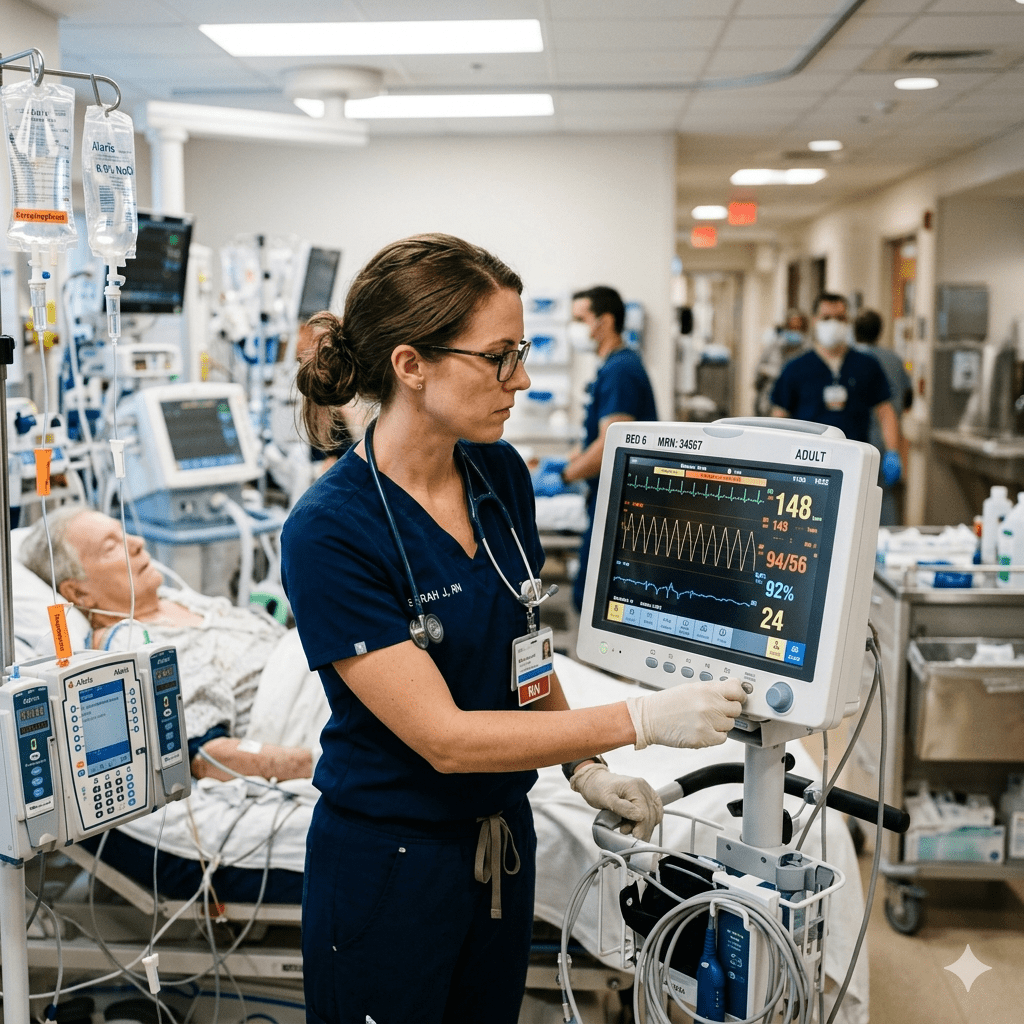
Atrioventricular dissociation is one of the most misunderstood rhythm abnormalities a nurse will encounter on the cardiac monitor — and on the NCLEX. It is not a single diagnosis but a phenomenon in which the atria and ventricles beat independently of one another, each controlled by its own pacemaker. For the registered nurse, recognizing this pattern early, understanding its underlying causes, and knowing when to escalate can be the difference between a routine shift and a rapid response. This guide breaks down the pathophysiology, EKG characteristics, clinical implications, and priority nursing interventions every RN nurse needs to know.
What Is Atrioventricular Dissociation?
Atrioventricular (AV) dissociation occurs when the atria and ventricles are driven by independent electrical impulses rather than the coordinated top-down conduction that defines normal sinus rhythm. Under normal conditions, the sinoatrial (SA) node fires, the impulse travels through the AV node, and the ventricles contract in a synchronized response. In AV dissociation, this relationship is broken.
It is critical for nursing students and practicing nurses alike to understand that AV dissociation is a consequence, not a primary diagnosis. It results from one of three broad mechanisms:
- Slowing of the dominant pacemaker — The SA node fires too slowly, allowing a lower pacemaker (junctional or ventricular) to escape and take over.
- Acceleration of a subsidiary pacemaker — A junctional or ventricular focus speeds up and overtakes the SA node, firing faster than the normal sinus rate.
- Complete AV block — Third-degree heart block causes true, complete AV dissociation, where no impulses from the atria are conducted to the ventricles at all.
Understanding this distinction is high-yield for NCLEX questions, which frequently test whether the nursing student can differentiate incomplete from complete AV dissociation.
AV Dissociation vs. Complete Heart Block: A Key Nursing Distinction
Many nurses — and many NCLEX test-takers — confuse AV dissociation with third-degree (complete) heart block. While complete heart block is always a form of AV dissociation, not all AV dissociation represents complete heart block.
| Feature | AV Dissociation (Incomplete) | Complete Heart Block |
|---|---|---|
| P waves conducted? | Sometimes (occasional capture beats) | Never |
| Ventricular rate vs. atrial rate | Ventricular ≥ Atrial | Ventricular < Atrial |
| Capture beats present? | Yes | No |
| Cause | Escape rhythm, accelerated focus | AV nodal block |
| Hemodynamic instability | Variable | Often present |
A capture beat — where a sinus impulse successfully conducts to the ventricles and produces a narrow QRS at an expected time — is the hallmark that distinguishes incomplete AV dissociation from complete block. The registered nurse should flag capture beats on the rhythm strip and report them to the provider.
EKG Characteristics: What the Nurse Must Identify
Interpreting the EKG strip is a foundational skill in cardiac nursing and a reliable NCLEX topic. In AV dissociation, look for the following:
- P waves and QRS complexes are present but unrelated — P waves “march through” the QRS complexes without consistent timing
- PR interval varies — No fixed PR interval exists because the atria and ventricles are not communicating
- Ventricular rate is often equal to or faster than the atrial rate (in incomplete dissociation)
- QRS morphology depends on the escape focus — Junctional rhythms produce narrow QRS; ventricular rhythms produce wide, bizarre QRS complexes
- Fusion beats may appear — these are hybrid complexes caused when a sinus impulse partially conducts at the same time the ventricular focus fires
The RN nurse should document the rhythm, rate, and presence or absence of capture and fusion beats when communicating with the healthcare team using SBAR (Situation, Background, Assessment, Recommendation).
Common Causes Every Nurse Should Know
AV dissociation does not develop randomly. Recognizing the clinical context helps the nurse anticipate this rhythm and respond efficiently. Common causes include:
- Digitalis toxicity — A classic pharmacologic cause; the RN nurse must monitor digoxin levels and assess for nausea, visual changes, and bradycardia
- Beta-blocker or calcium channel blocker overdose — Suppresses SA node automaticity, allowing lower pacemakers to escape
- Inferior MI — Ischemia to the AV node can produce junctional escape rhythms and dissociation
- Increased vagal tone — Seen in athletes or during valsalva maneuvers; often benign
- Post-cardiac surgery — Temporary AV dissociation may follow open-heart procedures
- Hyperkalemia — Elevated potassium levels impair conduction and can precipitate this rhythm; nurses managing electrolytes should remain alert
Each of these causes links closely to NCLEX pharmacology, electrolyte, and cardiac content tested across all nursing programs.
Priority Nursing Interventions
The nursing approach to AV dissociation is driven by hemodynamic stability. A patient with a normal blood pressure, adequate mentation, and no symptoms may require only monitoring, while a hemodynamically unstable patient requires immediate escalation.
Assessment priorities:
- Assess level of consciousness and orientation
- Obtain a full set of vital signs — blood pressure, pulse (apical and radial), oxygen saturation, and respiratory rate
- Evaluate for signs of decreased cardiac output: pallor, diaphoresis, dizziness, hypotension, chest pain
- Review current medications — especially digoxin, beta-blockers, and antiarrhythmics
Nursing interventions:
- Place the patient on continuous cardiac monitoring
- Establish IV access if not already present
- Obtain a 12-lead EKG and notify the provider with SBAR report
- Prepare for atropine administration if symptomatic bradycardia accompanies the dissociation
- Anticipate transcutaneous pacing for hemodynamically significant complete AV block
- If digitalis toxicity is suspected, hold the medication, obtain a serum digoxin level, and prepare digoxin immune Fab (Digibind) if ordered
- Implement fall precautions in patients with dizziness or altered perfusion
A well-prepared nursing bundle that covers cardiac rhythms, ACLS algorithms, and EKG interpretation will reinforce these interventions and solidify clinical decision-making for both the exam and the bedside.
💡 NCLEX Tips for Atrioventricular Dissociation
- AV dissociation is a finding, not a primary diagnosis — always identify the underlying cause on the NCLEX
- Complete heart block = ventricular rate slower than atrial rate, with NO capture beats
- Capture beats rule OUT complete heart block — the AV node still conducts occasionally
- Digoxin toxicity is a classic NCLEX trigger for AV dissociation — always check the level and review symptoms
- If a patient with AV dissociation is hypotensive or unconscious, the nurse’s priority is immediate provider notification and preparation for pacing
Hemodynamic Monitoring in AV Dissociation
Loss of AV synchrony — the coordinated timing of atrial and ventricular contraction — reduces cardiac output by approximately 15–30%. This is clinically significant, especially in patients with pre-existing heart failure, cardiomyopathy, or valvular disease. Nurses in the ICU or telemetry unit should monitor:
- Arterial line readings for beat-to-beat pressure variation
- Central venous pressure for signs of fluid overload or poor forward flow
- Urine output — less than 0.5 mL/kg/hr signals declining perfusion
- Mental status changes — restlessness or confusion may be the earliest indicator of compromised cerebral perfusion in older patients
Nurses using a comprehensive nursing bundle during clinical preparation will find these hemodynamic parameters covered in the cardiac and critical care modules, making it easier to apply knowledge from classroom to bedside.
Conclusion
Atrioventricular dissociation nursing knowledge is essential for any registered nurse working in cardiac, telemetry, critical care, or emergency settings — and it remains a reliable source of NCLEX questions that test rhythm interpretation, pharmacologic awareness, and priority-setting. By mastering the EKG features, clinical causes, and hemodynamic consequences of AV dissociation, the RN nurse is better equipped to act quickly, communicate effectively, and protect patient safety.
Reinforce your understanding with practice questions and test your cardiac rhythm skills today at rn-nurse.com/nclex-qcm/. For a structured review of EKG interpretation and advanced cardiology concepts, explore the full nursing courses at rn-nurse.com.