
A High-Yield NCLEX Guide for the Nurse, Registered Nurse, and RN Nurse
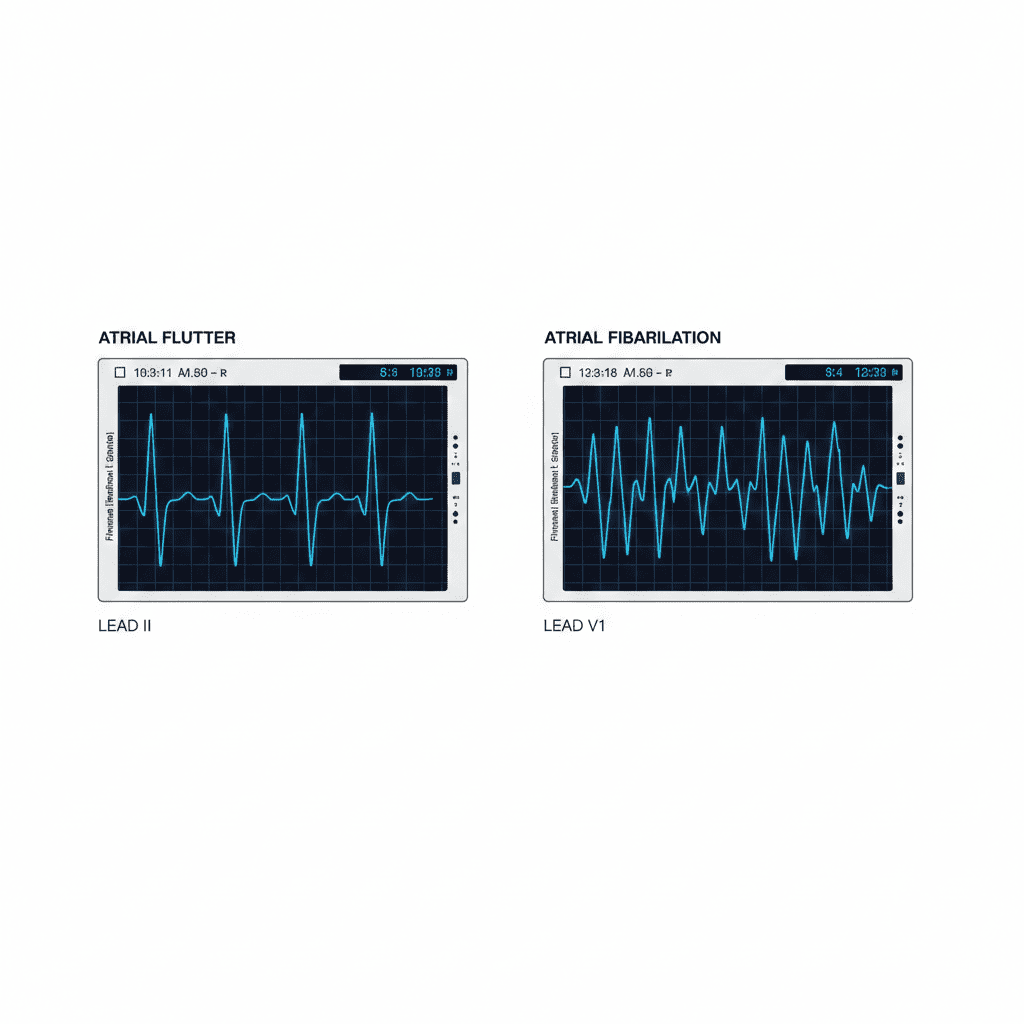
Atrial flutter is regular and sawtooth-shaped, while atrial fibrillation is irregularly irregular with no visible P waves.
For every nurse, registered nurse, and RN nurse, distinguishing atrial flutter (AFL) from atrial fibrillation (AFib) is a critical ECG interpretation skill. Both are supraventricular arrhythmias, both increase stroke risk, and both are commonly tested on the NCLEX — yet their ECG patterns and management strategies have subtle but important differences.
Mastering these differences strengthens clinical decision-making in cardiac nursing practice.
What Is Atrial Flutter?
Atrial flutter is caused by a single reentry circuit in the atria, usually the right atrium.
Key ECG Finding:
AtrialRate≈250–350bpm(SawtoothFwaves)Atrial Rate ≈ 250–350 bpm (Sawtooth F waves)AtrialRate≈250–350bpm(SawtoothFwaves)
Characteristics:
- Sawtooth “flutter waves” (F waves)
- No distinct P waves
- Atrial rate 250–350 bpm
- Ventricular rhythm may be regular (e.g., 2:1 conduction)
For the bedside nurse, atrial flutter often appears organized and repetitive.
What Is Atrial Fibrillation?
Atrial fibrillation results from chaotic atrial electrical activity with multiple reentry circuits.
Key ECG Finding:
IrregularlyIrregularRhythm+NoDiscerniblePWavesIrregularly Irregular Rhythm + No Discernible P WavesIrregularlyIrregularRhythm+NoDiscerniblePWaves
Characteristics:
- No P waves
- Irregularly irregular ventricular rhythm
- Fibrillatory baseline
- Variable R-R intervals
For the RN nurse, AFib is recognized by its unpredictability.
Visual ECG Comparison
| Feature | Atrial Flutter | Atrial Fibrillation |
|---|---|---|
| P waves | No | No |
| Baseline | Sawtooth pattern | Chaotic fibrillation |
| Rhythm | Often regular | Irregularly irregular |
| Atrial Rate | 250–350 bpm | 350–600 bpm |
| Stroke Risk | Yes | Yes |
This table format is frequently tested on the NCLEX.
Subtle Differences Every Nurse Must Know
1️⃣ Rhythm Regularity
- Flutter → Often regular ventricular response
- AFib → Always irregularly irregular
This is one of the most reliable distinguishing clues.
2️⃣ Atrial Activity Appearance
- Flutter → Organized, repeating pattern
- AFib → Disorganized, chaotic baseline
For the experienced registered nurse, pattern recognition becomes intuitive with practice.
3️⃣ Ventricular Response
Both can present with:
- Rapid ventricular response (RVR)
- Stable or unstable presentations
Rate control is a priority in both arrhythmias.
Why Both Matter Clinically
Both atrial flutter and atrial fibrillation:
- Increase risk of thrombus formation
- Increase risk of ischemic stroke
- Require anticoagulation consideration
In cardiac nursing, stroke prevention is just as important as rhythm control.
Nursing Assessment Priorities
For the RN nurse:
- Assess hemodynamic stability
- Monitor heart rate
- Evaluate blood pressure
- Assess for chest pain or dyspnea
- Monitor for signs of decreased cardiac output
Unstable patients may require synchronized cardioversion.
Nursing Bundle for AFib and Atrial Flutter
A structured cardiac nursing bundle includes:
- Continuous telemetry monitoring
- Rate control medication administration (per order)
- Anticoagulation monitoring
- Stroke risk assessment
- Electrolyte correction
- Patient education
This bundle approach improves patient outcomes and reduces complications.
NCLEX High-Yield Pearls
✔️ AFib = irregularly irregular
✔️ Flutter = sawtooth pattern
✔️ Both increase stroke risk
✔️ Anticoagulation often required
✔️ Cardioversion for unstable patients
The NCLEX often presents ECG strips requiring rhythm identification and immediate action.
Common Clinical Scenario (NCLEX Style)
A telemetry patient shows a sawtooth pattern in lead II with a ventricular rate of 150 bpm.
Most likely rhythm?
→ Atrial flutter with 2:1 conduction.
A different patient shows no P waves and irregular R-R intervals.
→ Atrial fibrillation.
For the practicing nurse, this distinction guides treatment strategy.
Complications to Anticipate
For both rhythms:
- Stroke
- Heart failure
- Hypotension (if RVR present)
In advanced nursing practice, early intervention prevents deterioration.
Advanced Clinical Insight for the Registered Nurse
Atrial flutter can convert into atrial fibrillation — and vice versa.
Both are treated with:
- Rate control (beta blockers, calcium channel blockers)
- Rhythm control (antiarrhythmics)
- Anticoagulation
However, flutter may respond more predictably to ablation therapy.
Understanding pathophysiology enhances clinical reasoning for the RN nurse.
Final Thoughts for the Nurse and RN Nurse
Atrial flutter and atrial fibrillation may appear similar at first glance — but their ECG patterns reveal subtle distinctions.
For every registered nurse, mastering these differences:
- Improves rapid rhythm identification
- Strengthens NCLEX performance
- Enhances stroke prevention
- Supports safe cardiac nursing care
When interpreting telemetry:
If it’s regular and sawtooth → Think flutter.
If it’s irregularly irregular → Think AFib.
Small differences on the monitor can mean major differences in patient care.