Introduction
Tuberculosis is one of the oldest infectious diseases, and it’s still a major concern. It spreads through the air, so it can reach other patients and staff before anyone suspects it. Therefore, fast recognition and correct isolation protect everyone. Nurses also support months of treatment, which makes this topic both an infection control skill and a patient teaching skill. This guide covers what TB is, how to isolate patients, how treatment works, and what to teach.
Table of Contents
- What Is Tuberculosis?
- Latent TB Infection vs. TB Disease
- Risk Factors
- Signs and Symptoms
- Diagnosis
- Airborne Precautions
- Treatment of Latent TB Infection
- Treatment of TB Disease
- Medication Side Effects and Monitoring
- Nursing Interventions
- Public Health Responsibilities
- Patient Education
- Complications
- NCLEX Tips and Memory Tricks
- Clinical Pearls
- Key Takeaways
- FAQs
- References
What Is Tuberculosis?
Tuberculosis is an infection caused by Mycobacterium tuberculosis. It most often affects the lungs. The bacteria spread when a person with TB disease coughs, speaks, or sneezes, and others inhale the tiny airborne droplet nuclei. Not everyone who inhales the bacteria becomes sick, so two conditions exist.
Latent TB Infection vs. TB Disease
| Feature | Latent TB Infection | TB Disease |
|---|---|---|
| Symptoms | None | Cough, fever, night sweats, weight loss |
| Contagious | No | Yes, when in the lungs or airway |
| Chest X-ray | Usually normal | Often abnormal |
| TB blood test or skin test | Positive | Usually positive |
| Risk | May progress to disease without treatment | Can spread and can be fatal |
| Treatment | Short-course preventive therapy | Multi-drug therapy over months |
The CDC estimates that up to 13 million people in the United States have latent TB infection. Treating it prevents TB disease, so testing people at higher risk is an important public health step.
Risk Factors
- Close contact with a person who has infectious TB
- HIV infection or other immunosuppression, including some biologic and steroid therapies
- Diabetes, kidney disease, and malnutrition
- Substance use and heavy alcohol use
- Homelessness, incarceration, or crowded living settings
- Birth in or travel to countries where TB is common
- Healthcare work, especially in high-risk settings
- Age extremes, such as children under 5
Signs and Symptoms
- A cough lasting 3 weeks or longer
- Coughing up blood (hemoptysis) or bloody sputum
- Chest pain
- Fever, chills, and night sweats
- Unintended weight loss and loss of appetite
- Fatigue and weakness
Because immunocompromised patients and older adults may present atypically, keep a high index of suspicion.
Diagnosis
- TB blood test (IGRA): CDC prefers it for testing at-risk people when possible, since it isn’t affected by prior BCG vaccination
- Tuberculin skin test: a positive result depends on induration size and the patient’s risk group
- Chest X-ray: may show upper-lobe infiltrates or cavities in active disease
- Sputum tests: acid-fast bacilli smears, culture, and rapid molecular tests. Collect early-morning specimens, and collect several as ordered
- Drug susceptibility testing: guides therapy and detects resistance
A positive TB test with a normal chest X-ray and no symptoms usually means latent infection. Still, a positive test alone doesn’t tell you whether the infection is latent or active.
Airborne Precautions
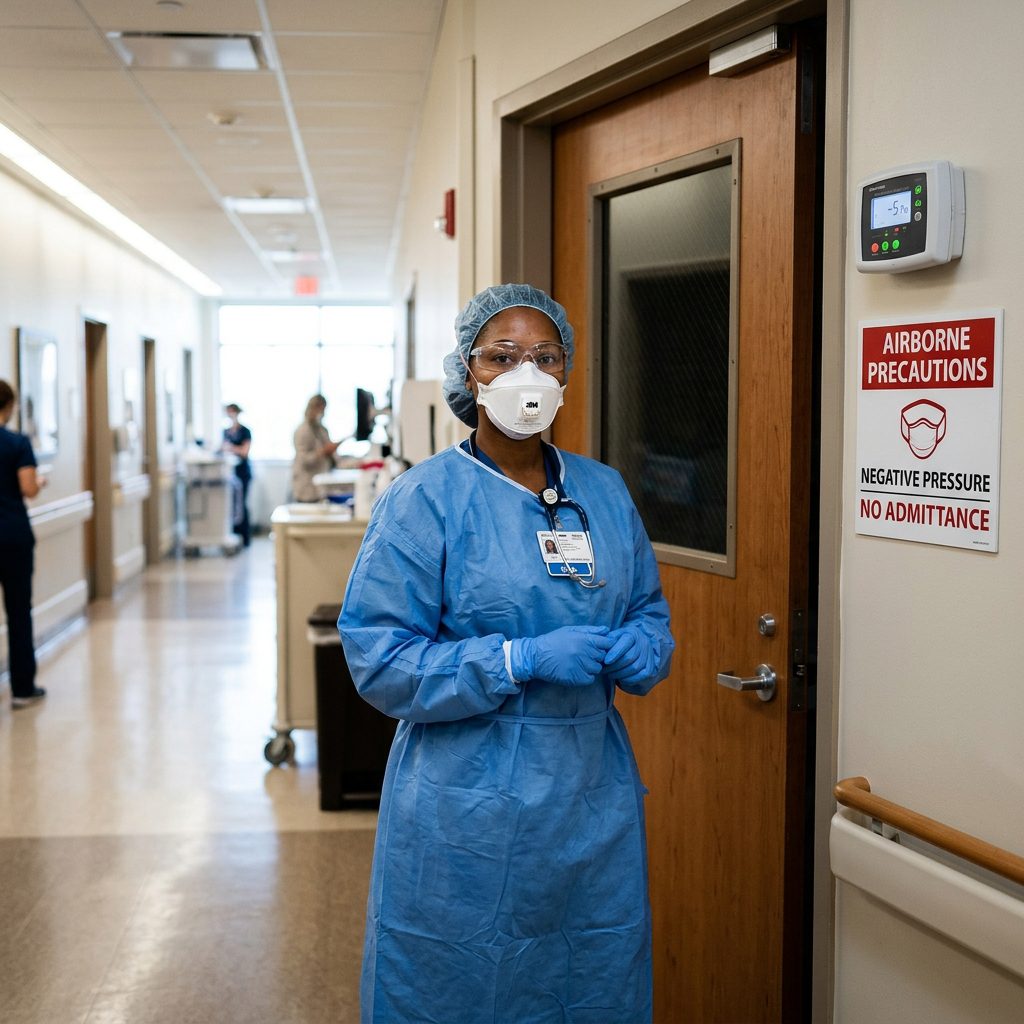
All patients with suspected or confirmed TB disease need airborne precautions right away, without waiting for test results. The key elements are:
- Airborne infection isolation room (AIIR): a negative-pressure room with the door kept closed
- Fit-tested N95 respirator (or PAPR) for all staff and visitors entering the room
- Surgical mask on the patient when leaving the room, and limit transport to essential needs
- Cover your cough: teach the patient to cover the mouth and nose
- Limit cough-inducing and aerosol-generating procedures, and perform them in appropriate controlled areas
- Post clear signage and keep a log of room entry if facility policy requires it
- Notify infection prevention and the local health department
A surgical mask on staff doesn’t protect them. Only a properly fitted N95 or PAPR does.
Discontinuing isolation: facilities usually require clinical improvement, effective treatment, and a set number of negative sputum smears before stopping isolation. Follow your facility policy and the health department’s direction.
Treatment of Latent TB Infection
The CDC and the National Tuberculosis Controllers Association prefer short-course, rifamycin-based regimens over 6- or 9-month isoniazid alone. Preferred regimens include:
- 3HP: isoniazid plus rifapentine once weekly for 3 months
- 4R: rifampin daily for 4 months
- 3HR: isoniazid plus rifampin daily for 3 months
Shorter regimens improve completion rates. The provider chooses the regimen based on age, drug interactions, and other factors.
Treatment of TB Disease
Standard treatment for drug-susceptible TB uses several drugs, so the bacteria can’t develop resistance. The usual approach is:
- An intensive phase of four drugs for the first 8 weeks: rifampin, isoniazid, pyrazinamide, and ethambutol (often called RIPE)
- A continuation phase with fewer drugs for several more months, with a total course of about 6 months or longer
Some patients may qualify for shorter regimens, and drug-resistant TB needs specialist-guided treatment. Because stopping early can cause relapse and resistance, adherence is critical. Many programs use directly observed therapy (DOT), in which a health worker watches the patient take each dose.
Medication Side Effects and Monitoring
| Drug | Key Concern | Nursing Action |
|---|---|---|
| Isoniazid | Hepatotoxicity, peripheral neuropathy | Monitor liver tests and symptoms; pyridoxine (B6) as ordered |
| Rifampin | Hepatotoxicity, orange-red body fluids, many drug interactions | Warn that urine, sweat, and tears turn orange, and can stain contact lenses; review interactions, including hormonal contraceptives |
| Pyrazinamide | Hepatotoxicity, high uric acid and joint pain | Monitor liver tests and uric acid; ask about joint pain |
| Ethambutol | Optic neuritis | Check visual acuity and color vision; report vision changes immediately |
Instruct patients to stop the medication and seek care at once if they develop yellow skin or eyes, dark urine, severe nausea, abdominal pain, or vision changes. Also advise them to avoid alcohol.
Nursing Interventions
- Implement airborne precautions immediately on suspicion
- Wear a fit-tested N95, and verify the room’s negative pressure indicator if available
- Monitor respiratory status, oxygen saturation, and fever
- Encourage coughing and deep breathing, and use incentive spirometry as ordered
- Change the patient’s position at least every 2 hours
- Support nutrition, since weight loss is common
- Collect sputum specimens correctly, usually early in the morning, and label them promptly
- Administer medications on time, and watch for side effects
- Monitor liver function results and report abnormal values
- Support adherence with teaching, reminders, and DOT
- Reduce stigma by providing respectful, private, nonjudgmental care
- Document precautions, teaching, and patient response
Public Health Responsibilities
- Report all suspected and confirmed cases to the local health department according to law
- Support contact investigation by helping identify people exposed to the patient
- Coordinate discharge planning with the health department so treatment continues
- Maintain patient confidentiality while sharing required information
- For home visits, follow protective measures such as respirator use in line with your agency’s TB infection control plan
Patient Education
- Explain that TB is curable when patients take all medicine as prescribed
- Stress the importance of finishing the full course, even after symptoms improve
- Teach cough etiquette: cover the mouth and nose, and dispose of tissues properly
- Explain isolation, mask use, and why visitors need respirators
- Review medication side effects and when to call the provider
- Advise avoiding alcohol during treatment
- Encourage follow-up appointments, lab monitoring, and sputum checks
- Offer resources for nutrition, housing, and social support
- Encourage close contacts to get tested
Complications
- Spread to other organs, including meninges, bones, kidneys, and lymph nodes
- Drug-resistant TB, especially after incomplete treatment
- Lung damage and respiratory failure
- Massive hemoptysis
- Drug-induced liver injury
- Death, if untreated
NCLEX Tips and Memory Tricks
- TB means airborne precautions: negative-pressure room, N95 for staff, surgical mask on the patient for transport.
- Start isolation on suspicion, not after confirmation.
- Latent TB isn’t contagious. TB disease is.
- Adherence matters most, because multiple drugs for months prevent resistance.
- Ethambutol affects the eyes. Rifampin turns body fluids orange. Isoniazid affects the nerves and liver.
- Mnemonic — “RIPE”: Rifampin (orange fluids), Isoniazid (neuropathy, liver), Pyrazinamide (gout and liver), Ethambutol (eyes).
Clinical Pearls
- A fit-tested N95 only works if it seals. Perform a seal check every time.
- Many patients stop feeling sick within weeks, so they stop medicine early. Emphasize completion at every visit.
- Ask about vision and liver symptoms at every follow-up. Early side effects are easy to fix, but late ones can cause harm.
Key Takeaways
- TB spreads through the air, so suspected TB disease needs immediate airborne isolation with a negative-pressure room and N95 for staff.
- Latent TB infection isn’t contagious, but treatment prevents progression. The CDC prefers 3- and 4-month rifamycin-based regimens.
- TB disease needs multi-drug therapy for months, and directly observed therapy helps adherence.
- Nurses monitor drug side effects, report cases, support contact investigation, and educate patients with respect.
FAQs
What precautions are needed for tuberculosis?
Airborne precautions: a negative-pressure room with the door closed, a fit-tested N95 respirator for staff, and a surgical mask on the patient when leaving the room.
What is the difference between latent TB and active TB?
Latent TB causes no symptoms and doesn’t spread, but it can progress. Active TB causes symptoms such as cough, fever, night sweats, and weight loss, and it can spread to others.
Why do TB patients take several medications?
Using several drugs together kills the bacteria more effectively and prevents resistance from developing.
What are the side effects of TB medications?
Liver injury, peripheral neuropathy with isoniazid, orange body fluids with rifampin, gout with pyrazinamide, and optic neuritis with ethambutol.
When can airborne isolation stop?
Facilities usually require clinical improvement, effective therapy, and negative sputum results according to policy and health department guidance.
References
- CDC — Clinical Overview of Tuberculosis
- CDC — Guidelines for Preventing the Transmission of Mycobacterium tuberculosis in Health-Care Settings
- MMWR/NTCA — Guidelines for the Treatment of Latent Tuberculosis Infection (2020)
- Washington State Department of Health — Tuberculosis Guidelines for Health Care Providers
- Nurse.com Clinical Guides — Tuberculosis: Nursing Diagnosis and Interventions
RELATED ARTICLES:
- https://rn-nurse.com/standard-vs-transmission-based-precautions/
- https://rn-nurse.com/infection-control-standard-vs-transmission-based-precautions-nclex-nursing-guide/
- https://rn-nurse.com/proper-hand-hygiene-prevent-infections/
- https://rn-nurse.com/lab-value-cheats/
- https://rn-nurse.com/drug-toxicity-signs/
- https://rn-nurse.com/high-alert-medications-nurses/