
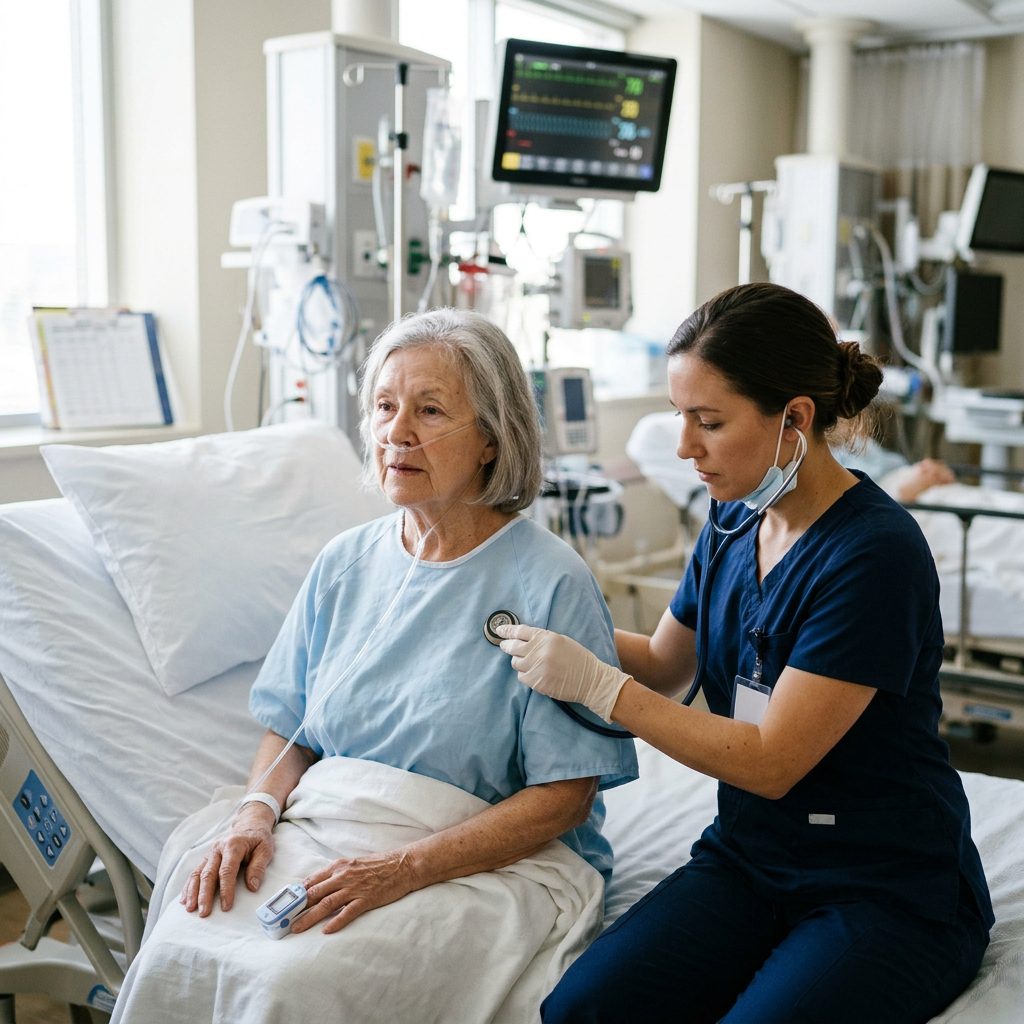
Introduction
Pneumonia remains one of the most common reasons adults are hospitalized, and it can turn serious quickly. Nurses often notice the first sign, such as a rising respiratory rate or new confusion. Because early action improves outcomes, careful assessment matters. This guide covers the types of pneumonia, current severity criteria, nursing interventions, and the prevention steps that reduce risk.
Table of Contents
- What Is Pneumonia?
- Types of Pneumonia
- Risk Factors
- Signs and Symptoms
- Nursing Assessment
- Diagnostic Workup
- Severity Assessment
- Treatment
- Nursing Interventions
- Prevention
- Complications
- Discharge Teaching
- NCLEX Tips and Memory Tricks
- Clinical Pearls
- Key Takeaways
- FAQs
- References
What Is Pneumonia?
Pneumonia is an infection of the lung parenchyma. Bacteria, viruses, or fungi cause the air sacs to fill with fluid and inflammatory cells. As a result, gas exchange drops, and the patient develops cough, fever, and breathing problems. Most hospital teaching centers on bacterial pneumonia, although viral pneumonia is also common.
Types of Pneumonia
| Type | Definition | Notes |
|---|---|---|
| Community-acquired (CAP) | Acquired outside the hospital, or within 48 hours of admission | Most common; typical pathogens include Streptococcus pneumoniae |
| Hospital-acquired (HAP) | Develops 48 hours or more after admission | Higher risk of resistant organisms such as MRSA and Pseudomonas |
| Ventilator-associated (VAP) | Develops 48 hours or more after intubation | Prevented with VAP bundles |
| Aspiration pneumonia | Follows inhalation of stomach contents or oral secretions | Common in dysphagia and decreased consciousness |
Risk Factors
- Age over 65 or under 2
- Chronic lung disease, heart disease, or diabetes
- Smoking and heavy alcohol use
- Weakened immune system
- Dysphagia, stroke, or decreased level of consciousness
- Recent viral respiratory infection
- Mechanical ventilation and prolonged immobility
- Poor oral hygiene
- Residence in a long-term care facility
Signs and Symptoms
- Fever and chills
- Productive or dry cough, sometimes with discolored sputum
- Shortness of breath and rapid breathing
- Pleuritic chest pain
- Fatigue and loss of appetite
- Crackles, bronchial breath sounds, or dullness to percussion over the affected area
- Older adults may show only confusion, weakness, falls, or poor appetite, without fever or cough
Nursing Assessment
- Measure respiratory rate, oxygen saturation, and heart rate
- Observe work of breathing, accessory muscle use, and ability to speak in full sentences
- Auscultate all lung fields and compare sides
- Note cough characteristics and sputum color, amount, and odor
- Check temperature trends
- Assess level of consciousness and orientation, since new confusion signals worsening illness
- Review hydration status
- Assess swallowing ability if aspiration is a concern
- Screen for sepsis with each assessment
Diagnostic Workup
- Chest imaging: chest X-ray usually confirms suspected pneumonia. Where resources and training exist, clinicians can also use lung ultrasound
- Blood tests: CBC and basic chemistry, and lactate if sepsis is suspected
- Cultures: blood and sputum cultures when indicated, ideally before starting antibiotics
- Urinary antigen testing: guidelines recommend it for S. pneumoniae and Legionella mainly in severe pneumonia
- Procalcitonin: can support antibiotic de-escalation, but clinicians shouldn’t use it alone to start antibiotics
- ABG: helps assess oxygenation and ventilation in severe cases
Severity Assessment
Severity guides where the patient receives care. The 2019 ATS/IDSA guideline recommends the Pneumonia Severity Index over CURB-65 for decisions about hospital admission, although many units still use CURB-65. CURB-65 scores confusion, urea, respiratory rate of 30 or higher, low blood pressure, and age 65 or older.
The updated ATS guideline, published in January 2026, defines severe CAP with these criteria:
| Category | Criterion |
|---|---|
| Major | Septic shock requiring vasopressors |
| Major | Respiratory failure requiring mechanical ventilation |
| Minor | Respiratory rate 30 or higher |
| Minor | PaO2/FiO2 ratio 250 or lower |
| Minor | Multilobar infiltrates |
| Minor | Confusion or disorientation |
Clinicians typically diagnose severe CAP with one major criterion or three or more minor criteria. Earlier criteria also counted leukopenia, thrombocytopenia, hypothermia, and a need for aggressive fluid resuscitation. Importantly, nurses who spot a rising respiratory rate or new confusion help the team catch severe disease early.
Treatment
- Antibiotics: the provider selects therapy based on severity, setting, and risk of resistant organisms. For severe pneumonia, common regimens combine a beta-lactam such as ceftriaxone with a macrolide
- Duration: guidelines support treating for at least 5 days with clinical stability, and many mild or moderate cases need no more. Longer courses add risk without added benefit, so stewardship matters
- Oxygen: titrate to the ordered target, and use a lower range in patients at risk of carbon dioxide retention
- Fluids: replace losses, but avoid overload in patients with heart failure
- Respiratory support: high-flow oxygen, noninvasive ventilation, or mechanical ventilation for severe disease
- Sepsis management: start the sepsis bundle promptly when criteria appear
Nursing Interventions
- Give antibiotics on time, after cultures when possible, and monitor for allergic reactions and side effects
- Monitor oxygen saturation continuously or often, and titrate oxygen as ordered
- Position the patient upright in semi-Fowler’s or high Fowler’s position. In unilateral pneumonia, lying with the healthy lung down can improve oxygenation
- Encourage coughing and deep breathing every 1 to 2 hours while awake
- Use incentive spirometry as ordered
- Promote hydration, since fluids thin secretions, unless contraindicated
- Support nutrition and rest, and cluster care to conserve energy
- Provide oral care regularly to lower bacteria in the mouth
- Follow aspiration precautions for patients with dysphagia or low consciousness
- Encourage early mobility as tolerated
- Monitor for deterioration: rising respiratory rate, falling oxygen saturation, new confusion, low blood pressure
- Use isolation precautions as the organism and facility policy require
Prevention
- Teach and encourage pneumococcal and influenza vaccination, and discuss other recommended vaccines, such as COVID-19 and RSV, with eligible patients per current immunization guidance
- Perform strict hand hygiene
- Support smoking cessation
- Follow VAP and HAP prevention bundles, including head-of-bed elevation, oral care, and daily sedation review
- Screen swallowing before oral intake in at-risk patients
- Encourage early mobility after surgery and illness
Complications
- Respiratory failure and ARDS
- Sepsis and septic shock
- Pleural effusion and empyema
- Lung abscess
- Atrial fibrillation and other cardiac events
- Delirium, especially in older adults
- Death in severe disease
Discharge Teaching
- Complete the entire antibiotic course as prescribed
- Rest, drink fluids, and increase activity gradually
- Keep taking deep breaths and using the incentive spirometer if instructed
- Avoid smoking and secondhand smoke
- Review vaccines
- Return for worsening shortness of breath, high fever, chest pain, confusion, or coughing blood
- Schedule follow-up as directed, since some patients need a follow-up chest X-ray
NCLEX Tips and Memory Tricks
- Crackles, productive cough, and fever suggest pneumonia.
- New confusion in an older adult can be the first sign.
- Position upright, and consider the good lung down in unilateral pneumonia.
- Collect cultures before antibiotics when possible.
- Rising respiratory rate and confusion signal severe disease.
- Mnemonic — “LUNGS”: Listen to breath sounds, Upright positioning, Need for oxygen titration, Give antibiotics on time, Screen for sepsis.
Clinical Pearls
- Don’t wait for fever in older adults. Confusion, falls, or poor intake may be all you see.
- Ask whether the patient can swallow safely. Aspiration often starts the problem and returns after discharge.
- Check the trend, not a single reading. A slowly rising respiratory rate over a shift often shows deterioration before a number crosses a threshold.
Key Takeaways
- Pneumonia infects the lung tissue and causes cough, fever, dyspnea, and abnormal breath sounds.
- The updated ATS guideline defines severe CAP using major and minor criteria that include respiratory rate, oxygenation, imaging, and mental status.
- Nursing care centers on respiratory monitoring, positioning, airway clearance, timely antibiotics, hydration, and sepsis screening.
- Vaccination, oral care, aspiration precautions, and hand hygiene reduce risk.
FAQs
What are the signs and symptoms of pneumonia?
Fever, cough, sputum, shortness of breath, pleuritic chest pain, fatigue, and crackles on auscultation. Older adults may show only confusion or weakness.
How do you position a patient with pneumonia?
Upright in semi-Fowler’s or high Fowler’s position. In unilateral pneumonia, positioning the patient with the healthy lung down can improve oxygenation.
What defines severe community-acquired pneumonia?
Major criteria (septic shock requiring vasopressors, respiratory failure requiring mechanical ventilation) or minor criteria (respiratory rate 30 or higher, PaO2/FiO2 of 250 or lower, multilobar infiltrates, confusion). Clinicians typically use one major or three or more minor criteria.
How long should antibiotics last for pneumonia?
Guidelines support at least 5 days with clinical stability, with shorter courses reasonable in some mild or moderate cases. Severe pneumonia often needs a longer course.
How can nurses help prevent pneumonia?
Promote vaccination, hand hygiene, oral care, aspiration precautions, early mobility, smoking cessation, and adherence to VAP and HAP bundles.
References
- American Thoracic Society — Diagnosis and Management of Community-Acquired Pneumonia: An Official ATS Clinical Practice Guideline (American Journal of Respiratory and Critical Care Medicine, 2026)
- Medscape — Community-Acquired Pneumonia: ATS 2025 Guideline Summary
- Guideline Central — ATS/IDSA Pneumonia Guidelines Timeline (2019–2025)
- ebm.one — New ATS Guidelines on Community-Acquired Pneumonia
- SimpleNursing — Nursing Diagnosis for Pneumonia: Sample Care Plans and Interventions
RELATED ARTICLES: