
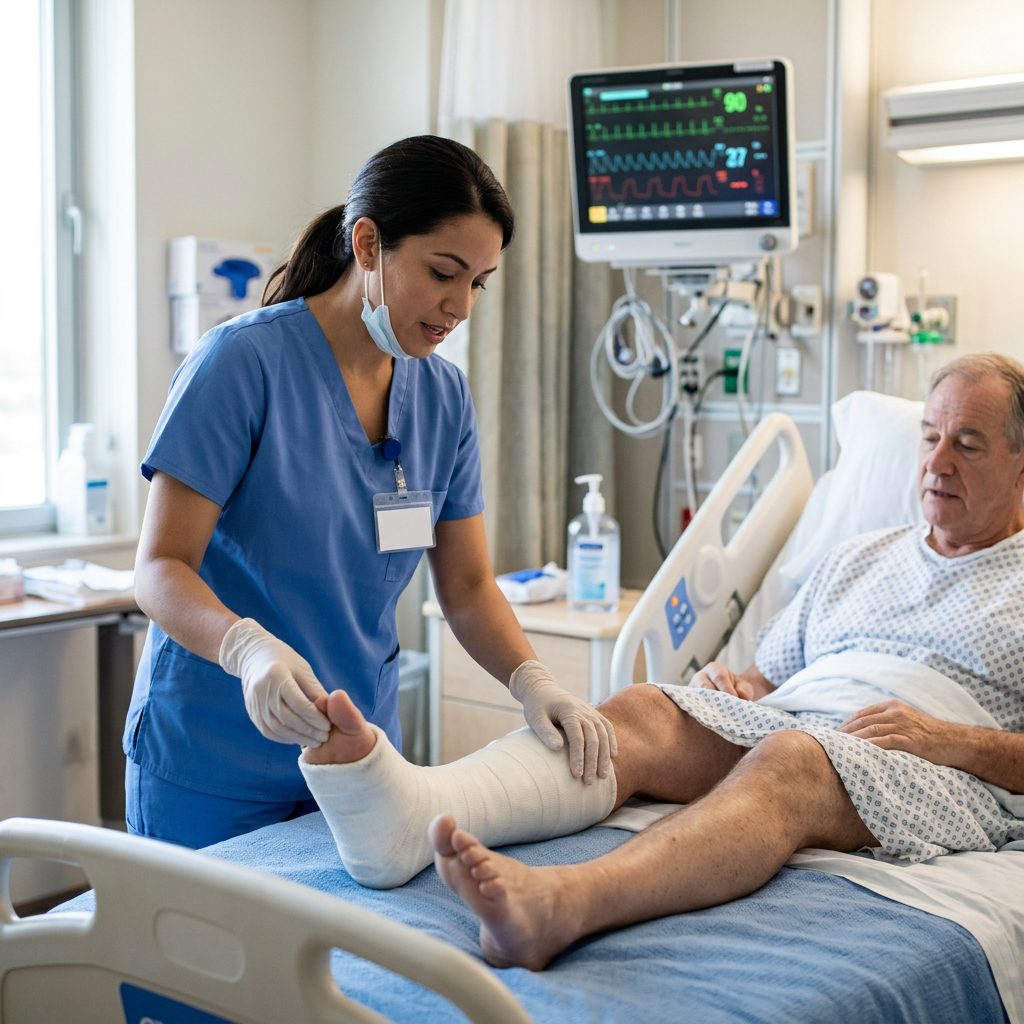
Introduction
Compartment syndrome moves fast, and delayed recognition can cost a patient their limb or even their life. Because nurses check the limb more often than anyone else on the team, they often spot the first warning sign. Yet many nurses learn the “6 Ps” and wait for pulses to disappear, which is far too late. This guide shows you what to watch for early, what to do immediately, and what to expect after treatment.
Table of Contents
- What Is Compartment Syndrome?
- Causes and Risk Factors
- Pathophysiology
- Early Signs vs. Late Signs
- Pediatric Considerations
- Nursing Assessment
- Diagnosis
- Immediate Nursing Actions
- Treatment: Fasciotomy
- Post-Fasciotomy Nursing Care
- Complications
- NCLEX Tips and Memory Tricks
- Clinical Pearls
- Key Takeaways
- FAQs
- References
What Is Compartment Syndrome?
Acute compartment syndrome (ACS) is a surgical emergency. Pressure rises within a closed osteofascial compartment, so blood flow to the muscles and nerves inside drops. Without prompt treatment, tissue dies. In fact, a delay in initial recognition is a critical factor behind poor outcomes, including amputation and death.
Causes and Risk Factors
- Fractures, especially of the tibia and forearm
- Crush injuries and high-energy trauma
- Tight casts, splints, bandages, or circumferential dressings
- Reperfusion after a period of ischemia
- Burns, especially circumferential burns
- Bleeding into a compartment, including in patients on anticoagulants
- Prolonged limb compression during immobility or surgery
- IV or medication infiltration
Pathophysiology
First, swelling or bleeding increases pressure inside a tight compartment. Next, venous outflow slows, and the pressure climbs further. Then arterial inflow falls below what muscle and nerve need. Finally, ischemic tissue swells more, which feeds the cycle. Because muscle can tolerate only a few hours of ischemia, timing decides the outcome.
Early Signs vs. Late Signs
Early signs matter most. Look for:
- Pain out of proportion to the injury
- Pain with passive stretch of the muscles in the affected compartment
- A tense, swollen, firm compartment
- Pain that doesn’t respond to usual analgesia, including opioids, or that needs escalating doses
The 6 Ps describe the classic picture: pain, pressure, paresthesia, paralysis, pallor, and pulselessness. Some references use poikilothermia in place of pressure. However, most of these are late signs. By the time the patient has all of them, irreversible damage has often occurred.
| Finding | Timing | Why It Matters |
|---|---|---|
| Pain out of proportion | Early | Often the first and most reliable sign |
| Pain on passive stretch | Early | Highly suggestive |
| Paresthesia | Intermediate | Nerve ischemia starting |
| Paralysis | Late | Significant damage |
| Pallor and pulselessness | Very late | Pulses may stay normal until very late |
Pediatric Considerations
Children can’t describe pain well, and the 5 Ps are unreliable in them. A 2026 review recommends the “3 As” instead: anxiety, agitation, and increasing analgesic requirement. A child with a supracondylar fracture who grows restless despite pain medicine needs immediate evaluation. Missed compartment syndrome in the forearm can cause Volkmann’s contracture.
Nursing Assessment
- Perform and document frequent neurovascular checks on any patient at risk, using your unit’s required frequency
- Compare the affected limb with the unaffected one
- Palpate for tenseness and ask about pain on passive stretch
- Assess capillary refill, color, temperature, sensation, and movement
- Reassess pain after every analgesic dose, and note poor response
- Ask whether the cast, splint, or dressing feels tighter
- Watch urine color, since dark urine can signal rhabdomyolysis
Notably, one nursing quality improvement project found that 38% of nurses ranked absent pulses as the most important sign before teaching. After training, that response dropped sharply. In other words, education can fix this common misconception.
Diagnosis
Compartment syndrome is mainly a clinical diagnosis. Don’t delay treatment while waiting for pressure measurement if the exam strongly suggests it. When clinicians do measure, a compartment pressure above 30 mmHg, or a delta pressure below 30 mmHg (diastolic pressure minus compartment pressure), supports fasciotomy. Borderline numbers with a worrying exam still call for decompression.
Immediate Nursing Actions
- Notify the provider immediately and state your concern clearly
- Release anything constrictive: loosen bandages, and split or bivalve the cast per order or protocol, including padding down to skin
- Keep the limb at heart level. Do not elevate it above the heart, because elevation lowers arterial pressure and worsens perfusion
- Give analgesia as ordered
- Give supplemental oxygen as ordered
- Keep the patient NPO in case surgery is needed
- Prepare for emergency fasciotomy, and gather labs, consent, and transport
- Document the time of symptom onset, the findings, and every notification
Importantly, tell your team explicitly not to elevate the limb. Many units default to elevation after injury, so clear communication prevents harm.
Treatment: Fasciotomy
Emergency fasciotomy is the definitive treatment. Surgeons cut open the fascia to relieve pressure. Time to fasciotomy is the most important factor for outcome, and teams aim to operate within about 6 hours of symptom onset. After that window, the risk of reperfusion injury rises, although surgery may still be appropriate. In contrast, current orthopedic guidance notes that fasciotomy generally isn’t indicated in an adult with evidence of irreversible muscle and nerve damage.
Post-Fasciotomy Nursing Care
- Keep dressings clean and monitor wound drainage
- Watch for surgical site infection, which is the most important complication after fasciotomy
- Monitor creatine kinase, creatinine, and urine output, since muscle breakdown can injure the kidneys
- Maintain hydration per orders
- Assess pain, neurovascular status, and the contralateral limb
- Prepare the patient for delayed closure, skin grafting, or repeat debridement
- Support mobility with physical therapy as ordered
- Provide emotional support, since recovery can take weeks
Complications
- Muscle necrosis and permanent functional loss
- Nerve damage
- Rhabdomyolysis and acute kidney injury
- Volkmann’s contracture
- Infection after fasciotomy
- Amputation
- Death in severe, delayed cases
NCLEX Tips and Memory Tricks
- Pain out of proportion is the first red flag. Don’t wait for pulselessness.
- Pulses can be normal in established compartment syndrome.
- Keep the limb at heart level, not elevated.
- Remove constrictive devices first, then call and prepare for surgery.
- Mnemonic — “PRESSURE”: Pain out of proportion, Release constriction, Evaluate neurovascular status, Stretch pain, Stay at heart level, Urgent call, Ready for OR, Expect fasciotomy.
Clinical Pearls
- When a patient with a fracture or cast has rising pain despite opioids, think compartment syndrome first.
- Ask the child’s parent whether the child seems more anxious or agitated than before. That change may be the only early clue.
- Document the exact time you first noticed the change. Surgical timing depends on it.
Key Takeaways
- Acute compartment syndrome is a limb-threatening surgical emergency that depends on rapid recognition.
- Early signs, especially pain out of proportion and pain with passive stretch, matter more than the late 6 Ps.
- Immediate actions include notifying the provider, releasing constriction, keeping the limb at heart level, and preparing for fasciotomy.
- After surgery, watch for infection and rhabdomyolysis, and support wound care and rehabilitation.
FAQs
What are the early signs of compartment syndrome?
Pain out of proportion to the injury, pain with passive stretch, and a tense, swollen compartment that responds poorly to pain medicine.
Why is pulselessness a late sign of compartment syndrome?
Compartment pressure can compress small vessels and nerves while the main artery still carries a pulse, so pulses often remain present until very late.
Should you elevate a limb with suspected compartment syndrome?
No. Keep it at heart level, because elevation above the heart lowers arterial pressure and reduces perfusion.
How quickly does compartment syndrome need surgery?
Teams aim for fasciotomy within about 6 hours of symptom onset, since time to surgery strongly affects outcome.
What are the 3 As of pediatric compartment syndrome?
Anxiety, agitation, and increasing analgesic requirement, which replace the unreliable 5 Ps in young children.
References
- American Academy of Orthopaedic Surgeons — Acute Compartment Syndrome Clinical Practice Guideline (2025 Rapid Update)
- PMC (2026) — Acute, Chronic, and Non-Fracture-Related Compartment Syndrome in Children: A Current Concepts Review
- PMC — A Quality Improvement Project to Improve Recognition of Compartment Syndrome by Nurses in the Orthopedic Department
- PMC (2026) — Knowledge and Awareness of Compartment Syndrome Among Orthopedic and Emergency Department Nurses
- Nurse.com Clinical Guides — Compartment Syndrome: Nursing Diagnosis and Interventions
RELATED ARTICLES:
https://rn-nurse.com/fall-precautions-nursing/
https://rn-nurse.com/trauma-nursing-the-abcde-approach-simplified-for-rn-nurses/