
Introduction
Heart failure exacerbation sends patients back to the hospital again and again, and much of that cycle comes down to fluid overload that could have been caught earlier. Because nurses are the ones weighing patients daily, tracking intake and output, and teaching self-management before discharge, this is genuinely a nursing-driven area of care. This guide covers how to recognize decompensation, what decongestion therapy actually involves, and the discharge teaching that helps break the readmission cycle.
Table of Contents
- What Is Heart Failure Exacerbation?
- HFrEF, HFpEF, and HFmrEF
- Common Triggers of Decompensation
- Signs and Symptoms
- Nursing Assessment
- Diagnostic Workup
- Decongestion Therapy
- Nursing Interventions
- Discharge Teaching and Readmission Prevention
- Complications
- NCLEX Tips and Memory Tricks
- Clinical Pearls
- Key Takeaways
- FAQs
- References
What Is Heart Failure Exacerbation?
Heart failure is a chronic, progressive clinical syndrome resulting from changes in cardiac structure that impair the heart’s ability to fill or pump effectively. An exacerbation, or acute decompensation, occurs when this underlying condition worsens quickly, usually because fluid has built up faster than the body can manage. Since heart failure is chronic by nature, treatment goals generally focus on slowing decline and maximizing quality of life rather than achieving a cure.
HFrEF, HFpEF, and HFmrEF
Heart failure is classified by ejection fraction, and this classification actually shapes treatment decisions:
- HFrEF (reduced ejection fraction) — impaired pumping function
- HFpEF (preserved ejection fraction) — impaired filling despite normal pumping
- HFmrEF (mildly reduced ejection fraction) — a more recently recognized intermediate category
Because guideline-directed medical therapy differs meaningfully across these categories, knowing a patient’s classification helps make sense of their specific medication regimen and expected disease trajectory.
Common Triggers of Decompensation
- Dietary sodium or fluid indiscretion
- Medication nonadherence
- Uncontrolled hypertension
- New or worsening arrhythmias, especially atrial fibrillation
- Infection or acute illness
- Myocardial ischemia
- Anemia
- Renal dysfunction
Signs and Symptoms
Clinical findings reflect congestion and volume overload:
- Increase in body weight, often the earliest detectable sign
- Jugular vein distension
- Shortness of breath on exertion, and in more severe cases, at rest
- Orthopnea and paroxysmal nocturnal dyspnea
- Fatigue
- Lower extremity edema
- Crackles on lung auscultation
- Abdominal distension or early satiety from hepatic and GI congestion in more advanced cases
Nursing Assessment
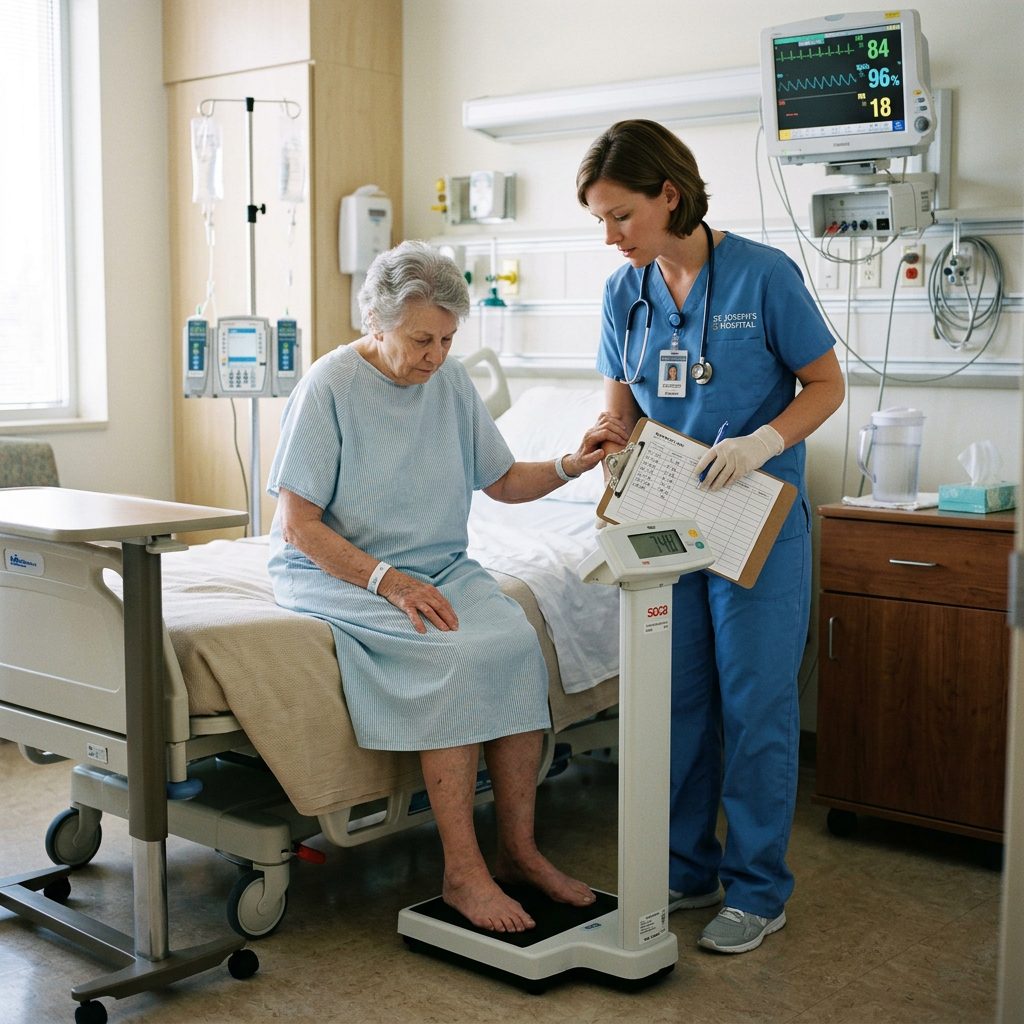
- Daily weights, obtained consistently (same scale, same time, same clothing) — this remains one of the single most sensitive indicators of fluid status
- Frequent vital signs, including oxygen saturation
- Continuous telemetry monitoring for arrhythmias in appropriate patients
- Lung sounds and respiratory effort
- Jugular vein distension and peripheral edema assessment
- Strict intake and output
- Mental status, since poor cerebral perfusion can cause confusion in more severe presentations
Diagnostic Workup
- BNP or NT-proBNP, useful for supporting the diagnosis and gauging severity
- Chest X-ray to assess for pulmonary congestion
- ECG to evaluate for arrhythmias or ischemic changes
- Echocardiogram to assess ejection fraction and structural changes
- Basic metabolic panel, since renal function and electrolytes both matter for diuretic dosing and monitoring
Decongestion Therapy
The primary goal of treatment for acute decompensation is decongestion, typically achieved with IV diuretics. Alongside diuresis, care focuses on:
- Assessment and monitoring of end-organ perfusion and oxygenation
- Optimization of cardiac output, including inotrope administration when appropriate for select patients
- Management of any contributing arrhythmias
- Close monitoring of electrolytes, particularly potassium, since diuretic therapy can cause significant losses
Nursing Interventions
- Administer diuretics and other prescribed medications, monitoring response through urine output and daily weight trends
- Position the patient to ease work of breathing (commonly high Fowler’s)
- Administer supplemental oxygen as needed and ordered
- Monitor electrolytes closely during aggressive diuresis, watching especially for hypokalemia
- Assess for signs of over-diuresis (hypotension, acute kidney injury) alongside signs of persistent overload
- Coordinate closely with the interprofessional team, since heart failure management in the hospitalized patient frequently involves the primary team, cardiology, and nursing working together on a shared plan
Discharge Teaching and Readmission Prevention
Patient education is central to successful heart failure management and should begin on admission, not just at discharge. Key components include:
- Explaining heart failure as a chronic condition where the heart is weaker or stiffer than normal, leading to fluid buildup — framed in terms the patient can act on, not just understand abstractly
- Teaching patients to weigh themselves daily and record the results
- Providing specific thresholds for calling the provider — for example, a defined weight gain over a short period, or new or worsening shortness of breath and swelling
- Reinforcing sodium restriction and medication adherence as ongoing daily habits, not just hospital-stay instructions
- Setting a follow-up goal of no preventable readmissions within a defined period (commonly 30 days) when adequate support and resources are in place
Complications
- Cardiogenic shock in severe, unresponsive decompensation
- Acute kidney injury, either from poor perfusion or aggressive diuresis
- Electrolyte imbalances, particularly hypokalemia from diuretic therapy
- Arrhythmias
- Pulmonary edema
- Frequent hospital readmission without adequate self-management support
NCLEX Tips and Memory Tricks
- Daily weight gain is often the earliest sign of decompensation — a heavily tested concept, and the reason weight monitoring gets so much nursing attention.
- Remember: decongestion, usually with IV diuretics, is the primary treatment goal for acute exacerbation.
- If a question describes specific weight-gain thresholds for calling the provider, this reflects real, evidence-based discharge teaching — not an arbitrary number.
- Mnemonic — “WEIGH”: Weigh daily and consistently, Evaluate lung sounds and JVD, Intake and output strictly monitored, Give diuretics as ordered, Home teaching on thresholds to call.
Clinical Pearls
- A patient can look clinically stable on a single assessment and still be trending toward decompensation — trended daily weights catch this earlier than almost any other single data point.
- Over-diuresis is a real risk during aggressive decongestion — watch for signs of hypotension or worsening renal function alongside signs of persistent fluid overload.
- Specific, concrete discharge instructions (“call if you gain X pounds in 2 days”) are measurably more effective than general advice like “watch your weight,” since they give patients an actionable trigger rather than a vague guideline.
Key Takeaways
- Heart failure exacerbation reflects acute decompensation, most often driven by fluid overload from dietary, medication, or clinical triggers.
- HFrEF, HFpEF, and HFmrEF classifications shape treatment approach and prognosis.
- Decongestion with IV diuretics is the cornerstone of acute management, alongside close electrolyte monitoring.
- Specific, actionable discharge teaching on daily weights and symptom thresholds is one of the most effective readmission-prevention tools available.
FAQs
What are the signs of heart failure exacerbation?
Increasing weight, jugular vein distension, worsening shortness of breath (including orthopnea and paroxysmal nocturnal dyspnea), fatigue, and lower extremity edema.
What causes heart failure decompensation?
Common triggers include dietary sodium or fluid indiscretion, medication nonadherence, uncontrolled hypertension, new arrhythmias, infection, myocardial ischemia, anemia, and renal dysfunction.
What weight gain should prompt a call to the provider in heart failure?
This varies by individualized care plan, but discharge teaching typically includes a specific weight-gain threshold over a short period (for example, a defined number of pounds within 2–3 days) as a trigger to contact the care team.
What is the difference between HFrEF and HFpEF?
HFrEF involves reduced ejection fraction and impaired pumping function; HFpEF involves preserved ejection fraction but impaired filling, meaning the heart pumps normally but doesn’t relax and fill properly.
What is the nurse’s role in the emergency department for heart failure?
Triage, ongoing monitoring, and evaluation of patients presenting with heart failure symptoms, with treatment focused on decongestion, assessment of end-organ perfusion and oxygenation, and management of any arrhythmias.
References
- American Nurse Journal (ANA) — Heart Failure Management: Updated Guidelines
- 2026 ESC Guidelines for the Management of Heart Failure (European Heart Journal)
- American Association of Heart Failure Nurses — Nursing Care of the Patient Hospitalized with Heart Failure: A Scientific Statement
- Nurse.com Clinical Guides — Congestive Heart Failure Nursing Guide
- StatPearls (NCBI Bookshelf) — Heart Failure (Congestive Heart Failure) (Nursing)