
Introduction
The first hour after surgery is arguably the most physiologically unstable window a patient will experience during their entire surgical journey — anesthesia is wearing off, protective reflexes haven’t fully returned, and complications can develop fast. PACU nursing exists specifically to catch problems in this window before they become emergencies. This guide breaks down exactly what to prioritize, in what order, and the pearls that make this dense topic click for both bedside practice and NCLEX.
Table of Contents
- Why the First Hour Matters
- The Handoff Report
- Airway First, Always
- Vital Signs and Hemodynamic Monitoring
- Level of Consciousness and Neurologic Status
- Surgical Site Assessment
- Pain and Nausea Management
- Temperature Monitoring
- Common Complications to Watch For
- Discharge Criteria and Phases of Care
- NCLEX Tips and Memory Tricks
- Clinical Pearls
- Key Takeaways
- FAQs
- References
Why the First Hour Matters
Immediately after surgery, patients are recovering from the combined effects of anesthesia, surgical stress, and often significant fluid shifts — all at once. PACU nurses are responsible for continuous, high-acuity monitoring precisely because complications in this window can develop rapidly and require immediate intervention, not delayed recognition.
The Handoff Report
Before the patient even arrives, the PACU nurse should receive a structured report from the anesthesia care team covering the general patient history, the procedure performed, anesthesia and pain medications given, intraoperative events, fluid balance, and any complications encountered. A thorough handoff sets the baseline for everything that follows — without it, the PACU nurse is assessing blind.
Airway First, Always
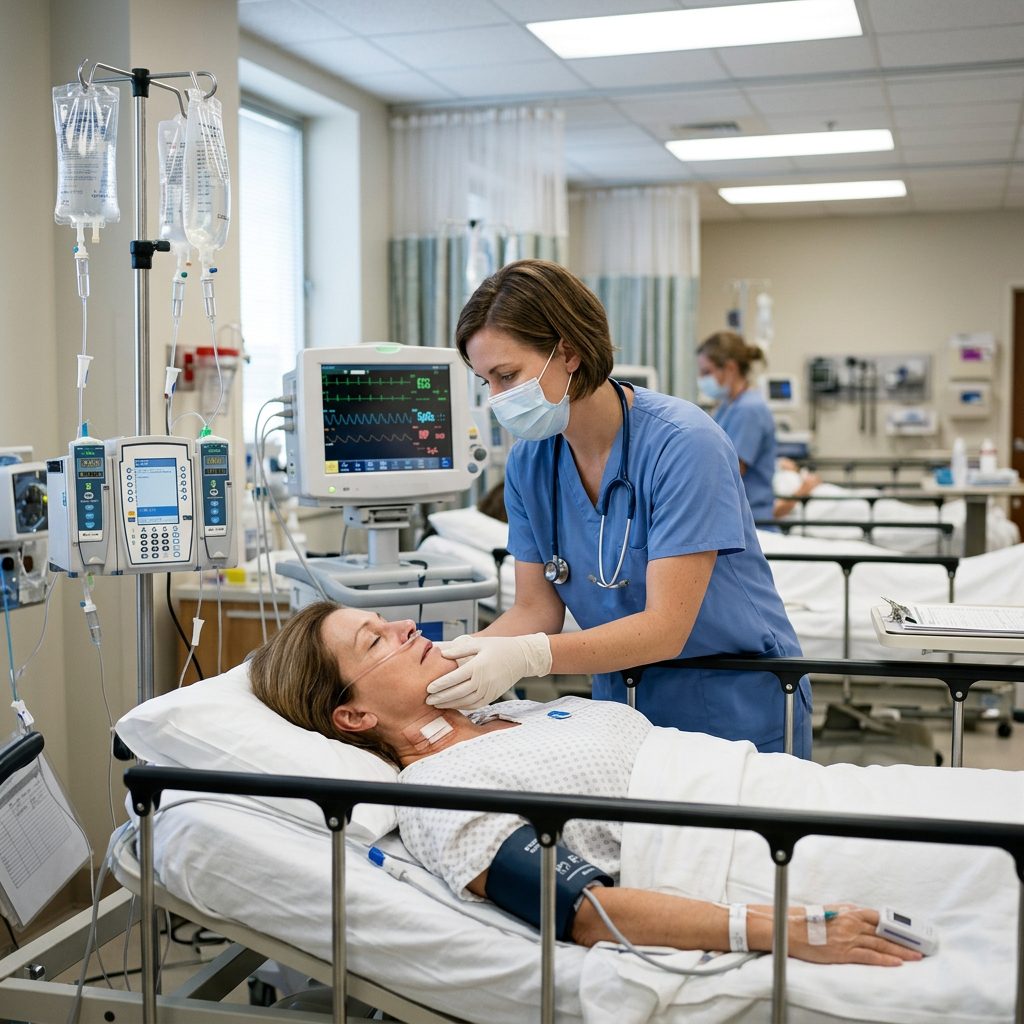
Airway is always the top priority in the immediate post-anesthesia period. On arrival, the PACU nurse performs an immediate assessment of airway, respiratory, and circulatory status before moving into a more thorough head-to-toe assessment. Specifically, respirations are the priority initial assessment for a patient admitted to PACU after general anesthesia — this reflects how quickly respiratory compromise can develop as anesthesia wears off and residual paralytics or opioids affect respiratory drive.
Vital Signs and Hemodynamic Monitoring
- Continuous ECG, blood pressure, heart rate, and oxygen saturation monitoring
- Frequent vital sign checks per protocol (often every 15 minutes initially, spacing out as the patient stabilizes)
- Watch specifically for hypotension, hypertension, and dysrhythmias — the most commonly encountered cardiovascular complications in this period, often related to residual anesthetic effects
- Assess and maintain fluid and electrolyte balance, since intraoperative fluid shifts can carry into the recovery period
Level of Consciousness and Neurologic Status
- Assess level of consciousness, orientation, and responsiveness as the patient emerges from anesthesia
- Neuro checks on a scheduled basis (commonly hourly, or more frequently if indicated)
- Musculoskeletal assessment — muscular response and strength, particularly relevant if regional or neuraxial anesthesia was used
- Watch for signs of emergence delirium, which can present as confusion, agitation, or combativeness as the patient wakes
Surgical Site Assessment
- Inspect the surgical dressing for drainage, bleeding, or signs of complication
- If bright red bleeding is noted on the dressing, the immediate nursing action is to reinforce the dressing — not remove it — while continuing to monitor and escalating per protocol if bleeding continues or worsens
- Assess for adequate circulation, sensation, and movement distal to the surgical site when relevant (e.g., orthopedic procedures)
Pain and Nausea Management
- Assess pain using an appropriate scale and administer analgesia per orders
- Achieving an optimal level of pain management is one of the defined PACU care goals, alongside adequate management of nausea and vomiting
- Postoperative nausea and vomiting is common and should be anticipated and treated proactively, not just reactively, since persistent vomiting can delay discharge and increase aspiration risk
Temperature Monitoring
- Document temperature on admission and at regular intervals (commonly every 1–2 hours) until discharge
- Implement rewarming techniques for hypothermic patients (below approximately 96.8°F/36°C), since intraoperative heat loss is common and hypothermia can affect coagulation, cardiac function, and patient comfort
Common Complications to Watch For
- Airway obstruction or respiratory depression
- Hypotension, hypertension, or dysrhythmias
- Hypoxia
- Surgical site bleeding
- Hypothermia
- Emergence delirium
- Persistent nausea and vomiting
- Urinary retention (a common reason a patient may need further monitoring rather than discharge, particularly after outpatient procedures)
Discharge Criteria and Phases of Care
Postoperative recovery generally moves through defined phases: Phase 1 focuses on immediate recovery from anesthesia — maintaining ventilation and circulation, monitoring oxygenation and consciousness, and managing pain. Phase 2 prepares outpatients for discharge home or inpatients for transfer to a nursing unit. Phase 3 provides ongoing care for patients needing extended observation, such as a 23-hour observation unit, continuing until the patient is ready for self-care. A patient must be stable and free of complications before transfer out of PACU — findings like persistent nausea without vomiting, inability to void, or lethargy that hasn’t resolved can all indicate the need for further monitoring rather than discharge.
NCLEX Tips and Memory Tricks
- Airway, then breathing, then circulation — always in that order. If a PACU question asks for the “priority” assessment, think ABCs before anything else.
- Bright red bleeding on a dressing = reinforce it first, don’t remove or replace it as the initial action.
- Remember: respirations, not heart rate or blood pressure, are the priority initial assessment on PACU arrival after general anesthesia.
- Mnemonic — “AWAKE”: Airway first, Watch vital sign trends, Assess surgical site, Keep warm (temperature), Evaluate pain/nausea.
Clinical Pearls
- A thorough anesthesia handoff report isn’t a formality — missing details about intraoperative events or medications given can directly delay recognition of a developing complication.
- Non-clinical factors like bed availability and staffing can meaningfully affect PACU length of stay — worth knowing since delayed discharge isn’t always a clinical issue, and quality-improvement efforts increasingly target this.
- A patient who “looks fine” on a single vital sign check can still be trending toward a problem — frequent reassessment during this hour matters more than any single number.
Key Takeaways
- Airway and respiratory status are always the top priority immediately after surgery.
- A structured anesthesia handoff report establishes the baseline for the entire PACU stay.
- Vital signs, level of consciousness, surgical site, pain, nausea, and temperature are all core ongoing PACU assessments.
- Discharge requires stability and freedom from complications — persistent nausea, urinary retention, or unresolved lethargy can all delay transfer.
FAQs
What is the priority initial assessment for a patient admitted to the PACU?
Respirations — assessing airway and respiratory status comes first, since this is the period of highest risk for airway compromise after anesthesia.
What are the phases of post-anesthesia care?
Phase 1 focuses on immediate anesthesia recovery, Phase 2 prepares the patient for discharge home or transfer to an inpatient unit, and Phase 3 provides extended observation for patients who need it.
What should a nurse do if a surgical dressing has bright red bleeding?
Reinforce the dressing first, then continue monitoring and escalate to the provider if bleeding continues or worsens.
What information should be included in the anesthesia handoff report?
General patient history, the procedure performed, anesthesia and pain medications given, intraoperative events, and fluid balance.
What are common complications in the first hour after surgery?
Airway obstruction, hypotension or dysrhythmias, hypoxia, surgical site bleeding, hypothermia, emergence delirium, and persistent nausea and vomiting.
References
- American Society of PeriAnesthesia Nurses (ASPAN) — PeriAnesthesia Nursing Standards, Practice Recommendations and Interpretive Statements
- The Operating Room Global (TORG) Foundation — Postoperative Care and the Post-Anesthesia Care Unit (PACU)
- Nursing Study Hub — PACU Nurse: A Comprehensive Guide to Post-Anesthesia Care Unit Nursing (2026)
- Beth Israel Deaconess Medical Center — Post Anesthesia Assessment Policy
RELATED ARTICLES:
- https://rn-nurse.com/preoperative-nursing-assessment-checklist/
- https://rn-nurse.com/malignant-hyperthermia-nursing-response/
- https://rn-nurse.com/mechanical-ventilation-modes-nursing-guide/
- https://rn-nurse.com/lab-value-cheats/
- https://rn-nurse.com/high-alert-medications-nurses/
- https://rn-nurse.com/drug-toxicity-signs/
- https://rn-nurse.com/fall-precautions-nursing/
- https://rn-nurse.com/bariatric-surgery-nursing-considerations/
- https://rn-nurse.com/recognizing-sepsis-post-surgical-patients/
- https://rn-nurse.com/central-line-care/