
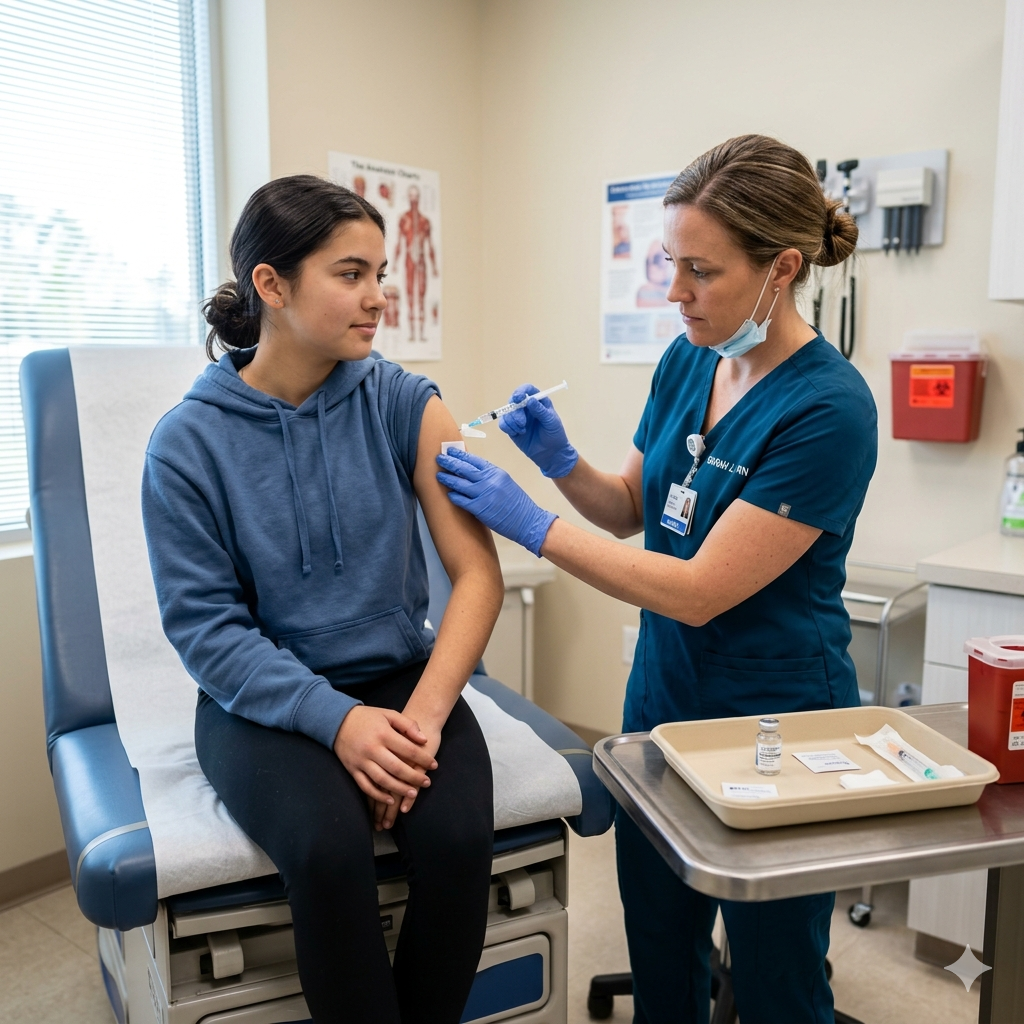
Human papillomavirus (HPV) is the most common sexually transmitted infection in the United States, and it is largely preventable. Yet vaccination rates remain below national targets — a gap that every registered nurse is positioned to close. Whether practicing in a pediatric office, a school-based health clinic, or a community health setting, nurses serve as the frontline educators who make or break a family’s decision to vaccinate. HPV vaccination nursing education is not just a Fundamentals topic; it is a high-yield NCLEX domain and a direct public health intervention that RN nurses perform every day.
Why HPV Vaccination Matters: The Clinical Foundation
HPV encompasses more than 200 related viral strains. Approximately 40 of these are transmitted through skin-to-skin sexual contact, and a subset carry significant oncogenic potential. High-risk strains, particularly types 16 and 18, are responsible for approximately 70% of cervical cancers, as well as a substantial proportion of oropharyngeal, anal, vulvar, vaginal, and penile cancers. Low-risk strains, types 6 and 11, cause the majority of genital warts.
The current vaccine available in the United States is Gardasil 9 (9-valent HPV vaccine), which protects against nine HPV strains: 6, 11, 16, 18, 31, 33, 45, 52, and 58. Together, these strains account for roughly 90% of cervical cancers and nearly all genital warts. The vaccine is prophylactic, meaning it prevents infection — it does not treat existing HPV infection or HPV-related disease. This distinction is critical when providing nursing patient education.
Recommended Schedule and Eligibility: What Nurses Must Know
The Advisory Committee on Immunization Practices (ACIP) and the CDC provide clear guidance that every nurse should master:
- Routine vaccination: Recommended for all adolescents at ages 11–12 years, though it can be given as early as age 9.
- Catch-up vaccination: Recommended through age 26 for anyone not adequately vaccinated.
- Shared clinical decision-making: For adults aged 27–45, vaccination is not routinely recommended but may be appropriate after a discussion of risks and benefits with a healthcare provider.
Dosing schedule depends on the patient’s age at initiation:
| Age at First Dose | Number of Doses | Schedule |
|---|---|---|
| 9–14 years | 2 doses | 0, 6–12 months |
| 15–26 years | 3 doses | 0, 1–2 months, 6 months |
| Immunocompromised (any age) | 3 doses | 0, 1–2 months, 6 months |
The registered nurse administers Gardasil 9 as an intramuscular (IM) injection in the deltoid muscle or the anterolateral thigh in younger children. Always verify the correct site based on patient age and muscle mass.
HPV Vaccination Nursing Education: Core Teaching Points
Effective HPV vaccination nursing education requires more than handing over a vaccine information statement (VIS). The nurse must anticipate common misconceptions and address them directly.
Key teaching points to cover with every patient and caregiver:
- The vaccine does not cause HPV — it contains no live virus.
- Vaccination is most effective when given before exposure to HPV, which is why early adolescent vaccination is emphasized.
- The vaccine does not protect against all HPV strains, so continued cervical cancer screening (Pap smears and HPV co-testing) remains necessary for eligible patients.
- The vaccine does not protect against other sexually transmitted infections — comprehensive STI education remains essential.
- Completing the full vaccination series is required for maximum protection.
- The vaccine is safe and extensively studied — it has been administered to hundreds of millions of people worldwide since 2006.
Nurses should also educate patients about syncope (fainting), which can occur after any injection. The nursing standard is to observe the patient for 15 minutes post-vaccination. Have the patient remain seated or lying down during this observation window.
Common Side Effects and Nursing Management
A registered nurse providing HPV vaccination education must prepare patients for expected local and systemic reactions:
Local reactions (most common):
- Pain, redness, and swelling at the injection site
- These are typically mild and resolve within 1–2 days
Systemic reactions (less common):
- Low-grade fever
- Headache
- Fatigue
- Nausea
Nursing interventions for side effect management:
- Apply a cool compress to the injection site for comfort
- Recommend acetaminophen or ibuprofen (following age-appropriate dosing) for pain or fever
- Encourage adequate hydration
- Instruct patients to report any signs of anaphylaxis — urticaria, throat tightening, difficulty breathing — and to seek emergency care immediately
Contraindications that every nurse must assess before administration include:
- Severe allergic reaction (anaphylaxis) to a previous HPV vaccine dose
- Known severe allergy to yeast (Gardasil 9 contains yeast proteins)
- The vaccine is not recommended during pregnancy — counsel patients of childbearing potential accordingly. If a patient becomes pregnant during the series, defer remaining doses until after delivery.
Addressing Vaccine Hesitancy: Communication Strategies for Nurses
Vaccine hesitancy is one of the most challenging aspects of HPV vaccination nursing practice. Research consistently shows that a strong, presumptive recommendation from a nurse or provider is the single most effective driver of vaccination uptake.
Evidence-based communication techniques:
- Announce, don’t ask: Frame vaccination as a routine part of the visit (“Today your child is due for the HPV vaccine and Tdap”) rather than a question (“Would you like the HPV vaccine today?”). Presumptive language increases acceptance.
- Acknowledge concerns without dismissing them: Validate the parent’s or patient’s hesitation, then provide accurate information.
- Use motivational interviewing: Ask open-ended questions (“What questions do you have about the vaccine?”) and reflect the patient’s own values back to them.
- Emphasize cancer prevention: Many families respond more favorably when the conversation centers on cancer prevention rather than sexual activity.
- Share statistics: Framing the vaccine as preventing thousands of cancer cases annually makes the benefit tangible.
The nursing bundle of patient-centered communication, accurate clinical knowledge, and anticipatory guidance is what makes RN nurses uniquely effective at moving the needle on vaccination rates.
Special Populations: Nursing Considerations
Immunocompromised patients — including those on immunosuppressive therapy, patients with HIV, and organ transplant recipients — should receive the 3-dose series regardless of age. The vaccine is not a live vaccine, so it is safe in this population, though immune response may be reduced.
Males: Gardasil 9 is approved and recommended for males through age 26. HPV vaccination in males prevents genital warts and reduces the risk of HPV-related cancers, including oropharyngeal and anal cancers. Men who have sex with men and transgender individuals benefit particularly from vaccination.
Patients who have already been sexually active: Vaccination is still recommended. While patients may have been exposed to one or more HPV strains, they are unlikely to have encountered all nine strains covered by the vaccine.
💡 NCLEX Tips for HPV Vaccination
- Gardasil 9 is an IM injection — never give subcutaneously.
- The 2-dose schedule applies to patients who begin the series before age 15; any patient 15 or older at initiation requires 3 doses.
- Syncope is a known post-vaccination risk — always observe the patient for 15 minutes after administration.
- The vaccine is contraindicated in pregnancy but is safe for breastfeeding patients.
- HPV vaccination does not replace cervical cancer screening — patients still require routine Pap smears and co-testing per guidelines.
- A yeast allergy is a contraindication to Gardasil 9 — always screen before administration.
Conclusion
HPV vaccination is a cornerstone of cancer prevention, and nursing education is the engine that drives its success. From understanding the 9-valent formulation and ACIP dosing schedules to managing side effects and navigating vaccine hesitancy with evidence-based communication, the RN nurse plays an irreplaceable role in protecting patient health across the lifespan. Mastering HPV vaccination nursing education means mastering both the science and the art of patient teaching — a skill set that translates directly to NCLEX success and real-world clinical impact.
Sharpen your patient education skills and test your knowledge with NCLEX-style practice questions at rn-nurse.com/nclex-qcm/, or explore the full nursing bundle of clinical courses at rn-nurse.com/nursing-courses/.