
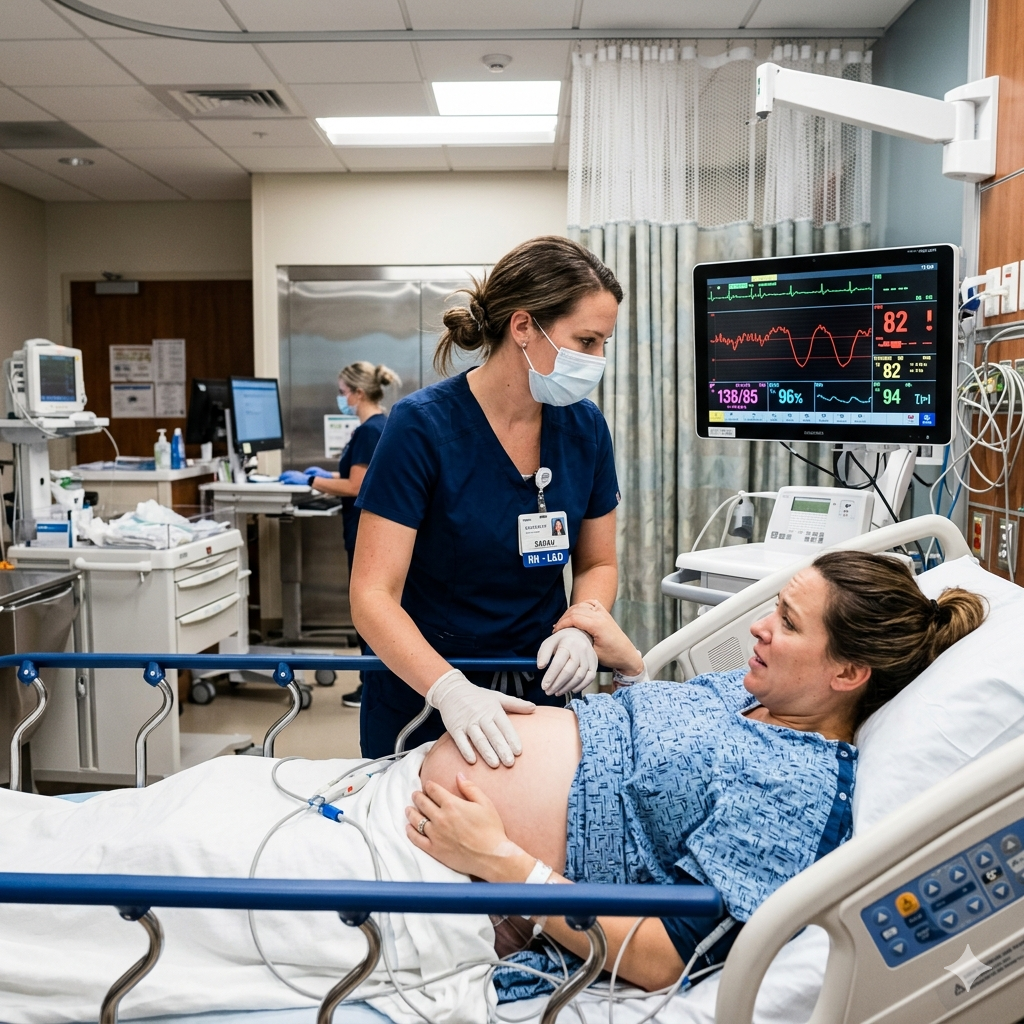
Umbilical cord prolapse is one of the most time-critical obstetric emergencies a nurse will ever face. When the cord descends ahead of or alongside the presenting fetal part, compression cuts off fetal oxygen supply — and every second matters. Cord prolapse emergency management demands that the registered nurse act decisively, in the correct sequence, without waiting for a physician order to begin life-saving interventions. For nursing students preparing for the NCLEX and for RN nurses practicing in labor and delivery, mastering this topic is non-negotiable.
Understanding Cord Prolapse: Types and Risk Factors
Cord prolapse occurs when the umbilical cord slips through the cervix ahead of the presenting fetal part, becoming compressed between the fetus and the pelvis. There are two primary types:
- Overt prolapse: The cord is visibly protruding from the vagina or palpable on vaginal exam.
- Occult prolapse: The cord lies beside the presenting part but is not visible — often detected only through persistent, severe variable decelerations on fetal monitoring.
Risk factors every nurse should recognize include:
- Rupture of membranes (spontaneous or artificial) with a high fetal station
- Polyhydramnios — excess amniotic fluid allows cord movement
- Fetal malpresentation: breech, transverse, or oblique lie
- Multiparity and preterm gestation
- Amniotomy performed with an unengaged presenting part
- Multiple gestation (especially after delivery of the first twin)
Recognizing these risk factors is a high-yield NCLEX strategy because the exam frequently tests the nurse’s ability to anticipate complications before they occur.
Recognizing the Emergency: Fetal Heart Rate Changes
The most common — and often first — sign of cord prolapse is a sudden, severe variable deceleration on the electronic fetal monitor (EFM). These decelerations reflect cord compression causing acute interruption of fetal oxygenation. Key assessment findings include:
- Abrupt drops in fetal heart rate (FHR), often below 70 bpm, lasting more than 60 seconds
- Decelerations that do not recover between contractions
- Loss of FHR variability accompanying the deceleration
- In overt prolapse: a visible or palpable loop of cord at the vaginal opening
The nurse must never perform a vaginal exam to confirm prolapse without immediately following the emergency protocol. Palpating the cord confirms the diagnosis and allows the nurse to elevate the presenting part — but this action must transition directly into the full emergency response.
Cord Prolapse Emergency Management: Priority Nursing Interventions
Cord prolapse emergency management is built on a sequential, rapid-response protocol. The priority nursing action is to relieve cord compression immediately.
Step-by-Step Emergency Response
- Call for help immediately — activate the emergency response team; do not leave the patient alone.
- Elevate the presenting part — using a sterile gloved hand inserted into the vagina, manually elevate the presenting fetal part off the cord. This is the single most critical intervention and must be maintained continuously until delivery.
- Position the patient — place the patient in Trendelenburg (head down), knee-chest, or left lateral Sims position to use gravity to reduce cord compression. The knee-chest position is often most effective in clinical practice.
- Administer supplemental oxygen — apply a 10–12 L/min non-rebreather mask to maximize fetal oxygenation.
- IV access and fluids — initiate or ensure IV access; administer a fluid bolus to support maternal perfusion.
- Tocolytic therapy — a tocolytic agent such as terbutaline may be ordered to stop or reduce uterine contractions and relieve additional cord compression.
- Do NOT push the cord back — never attempt to replace the cord into the uterus, as manipulation increases vasospasm and cord injury.
- Keep the cord moist — if the cord is external, cover it with a sterile saline-soaked towel. Never clamp or compress the cord.
- Prepare for emergent cesarean section — cord prolapse almost always necessitates immediate surgical delivery. The RN nurse should begin pre-op preparation simultaneously with the above interventions.
- Continuous fetal monitoring — document FHR, maternal vital signs, and all interventions in real time.
The goal from recognition to delivery is ideally under 30 minutes. Many institutions target a decision-to-incision time of less than 30 minutes, though immediate action is always the guiding principle.
NCLEX-Focused Nursing Priorities for Cord Prolapse
NCLEX questions on cord prolapse heavily test the nurse’s ability to sequence interventions and identify the correct priority action. The classic distractors include calling the physician first or repositioning without elevating the presenting part.
Key NCLEX principles:
- The first action is always to relieve cord compression by elevating the presenting part — this takes priority over calling the provider, documenting, or transporting the patient.
- Never leave the patient — once the gloved hand is in place, the nurse maintains that position until the surgical team takes over.
- Supplemental oxygen is always correct but is never the single highest priority when cord compression is confirmed.
- The nurse does not need a physician order to begin positioning, elevate the presenting part, or apply oxygen in a life-threatening obstetric emergency.
Reviewing this topic as part of a nursing bundle that includes fetal monitoring, obstetric emergencies, and antepartum complications will reinforce the clinical decision-making framework the NCLEX consistently tests.
💡 NCLEX Tips for Cord Prolapse Emergency Management
- The #1 priority intervention is elevating the presenting part off the cord — memorize this as your first action.
- Knee-chest position is the most effective gravity-assisted position for cord prolapse relief.
- Variable decelerations that are sudden, severe, and prolonged should immediately raise the suspicion of cord prolapse.
- The nurse should never replace the cord into the vagina or apply direct pressure to it.
- Always anticipate emergent cesarean delivery and begin prep simultaneously with other interventions.
Quick Reference Table: Cord Prolapse Emergency Management
| Intervention | Action | Rationale |
|---|---|---|
| Elevate presenting part | Gloved hand in vagina, lift fetal part | Directly relieves cord compression |
| Position | Knee-chest or Trendelenburg | Gravity reduces pressure on cord |
| Oxygen | 10–12 L/min non-rebreather mask | Maximizes fetal O₂ delivery |
| IV access | Fluid bolus as ordered | Supports maternal/fetal perfusion |
| Tocolytic | Terbutaline (per order) | Reduces uterine contractions |
| Cord care | Sterile saline-soaked towel if exposed | Prevents vasospasm and drying |
| Delivery | Emergent cesarean section | Definitive treatment |
| Documentation | Continuous — FHR, vitals, actions | Legal and clinical requirement |
Communication and Team-Based Nursing Response
Effective SBAR communication is essential during cord prolapse. The nurse must relay the situation rapidly and clearly to the obstetric provider, surgical team, and anesthesia simultaneously.
A rapid SBAR report should include:
- Situation: Cord prolapse identified, fetal heart rate showing severe variable decelerations
- Background: Gestational age, parity, when membranes ruptured, fetal station at last exam
- Assessment: Cord palpable/visible, hand in place elevating presenting part, patient in knee-chest position
- Recommendation: Requesting immediate cesarean delivery and full surgical team activation
For the registered nurse, maintaining manual elevation of the presenting part during transport to the OR — including through positioning changes and surgical prep — is standard practice. This is a test of clinical endurance and professional responsibility that separates prepared nurses from unprepared ones.
Conclusion
Cord prolapse emergency management is a defining skill for any RN nurse working in labor and delivery or preparing for the NCLEX. The intervention sequence — elevate, position, oxygenate, prepare for surgery — must become automatic. Delays in any of these steps directly threaten fetal survival.
As part of a comprehensive nursing bundle covering high-risk obstetrics, integrating cord prolapse with fetal monitoring interpretation and other obstetric emergencies builds the clinical reasoning the NCLEX demands. Practice with scenario-based NCLEX questions to reinforce your decision-making speed and accuracy.
Test your knowledge and strengthen your obstetric nursing skills at rn-nurse.com/nclex-qcm/, or explore the full OB/Maternity nursing course at rn-nurse.com/nursing-courses/.