
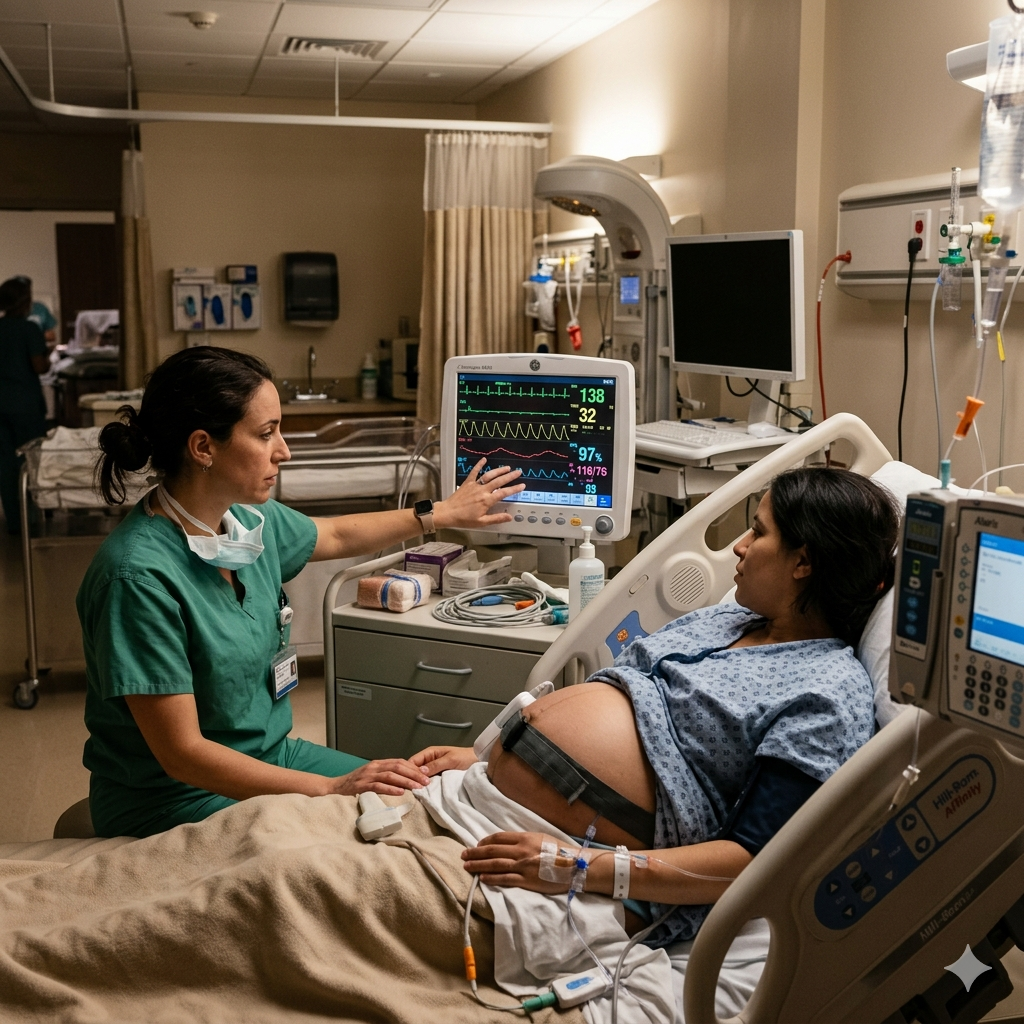
Placenta accreta spectrum (PAS) disorders represent one of the most dangerous obstetric complications a registered nurse will encounter in labor and delivery. Once considered rare, these conditions have surged in prevalence alongside rising cesarean section rates, making placenta accreta spectrum nursing knowledge essential for today’s OB/Maternity nurse. For nursing students preparing for the NCLEX, understanding the pathophysiology, clinical presentation, and priority interventions for PAS disorders is a high-yield topic that demands thorough preparation. This guide breaks down everything an RN nurse needs to know — from classification to hemorrhage management — to provide safe, competent, and life-saving care.
What Is Placenta Accreta Spectrum? Understanding the Classification
Placenta accreta spectrum is an umbrella term for a group of abnormal placental implantation disorders in which the placenta attaches too deeply into the uterine wall, failing to separate normally at delivery. There are three subtypes, classified by depth of invasion:
| Type | Invasion Depth | Description |
|---|---|---|
| Placenta Accreta | Myometrium (superficial) | Placenta attaches directly to the myometrium without invading deeply |
| Placenta Increta | Myometrium (deep) | Placenta penetrates deeply into the myometrial tissue |
| Placenta Percreta | Through the uterine wall | Placenta invades through the entire uterine wall and may affect adjacent organs (bladder, bowel) |
Placenta accreta is the most common subtype, accounting for approximately 75–80% of all PAS cases. Placenta percreta, though least common, carries the highest risk of maternal mortality due to potential invasion into the bladder or intestines.
For NCLEX purposes, nurses must recognize that any PAS disorder places the patient at extreme risk for massive obstetric hemorrhage, which is the leading cause of maternal mortality associated with these conditions.
Risk Factors Every Registered Nurse Must Recognize
Identifying patients at risk is a cornerstone of placenta accreta spectrum nursing care. The single greatest risk factor is a prior cesarean delivery, particularly when combined with an anterior low-lying placenta or placenta previa in a subsequent pregnancy.
Key risk factors include:
- Previous cesarean section(s) — risk increases exponentially with each additional cesarean scar
- Placenta previa in current pregnancy, especially anterior previa overlying a uterine scar
- Prior uterine surgery — myomectomy, dilation and curettage (D&C), or endometrial ablation
- Advanced maternal age (>35 years)
- Multiparity (grand multiparity, ≥5 pregnancies)
- Uterine anomalies or Asherman syndrome (intrauterine adhesions)
- Previous uterine infection or endometritis
A registered nurse caring for an antepartum patient with placenta previa and two prior cesareans should immediately recognize this as a high-risk combination for PAS. Early multidisciplinary planning — including maternal-fetal medicine, interventional radiology, urology, and blood banking — is a nursing priority.
Clinical Presentation and Antepartum Nursing Assessment
PAS disorders are often asymptomatic until delivery, which is why routine prenatal screening and nursing assessment are critical. The primary diagnostic tools are ultrasound (typically at 18–20 weeks) and MRI, used when ultrasound findings are inconclusive or when percreta is suspected.
Ultrasound findings suggestive of PAS include:
- Loss of the clear zone (hypoechoic area) between the placenta and myometrium
- Placental lacunae (irregular vascular spaces within the placenta)
- Increased vascularity at the bladder-uterine interface
Antepartum nursing responsibilities include:
- Monitoring for painless vaginal bleeding — a hallmark of placenta previa often co-occurring with PAS
- Assessing fetal heart rate patterns and fetal movement
- Educating the patient about bleeding precautions, activity restrictions, and signs requiring immediate emergency care
- Coordinating with the interdisciplinary team for scheduled cesarean delivery planning
- Preparing the patient emotionally — PAS frequently necessitates cesarean hysterectomy, and this requires careful, compassionate nursing communication
Many facilities use a nursing bundle protocol for PAS management, which standardizes surgical preparation, blood product availability, and team notification to reduce complications.
Intraoperative and Postoperative Nursing Priorities
Because PAS disorders are associated with life-threatening hemorrhage, surgical preparation is extensive. Most cases require a planned cesarean delivery at 34–37 weeks gestation (or earlier if hemorrhage occurs), performed by an experienced multidisciplinary surgical team.
Intraoperative nursing priorities:
- Ensure large-bore IV access (two 16-gauge or larger IVs) is in place preoperatively
- Confirm availability of packed red blood cells (pRBCs), fresh frozen plasma (FFP), cryoprecipitate, and platelets — massive transfusion protocol (MTP) readiness is mandatory
- Assist with interventional radiology procedures (e.g., balloon occlusion catheters in the iliac arteries) if used to reduce blood loss
- Monitor blood loss closely — EBL (estimated blood loss) in PAS cesareans can exceed 3,000–5,000 mL in severe cases
- Prepare for cesarean hysterectomy — the definitive treatment for most PAS cases
Postoperative nursing priorities (BUBBLE-HE framework):
- Breasts: Assess breastfeeding readiness, particularly if hysterectomy was performed
- Uterus: If the uterus was preserved, assess uterine firmness and position
- Bladder: Monitor urinary output closely — bladder injury is a known complication of percreta; watch for hematuria or decreased output
- Bowel: Assess for return of bowel function; bowel resection may have occurred in percreta cases
- Lochia: Monitor for abnormal or excessive postpartum bleeding
- Episiotomy/Incision: Assess surgical incision for signs of infection or dehiscence
- Homans sign/Lower extremities: Assess for DVT — major surgery significantly elevates clot risk
- Emotional status: Patients who underwent hysterectomy may grieve loss of fertility; therapeutic communication and referral to mental health support are nursing priorities
Hemorrhage Management: NCLEX-Priority Nursing Interventions
Postpartum hemorrhage (PPH) is the most critical complication of PAS disorders. The registered nurse must respond swiftly and systematically.
Priority nursing interventions for PAS-related hemorrhage:
- Activate the massive transfusion protocol (MTP) — do not wait for labs to confirm coagulopathy
- Administer uterotonic agents as ordered: oxytocin (Pitocin), methylergonovine (Methergine), carboprost (Hemabate), or misoprostol
- Position patient flat with legs elevated to maintain perfusion to vital organs
- Monitor vital signs every 5–15 minutes — tachycardia and hypotension are early signs of hemorrhagic shock
- Assess level of consciousness — restlessness or confusion signals decreased cerebral perfusion
- Maintain accurate intake and output — oliguria (<30 mL/hr) indicates reduced renal perfusion
- Prepare blood products for transfusion according to MTP ratios (typically 1:1:1 — pRBCs : FFP : platelets)
- Document all blood loss and communicate using SBAR (Situation, Background, Assessment, Recommendation) to the provider
💡 NCLEX Tips for Placenta Accreta Spectrum
- PAS disorders most commonly occur with prior cesarean + placenta previa — this combo is a red flag on any NCLEX question
- The definitive management for most PAS cases is cesarean hysterectomy — not uterine massage or bimanual compression
- Painless vaginal bleeding in the third trimester = suspect placenta previa/PAS until proven otherwise
- Always prioritize airway, breathing, circulation (ABC) in hemorrhage — assess vitals and establish IV access before administering medications
- Urine output <30 mL/hr is a critical indicator of hypovolemic shock in the postpartum patient
Patient and Family Education for Placenta Accreta Spectrum
Nursing education is a vital component of PAS care. Patients diagnosed antenatally need clear, compassionate information delivered at an appropriate health literacy level.
Key teaching points for the RN nurse to cover:
- Explain the diagnosis and what to expect — most patients are anxious about the possibility of hysterectomy and blood transfusions
- Bleeding precautions: Instruct the patient to avoid intercourse, strenuous activity, and travel without provider approval
- Emergency warning signs requiring immediate evaluation: bright red vaginal bleeding, severe abdominal pain, or decreased fetal movement
- Delivery planning: Emphasize the importance of delivering at a facility with a Level III or IV maternal care center, interventional radiology, and blood banking capabilities
- Emotional support: Acknowledge grief around potential loss of fertility; facilitate referral to counseling or support groups as needed
Utilizing a structured nursing bundle for patient education — including written materials, teach-back verification, and documented comprehension — reflects best practice and aligns with evidence-based nursing standards.
Conclusion
Placenta accreta spectrum disorders are among the most complex and potentially fatal conditions in obstetric nursing, demanding expertise, preparation, and rapid clinical judgment. For nursing students and practicing RN nurses alike, understanding the classification, risk factors, antepartum surveillance, hemorrhage response, and postoperative monitoring of PAS is not just academic — it saves lives. Mastering placenta accreta spectrum nursing knowledge prepares the registered nurse to function as a skilled advocate, clinician, and educator for one of the most vulnerable patient populations in maternity care.
Strengthen your obstetric nursing knowledge and sharpen your NCLEX readiness with practice questions at rn-nurse.com/nclex-qcm/, or explore comprehensive OB/Maternity resources in the nursing bundle at rn-nurse.com/nursing-courses/.