
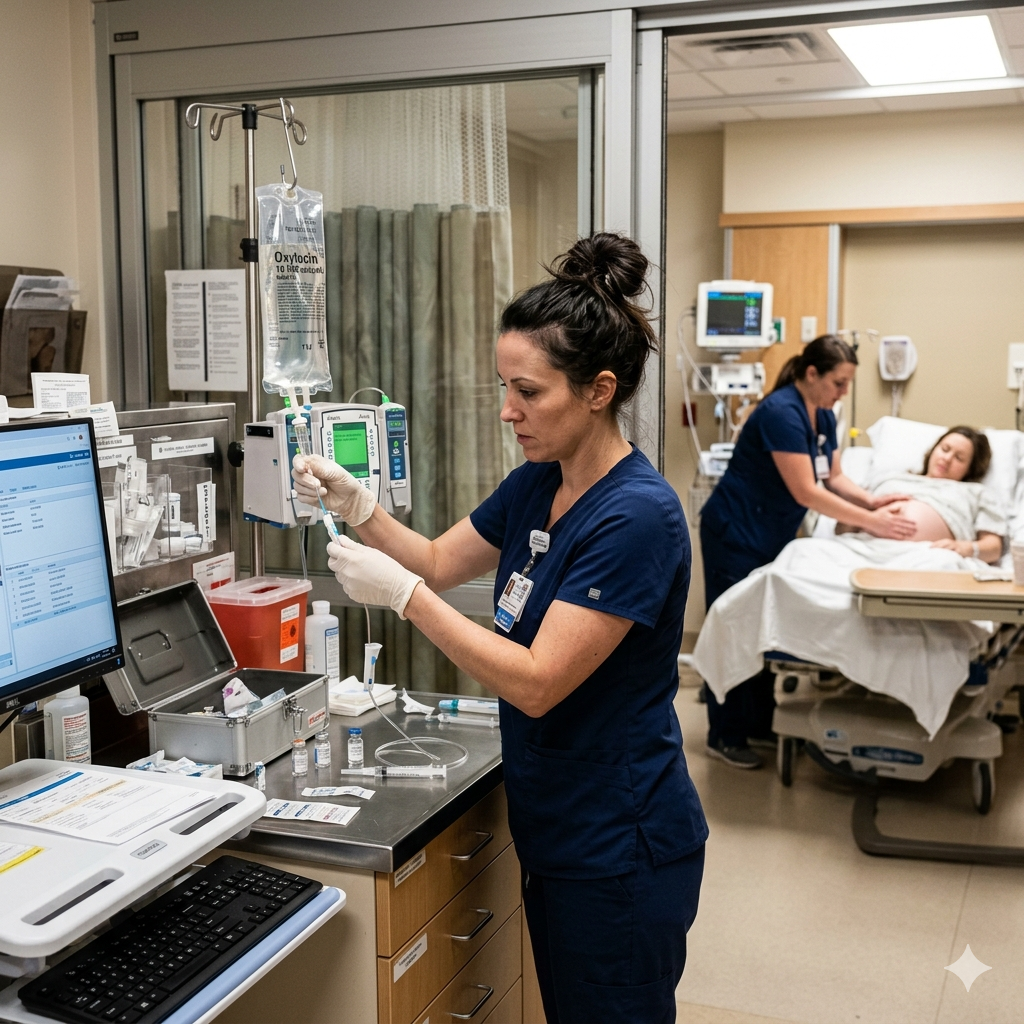
Postpartum hemorrhage (PPH) remains one of the leading causes of maternal mortality worldwide, making it a high-priority topic for any registered nurse working in labor and delivery, postpartum, or obstetric settings. For nursing students preparing for the NCLEX, understanding the full scope of postpartum hemorrhage emergency protocols — from early recognition to rapid intervention — is non-negotiable. A confident RN nurse must be able to identify the warning signs, escalate quickly, and implement evidence-based interventions without hesitation. This guide covers the clinical essentials every nurse must master to respond effectively when seconds count.
Defining Postpartum Hemorrhage: What Nursing Must Recognize
Postpartum hemorrhage is defined as a cumulative blood loss of ≥ 1,000 mL or blood loss accompanied by signs and symptoms of hypovolemia within 24 hours of delivery, regardless of the route of birth. This updated definition from the American College of Obstetricians and Gynecologists (ACOG) replaced the older threshold of 500 mL for vaginal delivery.
PPH is classified into two types:
- Primary (early) PPH: Occurs within the first 24 hours postpartum
- Secondary (late) PPH: Occurs between 24 hours and 12 weeks postpartum
The “4 T’s” framework is the cornerstone of nursing assessment for PPH etiology:
- Tone (uterine atony — most common cause, ~70–80% of cases)
- Trauma (lacerations, hematomas, uterine rupture, inversion)
- Tissue (retained placental fragments, placenta accreta spectrum)
- Thrombin (coagulopathy, disseminated intravascular coagulation)
Nursing documentation and early recognition using the 4 T’s framework guide the interdisciplinary response and support NCLEX-level clinical decision-making.
Early Recognition: Nursing Assessment Priorities
The registered nurse is often the first clinician to detect signs of hemorrhage. A structured assessment approach is essential in the immediate postpartum period.
Vital sign changes may include:
- Tachycardia (HR > 100 bpm) — often the earliest sign
- Hypotension (systolic BP < 90 mmHg) — a late and ominous finding
- Increased respiratory rate, narrowing pulse pressure
- Decreased oxygen saturation
Uterine assessment is a critical nursing skill. The fundus should be:
- Firm (contracted) and midline
- At or below the umbilicus after the first hour
A boggy (soft) uterus is a hallmark of uterine atony and demands immediate intervention. Every nurse must assess the fundus with consistent technique — one hand stabilizing the lower uterine segment while the other palpates the fundal height and tone.
Quantitative blood loss (QBL) has replaced subjective estimation in most hospital systems. Nurses should use calibrated drapes, weighing pads, and collection devices. QBL > 500 mL after vaginal delivery or > 1,000 mL after cesarean delivery warrants close monitoring and escalation.
Postpartum Hemorrhage Emergency Protocols: Step-by-Step Nursing Response
When PPH is suspected, the nursing response follows a systematic, time-sensitive sequence. Most institutions use a hemorrhage bundle or stage-based protocol aligned with ACOG and the Alliance for Innovation on Maternal Health (AIM).
Stage 1 (Cumulative Blood Loss 500–999 mL):
- Announce to the team and activate the hemorrhage response
- Uterine massage — perform fundal massage while voiding the bladder (insert urinary catheter if needed)
- Oxytocin (Pitocin) — administer per protocol (typically 10–40 units in 500–1,000 mL NS IV infusion)
- Large-bore IV access — establish two peripheral IVs (18-gauge or larger)
- Labs — CBC, coagulation panel (PT, aPTT, fibrinogen), type and screen
- Continuous vital sign monitoring every 5–15 minutes
Stage 2 (Cumulative Blood Loss ≥ 1,000 mL with signs of hemodynamic instability):
- Activate the massive transfusion protocol (MTP) if available
- Second-line uterotonic agents:
- Methylergonovine (Methergine) 0.2 mg IM — contraindicated in hypertension
- Carboprost (Hemabate) 0.25 mg IM — contraindicated in asthma
- Misoprostol 600–1,000 mcg sublingual or rectal
- Tranexamic acid (TXA) 1 g IV within 3 hours of delivery onset
- Blood product replacement — packed red blood cells (pRBCs), fresh frozen plasma (FFP), platelets per MTP ratio (1:1:1)
- Notify physician/midwife, anesthesia, and blood bank — use SBAR communication
- Prepare for possible surgical intervention (B-Lynch suture, uterine artery ligation, hysterectomy)
This stage-based postpartum hemorrhage emergency protocol is a core nursing bundle competency for OB nurses and a frequently tested concept on the NCLEX.
Pharmacological Interventions: Key Uterotonic Agents
Understanding the mechanism, route, and contraindications of each uterotonic is essential for the RN nurse in obstetric care.
| Drug | Dose/Route | Mechanism | Key Nursing Consideration |
|---|---|---|---|
| Oxytocin (Pitocin) | 10–40 units IV infusion | Stimulates uterine contractions | First-line; avoid rapid IV bolus (hypotension) |
| Methylergonovine (Methergine) | 0.2 mg IM | Sustained uterine contraction via smooth muscle | Contraindicated in hypertension |
| Carboprost (Hemabate) | 0.25 mg IM q15–90 min | Prostaglandin F2α; uterine contraction | Contraindicated in asthma; watch for bronchospasm |
| Misoprostol | 600–1,000 mcg sublingual/rectal | Prostaglandin E1 analog | Useful when IV access unavailable |
| Tranexamic Acid (TXA) | 1 g IV over 10 min | Antifibrinolytic; prevents clot breakdown | Administer within 3 hours of hemorrhage onset |
Nurses must be fluent in the rationale, contraindications, and monitoring parameters for each agent. This content appears consistently across NCLEX OB pharmacology questions and is central to any comprehensive nursing bundle for maternity care.
Non-Pharmacological and Surgical Nursing Considerations
When uterotonic medications do not achieve hemostasis, nursing care shifts toward preparing the patient for procedural or surgical intervention.
Non-pharmacological measures the nurse may assist with or initiate:
- Bimanual uterine compression — performed by the provider; nurse supports patient positioning and monitors response
- Uterine balloon tamponade (e.g., Bakri balloon) — nurse assists with insertion, monitors output, secures catheter
- Aortic compression — temporary measure for severe hemorrhage during emergent resuscitation
Surgical interventions the registered nurse must anticipate and prepare for:
- B-Lynch uterine compression sutures
- Uterine artery embolization (UAE) — performed by interventional radiology; requires transport and informed consent preparation
- Hysterectomy — definitive treatment for life-threatening hemorrhage; the nurse coordinates with OR team, anesthesia, and blood bank
Accurate and real-time nursing documentation throughout the emergency is critical. This includes time-stamped interventions, blood loss totals, vital sign trends, medications administered, and team communication records.
💡 NCLEX Tips for Postpartum Hemorrhage
- Uterine atony is the #1 cause of PPH — always assess fundal tone first.
- Tachycardia precedes hypotension — a rising heart rate in the postpartum patient is your first alarm bell.
- Methergine is contraindicated in hypertension — this is a classic NCLEX distractor; know your contraindications.
- Tranexamic acid must be given within 3 hours of hemorrhage recognition for maximum efficacy.
- Quantitative blood loss measurement is now the standard of care — subjective estimation consistently underestimates actual loss by 30–50%.
Resuscitation and Blood Product Nursing Management
Hemorrhagic shock management requires the RN nurse to work fluidly across multiple interventions simultaneously.
IV fluid resuscitation: Crystalloids (normal saline or lactated Ringer’s) are used for initial volume replacement, but large volumes can worsen coagulopathy. Blood products are preferred in active hemorrhage.
Massive transfusion protocol (MTP) delivers pRBCs, FFP, and platelets in a 1:1:1 ratio, mimicking whole blood. Nurses must:
- Confirm patient identity and blood product compatibility before transfusion
- Monitor for transfusion reactions (fever, chills, hypotension, urticaria, back pain)
- Warm blood products when possible to prevent hypothermia
- Track cumulative intake/output and hemodynamic response
Nursing vigilance during blood product administration is a direct patient safety responsibility and reflects core NCLEX safety and infection control principles.
Conclusion
Mastering postpartum hemorrhage emergency protocols is a defining skill for any registered nurse in obstetric care. From rapid recognition using the 4 T’s framework to staged pharmacological intervention, non-surgical tamponade techniques, and massive transfusion management, the RN nurse must be prepared to lead, communicate, and act decisively. These protocols integrate seamlessly into real-world nursing bundle competency training and appear across multiple NCLEX domains, including physiological adaptation, pharmacology, and management of care.
Solidify your understanding with NCLEX-style practice at rn-nurse.com/nclex-qcm/, or explore in-depth OB nursing content through the nursing courses at rn-nurse.com. Preparation today saves lives tomorrow.