
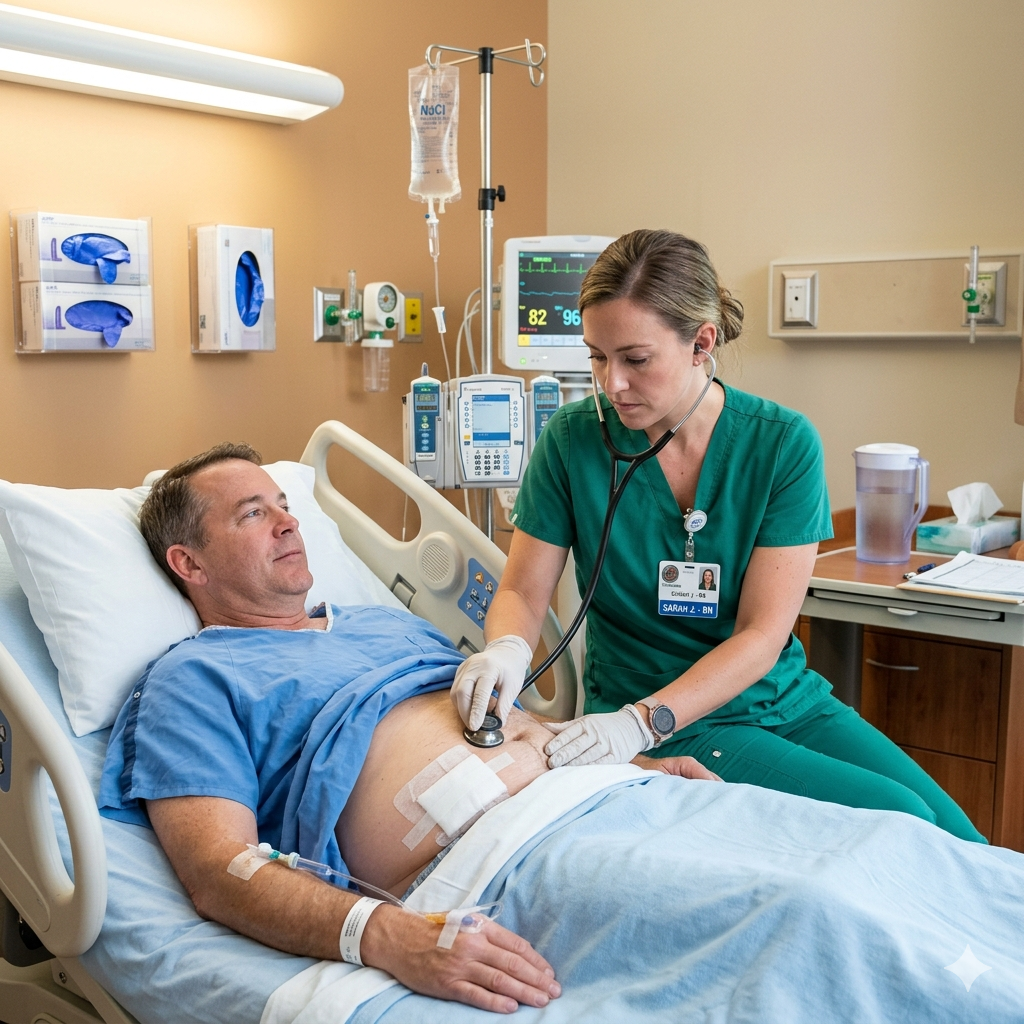
Postoperative ileus remains one of the most common and clinically significant complications a nurse will encounter in the medical-surgical setting. Specifically, it is defined as a temporary cessation of bowel motility following surgery — and because of this, postoperative ileus (POI) prolongs hospital stays, increases patient discomfort, and can escalate to serious complications if left unrecognized. For every registered nurse working in post-anesthesia care or on a surgical floor, understanding the pathophysiology, early warning signs, and evidence-based nursing interventions is non-negotiable. Furthermore, this topic is a high-yield target on the NCLEX. As a result, this guide provides a comprehensive clinical framework aligned with the nursing bundle of knowledge every RN nurse needs to manage POI with confidence.
What Is Postoperative Ileus and Why Does It Matter in Nursing Practice?
Postoperative ileus refers to the transient impairment of gastrointestinal motility that occurs after surgical procedures, particularly abdominal and pelvic surgeries. Unlike mechanical bowel obstruction, however, POI has no physical blockage — instead, the bowel simply stops moving effectively due to neurological, inflammatory, and pharmacological disruptions.
The normal return of bowel function follows a predictable pattern:
- Small intestine: motility typically resumes within 24 hours
- Stomach: resumes within 24–48 hours
- Colon: slowest to recover, often taking 3–5 days post-surgery
When this timeline is significantly exceeded, POI is suspected. Moreover, the condition affects up to 25% of patients following abdominal surgery and is associated with increased rates of pneumonia, deep vein thrombosis, and anastomotic complications. For these reasons, prompt nursing recognition is not simply best practice — it is essential to patient safety.
Recognizing the Signs and Symptoms: The Nurse’s Assessment Priorities
Early recognition is the cornerstone of postoperative ileus nursing care. Consequently, the registered nurse must perform systematic gastrointestinal assessments every 4–8 hours throughout the postoperative period.
Key clinical findings in POI include:
- Absent or hypoactive bowel sounds on auscultation (listen for at least 60 seconds per quadrant)
- Abdominal distension — visible bloating or a firm, tympanic abdomen on percussion
- Nausea and vomiting, often bilious
- Inability to pass flatus or stool beyond the expected recovery window
- Oral intolerance — inability to advance diet without vomiting
- Abdominal cramping or diffuse discomfort
In addition to these findings, the nurse should document the first passage of flatus and stool meticulously, as these are the most reliable clinical markers of bowel function return. Furthermore, communication using SBAR (Situation, Background, Assessment, Recommendation) with the surgical team ensures timely escalation when POI is suspected.
💡 NCLEX Tips for Postoperative Ileus
- Auscultate bowel sounds before palpation or percussion — mechanical stimulation can otherwise alter results
- The first priority nursing action for suspected POI is assessment, not intervention
- Opioid analgesics are a leading modifiable risk factor for POI — therefore, the nurse should advocate for multimodal analgesia
- Absent bowel sounds alone do not confirm POI — always correlate with clinical symptoms
- Early ambulation within 24 hours of surgery is one of the strongest evidence-based interventions for POI prevention
Risk Factors Every Nurse Must Identify
Proactive nursing care begins with risk stratification. Indeed, certain patients carry significantly elevated risk for developing postoperative ileus, and the RN nurse should flag these factors on admission and reassess postoperatively.
Modifiable risk factors:
- Opioid use — mu-opioid receptors in the gut directly inhibit peristalsis
- Prolonged surgical duration and extensive bowel manipulation
- Electrolyte imbalances — particularly hypokalemia and hypomagnesemia
- Inadequate early mobilization
- Nasogastric tube placement, especially with prolonged use
Non-modifiable risk factors:
- Advanced age
- History of prior abdominal surgeries or adhesions
- Open (versus laparoscopic) surgical approach
- Peritonitis or bowel perforation at time of surgery
Among all these factors, identifying electrolyte abnormalities is especially critical. Hypokalemia (potassium < 3.5 mEq/L), in particular, directly impairs smooth muscle contractility and represents a reversible cause of prolonged ileus. Therefore, the nurse must monitor labs closely and collaborate with the provider to correct deficiencies promptly.
Nursing Interventions for Postoperative Ileus Management
Evidence-based nursing care for POI is multifaceted. As a result, the registered nurse plays a central role in implementing and coordinating interventions across multiple domains.
1. Early and Consistent Ambulation Mobilizing the patient within 6–24 hours of surgery stimulates parasympathetic activity and, consequently, promotes peristalsis. The nurse should assist with dangling at the bedside, then progress to ambulation in the hallway, and document distance and tolerance with each attempt.
2. Multimodal Pain Management Reducing opioid exposure is a primary prevention strategy. To that end, the nurse should advocate for and administer scheduled NSAIDs, acetaminophen, and regional anesthesia techniques such as epidurals and nerve blocks as ordered. Additionally, patient-controlled analgesia (PCA) pumps should be monitored closely for overuse patterns.
3. Nasogastric Tube Management While NG tubes are no longer routinely placed prophylactically, they nevertheless remain an appropriate intervention for symptomatic POI with significant vomiting or distension. When in place, the nurse must ensure proper positioning, monitor drainage characteristics (color, volume, pH), and provide meticulous oral care.
4. Oral and Enteral Stimulation Chewing gum — also known as sham feeding — has demonstrated evidence-based efficacy in stimulating cephalic-vagal reflexes and thereby accelerating bowel recovery. When ordered, early clear liquids and dietary advancement should be closely coordinated with the surgical team. In select patients, Alvimopan (Entereg), a peripherally acting mu-opioid receptor antagonist, may also be ordered to directly counteract opioid-induced motility suppression.
5. Positioning and Comfort Positioning the patient upright as tolerated improves diaphragmatic excursion and, in turn, reduces abdominal pressure. Similarly, heating pads applied to the abdomen (per protocol) may provide relief from cramping during recovery.
6. Electrolyte Replacement The nurse must monitor potassium, magnesium, and sodium levels and administer replacements per protocol. Generally, oral supplementation is preferred when tolerated; however, IV replacement is initiated promptly for severe deficiencies.
Quick Reference: Postoperative Ileus Assessment and Intervention Summary
| Assessment Parameter | Normal Finding | Concerning Finding |
|---|---|---|
| Bowel sounds | Active in all 4 quadrants | Absent or hypoactive >48 hrs post-op |
| Passage of flatus | Within 24–72 hrs | Absent >72–96 hrs post-op |
| Abdominal distension | Soft, non-distended | Firm, tympanic, visibly distended |
| Nausea/Vomiting | Mild, resolving | Persistent, bilious, unresponsive to antiemetics |
| Serum Potassium | 3.5–5.0 mEq/L | < 3.5 mEq/L (hypokalemia) |
| Dietary Tolerance | Advancing per protocol | Unable to tolerate liquids or solids |
Patient Education: What the Nurse Must Teach
Patient and family education is a core nursing responsibility in both POI prevention and recovery. Accordingly, the nurse should instruct the patient on the following key points:
- The importance of getting out of bed early and walking, even when physically uncomfortable
- The need to report absence of flatus, increasing abdominal pain, or inability to tolerate fluids
- Understanding that opioid use should be minimized whenever pain is manageable with non-opioid alternatives
- Dietary progression — specifically, starting with clear liquids and advancing only after flatus returns
- Signs that warrant immediate reporting, such as severe abdominal distension, high-volume vomiting, or a sudden worsening of pain, which may otherwise indicate mechanical obstruction or further complications
Ultimately, empowered patients participate more actively in their own recovery. As a result, nursing education stands as one of the most impactful tools available to the RN nurse throughout the postoperative period.
Conclusion
Postoperative ileus nursing care demands vigilant assessment, proactive risk stratification, and coordinated evidence-based intervention. For the registered nurse, recognizing the hallmarks of POI — absent bowel sounds, distension, and failure to pass flatus — and responding swiftly with ambulation, electrolyte management, opioid reduction strategies, and timely escalation can meaningfully reduce patient morbidity and shorten recovery time. Moreover, this topic carries strong NCLEX relevance, as priority-setting and physiological adaptation questions frequently center on postoperative complications. To further sharpen clinical knowledge, practice with NCLEX-style questions at rn-nurse.com/nclex-qcm or explore the full nursing bundle of surgical nursing content at rn-nurse.com/nursing-courses. Every detail mastered now is ultimately a patient protected later.