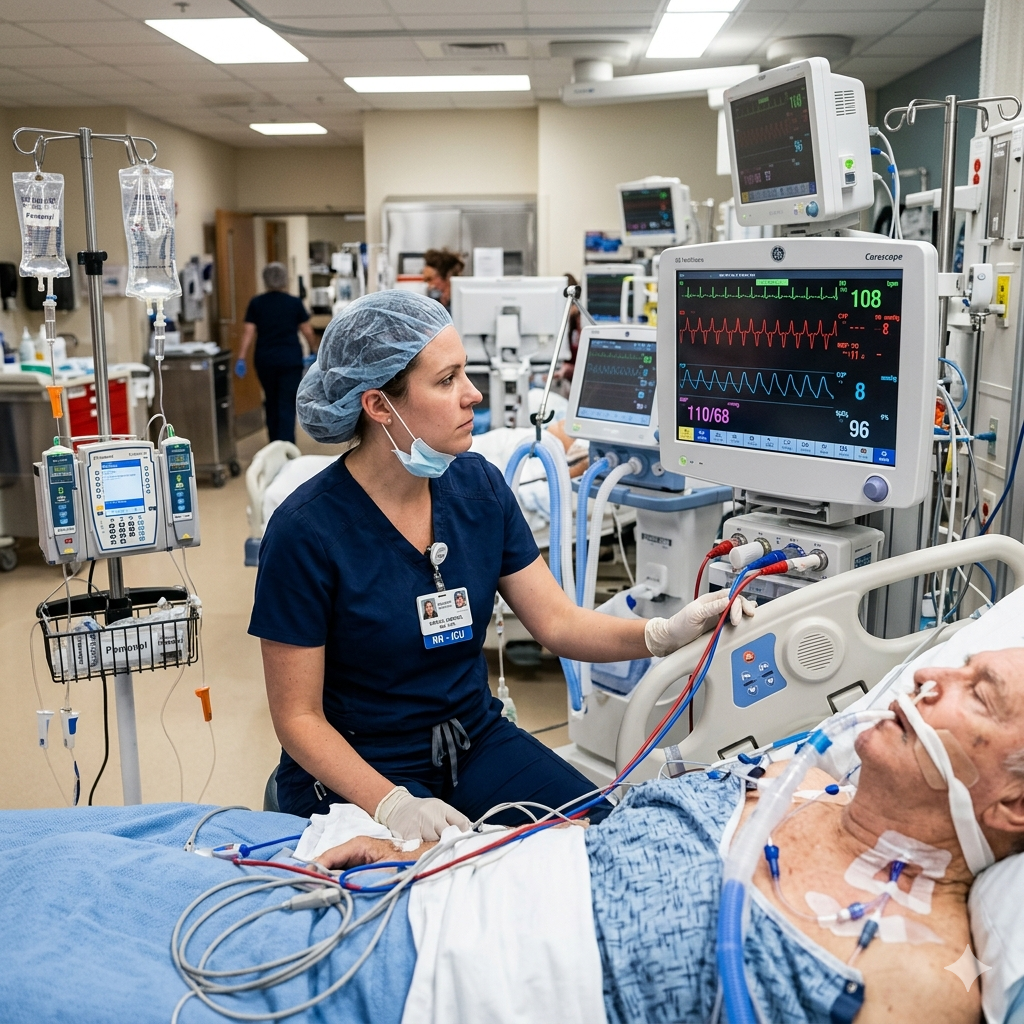
Pericardial tamponade is one of the most life-threatening emergencies a registered nurse will encounter in critical care. When fluid accumulates rapidly within the pericardial sac, it compresses the heart and dramatically reduces cardiac output — and without rapid recognition and intervention, the result can be fatal. At the center of every nursing assessment for this condition is Beck’s Triad, a classic cluster of three findings that every RN nurse must be able to identify with speed and precision. Understanding Beck’s Triad pericardial tamponade is a high-yield topic for NCLEX and an essential clinical skill for any nurse working in ICU, emergency, or surgical settings.
What Is Pericardial Tamponade?
Cardiac tamponade (also called pericardial tamponade) occurs when an abnormal accumulation of fluid — blood, pus, or effusion — collects within the pericardial space, the thin sac surrounding the heart. As fluid builds, intrapericardial pressure rises and begins to exceed the filling pressure of the cardiac chambers. The result is diastolic compression: the ventricles cannot adequately fill, stroke volume falls, and cardiac output collapses.
The pericardial sac normally contains 15–50 mL of fluid. In tamponade, volumes of 150–200 mL accumulated rapidly (as in trauma or aortic dissection) can cause immediate hemodynamic collapse. When fluid accumulates slowly — as in malignant effusions or hypothyroidism — the pericardium may stretch to accommodate 1,000 mL or more before symptoms appear.
Common causes include:
- Trauma (penetrating chest wounds, blunt thoracic injury)
- Post-cardiac surgery or post-MI free wall rupture
- Pericarditis (viral, bacterial, tuberculous, uremic)
- Malignancy (lung, breast, lymphoma)
- Aortic dissection
- Autoimmune disorders (lupus, rheumatoid arthritis)
Nursing recognition of the underlying cause shapes the urgency and direction of intervention.
Beck’s Triad: The Three Classic Signs
Beck’s Triad was described by cardiac surgeon Claude Beck in 1935 and remains the cornerstone of tamponade recognition in clinical nursing practice. The triad consists of three findings:
1. Hypotension
As cardiac output falls due to impaired ventricular filling, systolic blood pressure drops. The nurse may also observe a narrowed pulse pressure (the difference between systolic and diastolic BP). In severe tamponade, pulsus paradoxus — a drop in systolic BP greater than 10 mmHg during inspiration — is a hallmark finding. This occurs because inspiration increases venous return to the right heart, which in a compressed space shifts the interventricular septum leftward and reduces left ventricular output.
2. Jugular Venous Distension (JVD)
Impaired right-sided filling causes blood to back up into the venous system. The registered nurse will observe distended, non-collapsing neck veins — jugular venous distension (JVD) — even when the patient is positioned at 45 degrees. This finding reflects elevated central venous pressure (CVP).
3. Muffled Heart Sounds
Fluid surrounding the heart dampens the transmission of heart sounds to the chest wall. On auscultation, the nurse will note muffled or distant heart sounds — sometimes described as hearing the heart “through a pillow.” This is the most pathognomonic of the three signs but can be subtle and easily missed in a noisy ICU.
💡 NCLEX Tips for Beck’s Triad Pericardial Tamponade
- Beck’s Triad = Hypotension + JVD + Muffled heart sounds — memorize this as “The Three M’s: Muffled, Mapped veins, and Mean pressure drop”
- Pulsus paradoxus > 10 mmHg is a key associated finding — expect NCLEX to test this with blood pressure readings
- The emergency treatment for tamponade is pericardiocentesis — the nurse’s role includes positioning, monitoring, and assisting with the procedure
- On NCLEX, if a post-cardiac surgery patient suddenly becomes hypotensive with JVD — think tamponade first
- Tamponade is one of the reversible Hs and Ts in ACLS: remember “Tension pneumothorax and Tamponade” under the T’s
Nursing Assessment and Hemodynamic Monitoring
Recognition of Beck’s Triad pericardial tamponade requires a systematic nursing assessment. In the ICU, the RN nurse should monitor:
- Vital signs: progressive hypotension, tachycardia (compensatory), narrowed pulse pressure
- CVP/JVP: elevated CVP (typically >15 mmHg), visible JVD
- Auscultation: muffled or distant S1/S2
- Pulsus paradoxus: measured manually with a sphygmomanometer during respiratory cycle
- Urine output: decreasing UO signals worsening cardiac output and end-organ hypoperfusion
- Level of consciousness: agitation or decreased LOC may indicate cerebral hypoperfusion
In monitored patients, the nurse may also observe electrical alternans on ECG — a pattern of alternating QRS complex amplitude caused by the heart “swinging” within the fluid-filled sac. While not part of Beck’s Triad, it is a strongly supportive finding.
Bedside echocardiography (ECHO) has become the gold standard for rapid confirmation of tamponade. The nursing bundle for critical care should include competency in recognizing ECHO findings and facilitating point-of-care ultrasound teams.
Nursing Interventions and Emergency Management
Once Beck’s Triad pericardial tamponade is suspected, the nurse must act without delay. Time is critical.
Immediate nursing priorities:
- Call for immediate physician/advanced provider notification — use SBAR communication to relay hemodynamics, clinical findings, and suspected diagnosis
- Establish or confirm IV access — large-bore peripheral IVs or central venous access
- Administer IV fluids as ordered — cautious volume loading may temporarily improve venous return and cardiac output as a bridge to definitive treatment
- Prepare for pericardiocentesis — the definitive treatment involves needle aspiration of pericardial fluid, often guided by echocardiography or fluoroscopy
- Position the patient — semi-recumbent (30–45 degrees) to optimize venous return and comfort
- Continuous cardiac monitoring — watch for dysrhythmias, electrical alternans, and worsening hemodynamics
- Oxygen therapy — apply supplemental O₂ to support myocardial oxygen demand
- Prepare for surgical drainage — in trauma or recurrent effusion, surgical pericardiotomy (pericardial window) may be required
The nursing bundle for tamponade management also includes emotional support for the patient and family, documentation of the timeline of assessment changes, and post-procedure monitoring for reaccumulation.
Quick Reference: Beck’s Triad at a Glance
| Finding | Clinical Presentation | Physiologic Cause |
|---|---|---|
| Hypotension | Falling SBP, narrow pulse pressure, pulsus paradoxus | Decreased stroke volume and cardiac output |
| JVD | Distended neck veins visible at 45° | Elevated CVP from impaired right-sided filling |
| Muffled Heart Sounds | Distant S1/S2 on auscultation | Fluid surrounding heart dampens sound transmission |
| Tachycardia | HR compensatory rise (not part of triad but associated) | Sympathetic response to low output |
| Electrical Alternans | Alternating QRS amplitude on ECG | Heart swinging in pericardial fluid |
Pericardiocentesis: The Nurse’s Role
Pericardiocentesis — needle aspiration of fluid from the pericardial space — is the primary intervention for hemodynamically significant tamponade. The nurse’s role is multifaceted:
- Before: Obtain informed consent, confirm IV access, apply cardiac monitoring leads, gather the pericardiocentesis kit and ECHO equipment, administer sedation or analgesia as ordered
- During: Monitor vital signs continuously, observe ECG for ST elevation or dysrhythmias (which indicate needle contact with myocardium), provide patient reassurance
- After: Monitor for reaccumulation (return of hypotension, JVD, muffled sounds), document fluid volume removed, send fluid samples to lab as ordered (cytology, culture, protein/LDH)
Even 50–100 mL of fluid removal can produce dramatic hemodynamic improvement — a clinically rewarding moment for the nursing team.
Conclusion
Beck’s Triad pericardial tamponade is a life-threatening emergency that demands rapid recognition and decisive nursing action. The three hallmark findings — hypotension, JVD, and muffled heart sounds — provide a clear clinical roadmap for the registered nurse to identify this condition before hemodynamic collapse becomes irreversible. Whether in a trauma bay, a cardiac surgery ICU, or a general critical care unit, every RN nurse must be prepared to act the moment these signs converge.
Mastering Beck’s Triad and the full clinical picture of tamponade is essential preparation for NCLEX and for safe, competent practice at the bedside. Reinforce this knowledge with hands-on practice questions and targeted review through the rn-nurse.com NCLEX quiz bank and the comprehensive nursing bundle courses designed to build critical care confidence — one concept at a time.