
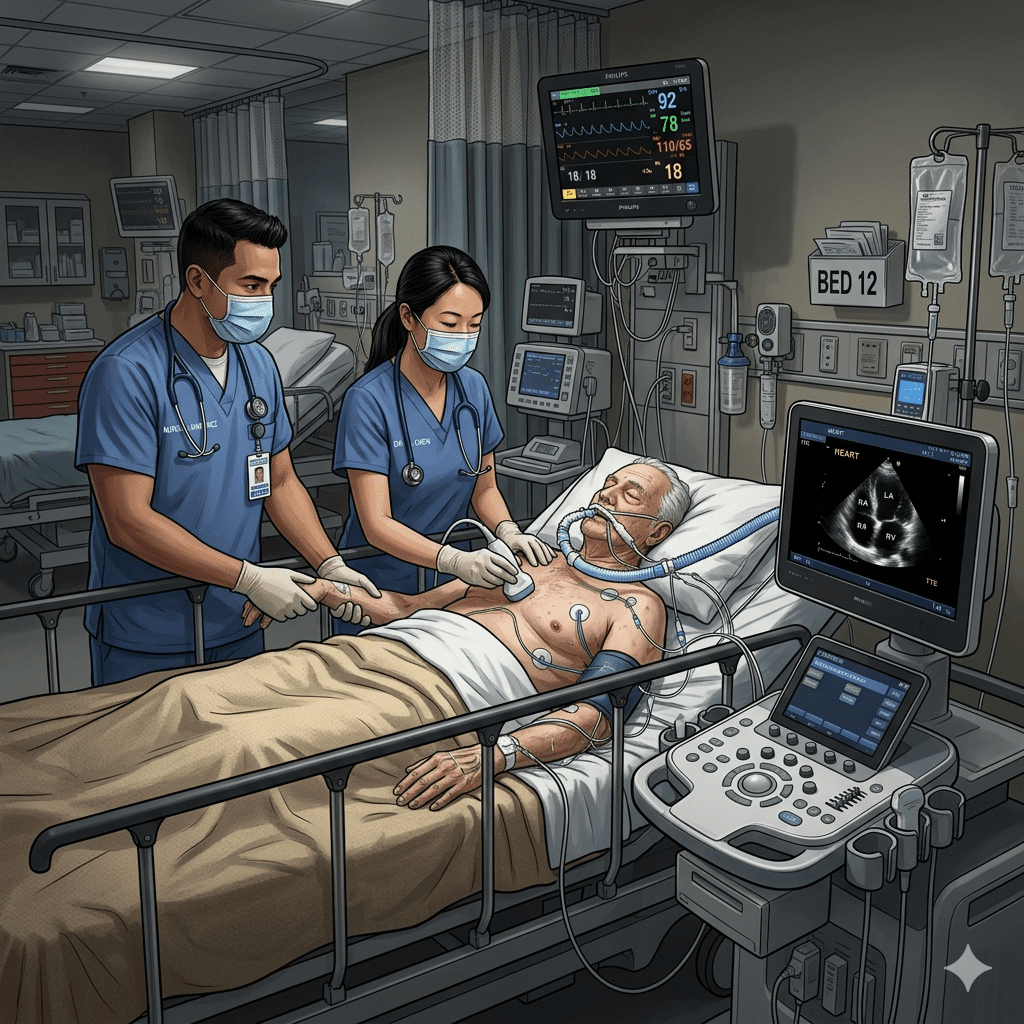
Technology has rapidly transformed modern healthcare, and one of the most powerful tools used in critical care today is bedside ultrasound. This imaging technique allows healthcare professionals to quickly assess patients directly at the bedside without moving them to another department. For the nurse working in intensive care settings, understanding how bedside ultrasound supports clinical decisions is becoming increasingly important.
Although physicians often perform the scan itself, the registered nurse (RN nurse) plays a key role in patient preparation, monitoring, and interpretation support during the procedure. Because ultrasound is widely used in emergency and ICU environments, it is also appearing more frequently in NCLEX review materials and advanced nursing education programs.
This article explores how bedside ultrasound works, its common applications in critical care, and the important role nurses play in supporting this technology.
What Is Bedside Ultrasound?
Bedside ultrasound, also called point-of-care ultrasound (POCUS), is a portable imaging technique that uses high-frequency sound waves to produce real-time images of internal organs and structures.
Unlike traditional imaging studies that require transportation to radiology departments, bedside ultrasound can be performed immediately at the patient’s bedside. This allows clinicians to assess urgent conditions quickly and begin treatment without delay.
In critical care environments, this rapid diagnostic ability can significantly improve patient outcomes.
For the RN nurse, understanding when and why ultrasound is used helps support effective patient monitoring and collaboration with the healthcare team.
Why Bedside Ultrasound Is Important in Critical Care
Critically ill patients often experience sudden changes in their condition. Rapid assessment is essential to identify life-threatening problems such as internal bleeding, cardiac dysfunction, or fluid overload.
Bedside ultrasound provides several advantages:
- Immediate results
- Noninvasive imaging
- No radiation exposure
- Portable equipment
- Real-time patient evaluation
Because of these benefits, ultrasound has become a standard tool in many intensive care units.
For nursing professionals, familiarity with ultrasound procedures improves communication with physicians and enhances patient care.
Common Uses of Bedside Ultrasound in the ICU
Bedside ultrasound is used for many diagnostic and procedural purposes in critical care. Understanding these applications helps the registered nurse anticipate procedures and prepare the patient appropriately.
Cardiac Assessment
Ultrasound can quickly evaluate heart function in critically ill patients. Clinicians use cardiac ultrasound to assess:
- Heart pumping ability
- Pericardial effusion (fluid around the heart)
- Signs of cardiac tamponade
- Heart chamber size
This information helps determine whether a patient may be experiencing conditions such as heart failure or shock.
During these assessments, the RN nurse monitors vital signs and ensures the patient remains stable throughout the procedure.
Lung Evaluation
Bedside ultrasound can also detect lung conditions that may be difficult to diagnose using physical examination alone.
Common findings include:
- Pleural effusion
- Pneumothorax
- Pulmonary edema
- Lung consolidation
These conditions are particularly important in patients receiving mechanical ventilation. Nurses caring for ventilated patients often assist with positioning and monitoring during these assessments.
Fluid Status Assessment
Ultrasound can help determine whether a patient requires fluid resuscitation or diuretics. Clinicians may evaluate structures such as the inferior vena cava (IVC) to estimate fluid volume status.
Changes in IVC size during breathing can provide valuable clues about a patient’s hydration and circulatory status.
This information supports safer fluid management, which is a key concept in critical care nursing.
Guiding Medical Procedures
Bedside ultrasound is also widely used to guide medical procedures safely. Examples include:
- Central venous catheter insertion
- Thoracentesis
- Paracentesis
- Arterial line placement
Using ultrasound guidance reduces complications and improves procedural accuracy.
The nurse assists by preparing sterile equipment, positioning the patient, and monitoring for complications.
Nursing Responsibilities During Bedside Ultrasound
Although nurses may not always perform the ultrasound scan, they play a critical role in supporting the procedure.
Key responsibilities of the RN nurse include:
- Preparing the patient and explaining the procedure
- Ensuring monitoring equipment is functioning properly
- Positioning the patient for optimal imaging
- Observing vital signs during the examination
- Documenting findings and patient responses
Because critically ill patients can deteriorate quickly, the registered nurse must remain alert throughout the procedure.
Benefits of Bedside Ultrasound in Nursing Practice
Bedside ultrasound has significantly improved patient care in intensive care settings. For nurses, this technology provides several advantages.
These include:
- Faster diagnosis of critical conditions
- Reduced patient transport risks
- Improved collaboration with physicians
- Enhanced monitoring of patient status
As ultrasound technology continues to evolve, many nursing programs are beginning to include basic ultrasound education.
Importance for NCLEX Preparation
Critical care assessment and patient monitoring are important topics in NCLEX examinations. Understanding the role of bedside ultrasound helps students recognize modern diagnostic tools used in healthcare.
For example, NCLEX questions may ask the RN nurse to:
- Identify situations requiring rapid diagnostic assessment
- Prioritize patient monitoring during procedures
- Recognize complications related to invasive lines
- Support physicians during bedside procedures
Learning about bedside ultrasound strengthens clinical awareness and improves decision-making skills.
How Nursing Study Bundles Support Learning
Complex ICU topics can sometimes feel overwhelming for students. Structured learning tools such as a nursing bundle can help simplify these concepts.
A comprehensive nursing bundle often includes:
- Visual diagrams of ultrasound applications
- Critical care assessment guides
- Quick-reference charts for ICU monitoring
- NCLEX-style practice questions
These resources help future registered nurses develop a deeper understanding of modern patient care technologies.
Final Thoughts
Bedside ultrasound has become an essential tool in modern critical care medicine. By providing real-time imaging at the patient’s bedside, it allows clinicians to quickly identify life-threatening conditions and begin treatment without delay.
Although physicians typically perform the scans, the nurse plays an essential role in supporting the procedure, monitoring patient stability, and ensuring safe care. The RN nurse is often the professional closest to the patient, making their role vital during these assessments.
For students preparing for the NCLEX, understanding the purpose and benefits of bedside ultrasound is an important part of advanced nursing knowledge. With continued education and the support of structured resources like a nursing bundle, future registered nurses can develop the confidence needed to care for critically ill patients using modern medical technology.