
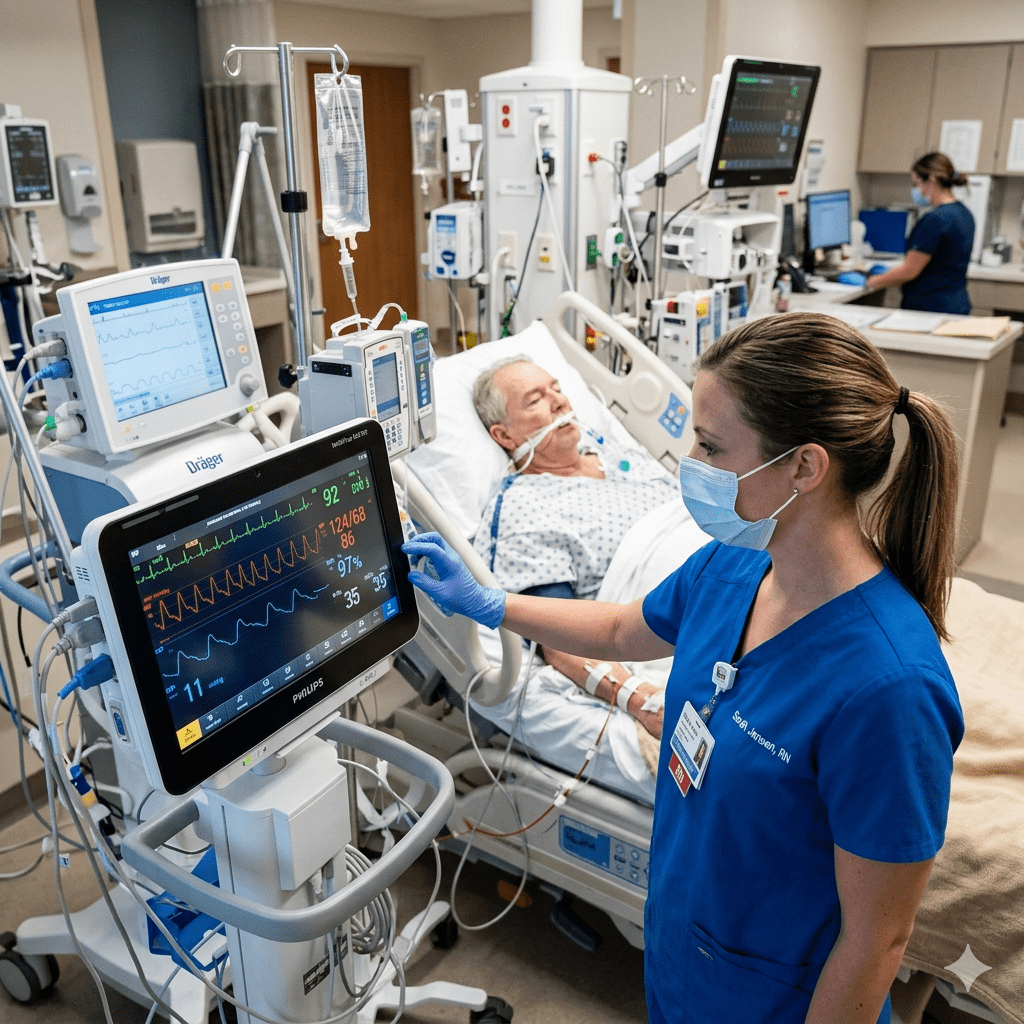
Managing fluid therapy is one of the most important aspects of care for critically ill patients. In emergency and intensive care settings, healthcare providers must determine whether a patient will benefit from additional intravenous fluids. Therefore, understanding hemodynamic indicators that predict fluid responsiveness is essential for every nurse and registered nurse (RN nurse) involved in critical care.
Traditionally, clinicians relied on static indicators such as central venous pressure (CVP) to guide fluid therapy. However, modern research has shown that dynamic indicators are often more accurate in predicting whether fluids will improve cardiac output. Because of this shift in practice, these concepts are increasingly discussed in advanced nursing education, NCLEX preparation materials, and many nursing bundle study guides.
This article will explain the difference between dynamic and static hemodynamic indicators and how they help guide fluid management in critically ill patients.
What Is Fluid Responsiveness?
Fluid responsiveness refers to a patient’s ability to increase cardiac output after receiving intravenous fluids. In simple terms, clinicians want to know whether giving fluids will improve circulation and oxygen delivery to the body’s tissues.
Not all patients benefit from additional fluids. Consequently, giving unnecessary fluids can lead to complications such as:
- Pulmonary edema
- Fluid overload
- Worsening respiratory function
- Increased ICU length of stay
Because of these risks, healthcare providers rely on hemodynamic indicators to guide fluid therapy decisions.
For the RN nurse, understanding these indicators helps support safe and effective patient care.
Static Hemodynamic Indicators
Static indicators are traditional measurements used to estimate a patient’s fluid status at a single point in time. These values are usually obtained through invasive monitoring or vital sign assessment.
Common static indicators include:
- Central Venous Pressure (CVP)
- Pulmonary Artery Occlusion Pressure (PAOP)
- Mean Arterial Pressure (MAP)
- Heart rate and blood pressure
These measurements reflect pressure within the cardiovascular system. However, pressure alone does not always indicate whether the heart will respond to additional fluid.
For example, a patient may have normal CVP values but still benefit from fluid administration. Therefore, relying solely on static indicators may lead to inaccurate clinical decisions.
Understanding the limitations of static measurements is an important concept in critical care nursing and may appear in NCLEX questions.
Dynamic Hemodynamic Indicators
Dynamic indicators evaluate how the cardiovascular system responds to changes in pressure or ventilation. Instead of providing a single measurement, they analyze variations over time.
Common dynamic indicators include:
- Pulse Pressure Variation (PPV)
- Stroke Volume Variation (SVV)
- Passive Leg Raise Test (PLR)
- Respiratory variation in arterial waveform
Because these indicators evaluate real-time physiological responses, they often provide more reliable predictions of fluid responsiveness.
Consequently, many modern intensive care units now rely on dynamic indicators to guide fluid therapy decisions.
Why Dynamic Indicators Are More Accurate
Dynamic indicators measure how the heart responds to temporary changes in blood flow or pressure. These responses reveal whether the heart is capable of increasing output when additional fluid is given.
For example, mechanical ventilation creates small fluctuations in intrathoracic pressure. Dynamic indicators analyze how these fluctuations affect stroke volume or pulse pressure.
If the cardiovascular system shows significant variation during these cycles, the patient is more likely to respond to fluid administration.
Therefore, dynamic monitoring helps healthcare providers make more precise treatment decisions.
The registered nurse must understand these principles when assisting with advanced hemodynamic monitoring in critical care settings.
The Passive Leg Raise Test
One of the most widely used dynamic assessments is the Passive Leg Raise (PLR) test.
During this test, the patient’s legs are temporarily elevated to shift blood from the lower extremities toward the heart. This movement simulates the effect of a small fluid bolus without actually giving IV fluids.
If cardiac output increases during the test, the patient is likely fluid responsive.
Benefits of the PLR test include:
- Noninvasive assessment
- Rapid results
- No fluid administration required
- Reversible if the patient does not respond
Because of these advantages, many clinicians use this technique as a bedside tool in critical care nursing.
Role of the Nurse in Hemodynamic Monitoring
The RN nurse plays a vital role in monitoring and interpreting hemodynamic data. Continuous assessment helps identify changes in patient status and guides fluid therapy decisions.
Key nursing responsibilities include:
- Monitoring vital signs and perfusion status
- Observing changes in blood pressure and heart rate
- Assessing urine output
- Evaluating mental status
- Assisting with advanced monitoring equipment
In addition, the nurse communicates abnormal findings to the healthcare team and participates in collaborative decision-making regarding fluid management.
Risks of Excessive Fluid Administration
Although fluid therapy can improve circulation in certain patients, excessive fluids may cause complications.
Potential risks include:
- Pulmonary edema
- Increased cardiac workload
- Tissue swelling
- Delayed recovery in critically ill patients
Therefore, careful evaluation of fluid responsiveness is essential before administering large fluid volumes.
The registered nurse must carefully monitor patient response to prevent fluid overload.
Importance for NCLEX Preparation
Fluid balance and hemodynamic monitoring are essential topics in modern nursing education. Because they are directly related to patient safety, these concepts frequently appear on the NCLEX exam.
For example, test questions may require the RN nurse to:
- Identify appropriate indicators of fluid responsiveness
- Recognize signs of fluid overload
- Prioritize nursing interventions in shock or sepsis
- Interpret hemodynamic monitoring data
Studying these concepts helps students strengthen their clinical reasoning skills.
How Nursing Study Bundles Support Learning
Advanced critical care topics can be difficult for many students to understand. Fortunately, structured study resources such as a nursing bundle can simplify these complex concepts.
A comprehensive nursing bundle often includes:
- Hemodynamic monitoring charts
- Simplified explanations of cardiovascular physiology
- NCLEX-style practice questions
- Quick reference guides for ICU care
These materials help future registered nurses develop confidence when managing critically ill patients.
Final Thoughts
Fluid management is a critical component of care for patients experiencing circulatory instability. Determining whether a patient will respond to fluid therapy requires careful evaluation of hemodynamic indicators.
While static indicators such as central venous pressure provide useful information, dynamic indicators often offer more accurate predictions of fluid responsiveness. Therefore, many modern healthcare settings now rely on dynamic monitoring techniques.
For the nurse, understanding these concepts improves patient assessment and supports better clinical decision-making. The RN nurse plays an essential role in monitoring hemodynamic status and communicating changes to the healthcare team.
For students studying advanced nursing topics, mastering fluid responsiveness concepts is also important for success on the NCLEX exam. With continued practice and the support of structured learning resources like a nursing bundle, future registered nurses can develop the knowledge needed to manage complex critical care situations.