
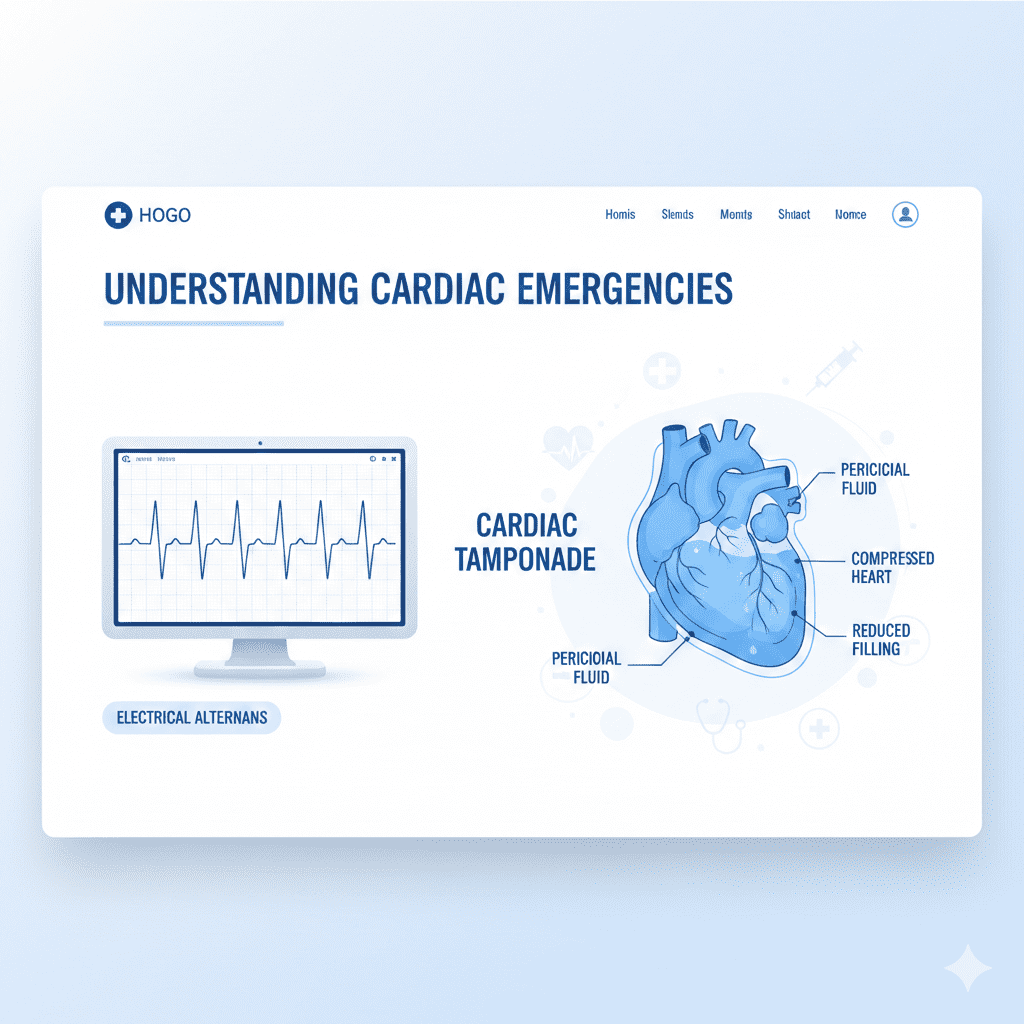
Electrical alternans is a classic ECG finding that every nurse must recognize. It is strongly associated with cardiac tamponade, a life-threatening emergency frequently tested on the NCLEX.
Electrical alternans plus hypotension and jugular venous distention should immediately make a nurse suspect cardiac tamponade.
Whether you are a nursing student, a new registered nurse, or reviewing your cardiac section inside a comprehensive nursing bundle, this guide simplifies everything you need to know.
What Is Electrical Alternans?
Electrical alternans is an ECG pattern where the QRS amplitude alternates beat-to-beat.
In simple terms:
- One QRS complex appears tall
- The next appears shorter
- This alternating pattern continues
It happens because the heart swings back and forth inside a fluid-filled pericardial sac.
For an RN nurse, recognizing this rhythm can be lifesaving.
What Is Cardiac Tamponade?
Cardiac tamponade occurs when fluid accumulates in the pericardial sac, compressing the heart and preventing proper filling.
This leads to:
- Decreased cardiac output
- Hypotension
- Shock
Tamponade is a medical emergency and heavily emphasized in nursing education and on the NCLEX.
Why Electrical Alternans Happens
When fluid builds up around the heart:
- The heart floats in excess pericardial fluid
- It swings slightly with each beat
- ECG amplitude changes as the electrical axis shifts
This mechanical movement produces electrical alternans.
Classic Cardiac Tamponade Clues (NCLEX High-Yield)
1️⃣ Beck’s Triad
Every registered nurse should memorize this:
- Hypotension
- Jugular venous distention (JVD)
- Muffled heart sounds
If you see electrical alternans + Beck’s triad → Think tamponade immediately.
2️⃣ Pulsus Paradoxus
- Drop in systolic BP > 10 mmHg during inspiration
- Common in tamponade
- Frequently appears in NCLEX-style questions
3️⃣ ECG Findings in Tamponade
- Electrical alternans
- Low voltage QRS complexes
- Sinus tachycardia
Unlike myocardial infarction, tamponade does not typically show localized ST elevation.
Electrical Alternans vs Other ECG Patterns
| Feature | Electrical Alternans | Hyperkalemia | MI |
|---|---|---|---|
| QRS Pattern | Alternating amplitude | Wide QRS (progressive) | Usually stable |
| Voltage | Often low | Normal or wide | Normal |
| ST Elevation | Rare | Rare | Localized |
| Clinical Clue | JVD + hypotension | High potassium | Chest pain |
This comparison is helpful when reviewing your cardiac section in a structured nursing bundle.
Causes of Cardiac Tamponade
Common causes tested on the NCLEX:
- Pericardial effusion
- Chest trauma
- Post-cardiac surgery
- Malignancy
- Pericarditis
As an RN nurse, always monitor post-operative cardiac patients carefully.
Nursing Assessment Priorities
When tamponade is suspected:
Immediate Assessment
- Check blood pressure
- Assess heart sounds
- Observe for JVD
- Monitor ECG changes
Critical Thinking Tip
Electrical alternans alone is not enough. Combine ECG findings with clinical signs.
This is the difference between memorizing and thinking like a registered nurse.
Emergency Treatment of Cardiac Tamponade
Tamponade is treated with:
1️⃣ Pericardiocentesis (Definitive Treatment)
- Removes excess fluid
- Relieves pressure on the heart
2️⃣ IV Fluids
- Temporarily increase preload
3️⃣ Oxygen Therapy
⚠️ Diuretics are generally avoided because they reduce preload further.
On the NCLEX, the correct priority is usually prepare for pericardiocentesis.
NCLEX Practice Question
A patient post-cardiac surgery develops hypotension, JVD, and muffled heart sounds. ECG shows alternating QRS amplitude. What should the nurse do first?
A. Administer IV furosemide
B. Prepare for pericardiocentesis
C. Start thrombolytics
D. Give calcium gluconate
Correct Answer: B
This type of scenario is common in cardiac sections of a comprehensive nursing bundle.
Key Takeaways for Nurses
For every nurse and RN nurse:
- Electrical alternans = alternating QRS height
- Think cardiac tamponade immediately
- Look for Beck’s triad
- Prepare for emergency intervention
- Early recognition saves lives
Mastering these cardiac clues strengthens your clinical confidence as a registered nurse and improves your performance on the NCLEX.