EKG: ELECTRICAL CONDUCTION SYSTEM OF THE HEART
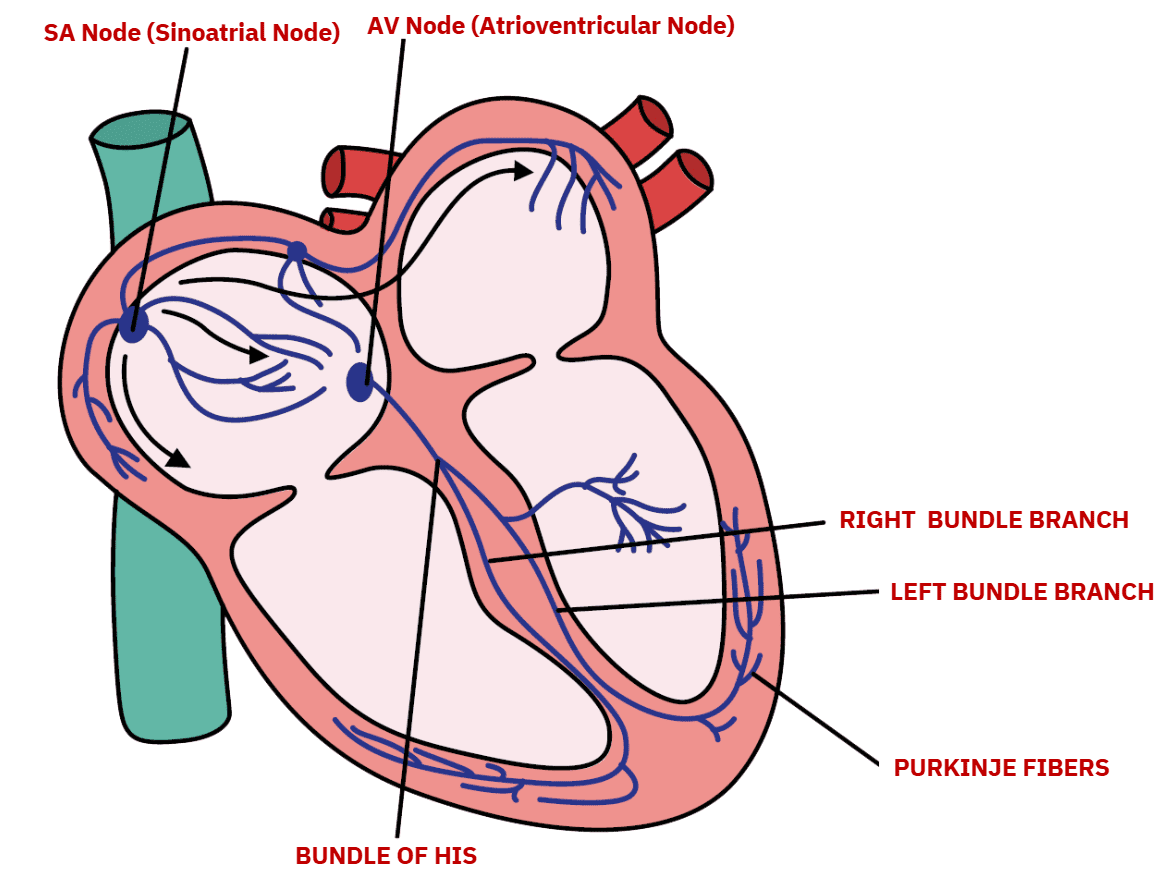
Illustration shows the flow from SA Node → AV Node → Bundle of His → Bundle Branches → Purkinje Fibers
ELECTRICAL CONDUCTION SYSTEM OF THE HEART.
1. SA Node (Sinoatrial Node)
- Known as the heart’s pacemaker
- Generates electrical impulses at a rate of 60–100 bpm
- Corresponds to the P wave on ECG
- Impulse travels through internodal pathways to the AV Node
2. AV Node (Atrioventricular Node)
- Known as the gatekeeper
- Delays impulse to allow ventricular filling
- Intrinsic rate: 40–60 bpm
3. Bundle of His
- Receives impulse from the AV Node
- Conducts impulse toward the ventricles
4. Bundle Branches
- Right and Left bundle branches carry impulse down each side of the interventricular septum
5. Purkinje Fibers
- Distribute impulse throughout ventricles
- Ventricular contraction rate: 20–40 bpm
Cardiac Conduction Quiz
1. Multiple Choice
- Which part of the heart is known as the “pacemaker”?
- The AV Node delays the impulse to allow:
- Which structure splits the impulse into right and left branches?
2. True / False
- The SA Node generates impulses at a rate of 40–60 bpm.
- Purkinje fibers distribute the impulse throughout the ventricles.
- The P wave on the ECG corresponds to the AV Node firing.
3. Short Answer
- What is the intrinsic firing rate of the AV Node?
- List the sequence of the cardiac conduction system from SA Node to Purkinje fibers.
- Why is the AV Node called the “gatekeeper” of the heart?
- What is the ventricular contraction rate if only the Purkinje fibers are functioning?
Related Resources