
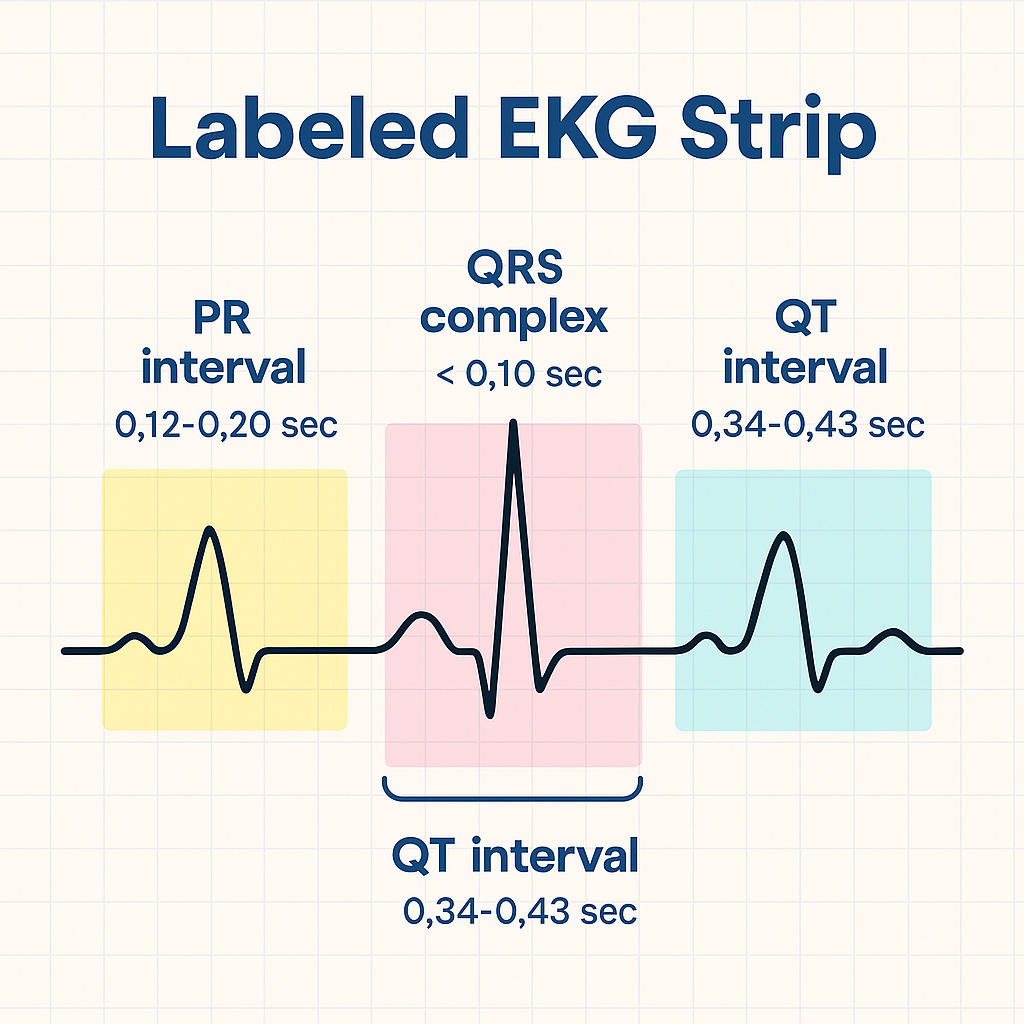
Electrocardiograms (EKGs) can feel intimidating at first. But once you break them down, they’re not so scary — especially if you know how to read the key intervals.
In nursing practice, understanding PR, QRS, and QT intervals helps you detect problems like heart blocks, electrolyte imbalances, and dangerous arrhythmias early — sometimes before a patient crashes.
This guide will teach you exactly what each interval means, how to measure them, normal ranges, and what abnormal results can mean for your patient.
Let’s make it simple!
🫀 What Are EKG Intervals?
An interval is the time it takes for electrical signals to travel through different parts of the heart.
When you look at an EKG strip, you see waves (P wave, QRS complex, T wave) and spaces in between. The length of these spaces — the intervals — tells you if the heart’s electrical system is working properly.
✅ Why Nurses Must Know EKG Intervals
Monitoring intervals is vital for:
- Spotting heart blocks
- Catching electrolyte problems (like hypo/hyperkalemia, hypo/hypercalcemia)
- Preventing sudden cardiac arrest
- Ensuring safe medication use (many drugs can prolong QT!)
Even if you don’t work in a cardiac unit, you’ll see EKGs in the ER, ICU, and med-surg floors. So, let’s break down the Big 3.
1️⃣ PR Interval
📌 What Is It?
The PR interval shows the time it takes for an electrical impulse to travel from the SA node (where the signal starts) through the atria and the AV node (which delays the signal slightly) before it enters the ventricles.
In simple terms:
PR = atrial depolarization + AV node delay
📏 Normal PR Interval
- 0.12–0.20 seconds (3–5 small boxes on EKG paper)
🩺 How to Measure It
- Find the start of the P wave.
- Find the start of the QRS complex.
- Count the small boxes between them.
Example: If there are 4 small boxes, that’s 0.16 seconds — normal.
⚠️ What If It’s Abnormal?
- Too long (>0.20):
Possible first-degree heart block (signal is delayed too long at the AV node). - Too short:
May suggest accessory pathways (like Wolff-Parkinson-White syndrome).
2️⃣ QRS Complex
📌 What Is It?
The QRS complex shows ventricular depolarization — the signal spreads through the ventricles, causing them to contract.
This is the most critical part: if the QRS is wide or abnormal, the ventricles aren’t conducting electricity properly.
📏 Normal QRS Duration
- 0.06–0.10 seconds (1.5–2.5 small boxes)
🩺 How to Measure It
- Find the beginning of the Q wave.
- Find the end of the S wave.
- Count the small boxes between them.
Example: 2 small boxes = 0.08 seconds — normal.
⚠️ What If It’s Abnormal?
- Wide QRS (>0.12):
Suggests a bundle branch block or a ventricular rhythm like V-Tach. - Very wide & bizarre:
Could be V-Tach, ventricular pacing, or hyperkalemia.
Always check electrolytes if you see a sudden change!
3️⃣ QT Interval
📌 What Is It?
The QT interval measures the time from the beginning of ventricular depolarization to the end of repolarization — in other words, how long it takes the ventricles to contract and reset for the next beat.
It’s very important because certain meds and electrolyte problems can prolong the QT interval, leading to a deadly rhythm called Torsades de Pointes.
📏 Normal QT Interval
- Varies with heart rate.
- Rough guide: 0.36–0.44 seconds (9–11 small boxes)
- Corrected QT (QTc) adjusts for HR — many monitors calculate this for you.
🩺 How to Measure It
- Find the beginning of the Q wave.
- Find the end of the T wave.
- Count the small boxes.
Example: 10 small boxes = 0.40 seconds — normal.
⚠️ What If It’s Abnormal?
- Long QT:
Risk for Torsades de Pointes. Causes include:- Low potassium, low magnesium, low calcium
- Medications (antiarrhythmics, some antibiotics)
- Congenital long QT syndrome
- Short QT:
Rare, but can be due to high calcium or digoxin toxicity.
🔑 Quick EKG Intervals Cheat Sheet
| Interval | Normal Duration | What It Tells You | Danger If Abnormal |
|---|---|---|---|
| PR | 0.12–0.20 sec | SA to AV node conduction | Heart blocks |
| QRS | 0.06–0.10 sec | Ventricular conduction | Blocks, V-Tach |
| QT | 0.36–0.44 sec | Ventricular depolarization & repolarization | Torsades risk |
✅ How to Get Faster at Reading EKG Intervals
👉 Practice on real strips: Don’t rely on just the monitor reading. Measure yourself!
👉 Use calipers or paper: Mark start & end points for accuracy.
👉 Check old vs. new EKGs: Look for changes — did the PR get longer? Is the QT increasing?
👉 Know your patient’s meds: Many drugs affect intervals!
👉 Double-check electrolytes: Always connect the EKG to lab values.
❤️ Common Nursing Pitfalls to Avoid
- Trusting the monitor alone — always confirm with a paper strip.
- Forgetting to look at electrolytes when the QT is prolonged.
- Not checking if the patient has symptoms — palpitations, dizziness, syncope.
- Ignoring slight prolongation — small changes can still lead to Torsades!
📌 Key Takeaways
✅ PR interval = atrial & AV node conduction
✅ QRS complex = ventricular conduction
✅ QT interval = complete ventricle cycle
✅ Know normal ranges, measure carefully, and monitor for sudden changes.
By mastering these basics, you can catch problems early and keep your patients safe.